Home
Home
 About Us



US textile groups seek monitoring of China imports
03/10/2008 12:00
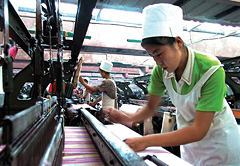
WASHINGTON (Reuters) - U.S. textile producers, supported by 73 members of Congress, urged the Bush administration Tuesday to monitor textile and clothing imports from China for unfair pricing once quotas are removed at the end of the year.
A quota agreement negotiated by Washington and Beijing in 2005 expires at the end of December, prompting U.S. industry fears of increased competition from cheap Chinese textiles.
"The need for stronger enforcement of trade with China has never been more evident," a bipartisan group of lawmakers said in a letter to President Bush.
"From problems with lead and other toxic substances in children's toys to recent trade cases that have revealed dozens of illegal subsidies, China is the leading violator of U.S. trade laws," the lawmakers said.
Clothing importers believe the (U.S.) domestic industry needs to learn how to "play by the rules and no longer receive special protection," said Julie Hughes of the United States Association of Importers of Textiles and Apparel.
A Commerce Department official said the Bush administration had worked hard to level the playing field for the U.S. textile industry, but it was too early to commit to a special import monitoring program for China.
"When the quotas on Chinese textile and apparel products expire next year, decision makers will look at the import data and decide how best to proceed," David Spooner, assistant secretary of commerce for import administration, said in a statement.
U.S. imports of clothing and other textile goods from China surged in early 2005 after a decades-old international quota system ended as a result of a world trade deal.
U.S. textile groups pressed the Bush administration to reimpose quotas on a number of Chinese items using a "safeguard" provision Beijing agreed to when it joined the World Trade Organization in 2001.
The 2005 agreement re-established 21 annual quotas covering 34 categories such as pants, shirts, socks and coated fabric.
The National Council of Textile Organizations and other industry groups are concerned China "will once again take this opportunity to illegally dump large quantities of artificially priced, heavily subsidized products into our market," they said in a letter.
Both the lawmakers and the industry group urged the Bush administration to extend the "textile monitoring program" in place for Vietnam to China beginning on Jan. 1.
U.S. industry officials said they had identified 63 Chinese subsidy programs for textiles, including many created since the United States imposed safeguard curbs in 2005.
Under the monitoring program, the Department of Commerce analyzes data from sensitive textile and apparel categories for possible dumping. If needed, it can open a probe that could lead to anti-dumping duties, industry officials say.
Hughes said a monitoring program would have a "chilling effect" on trade and described fears of Chinese flooding as overstated because importers are expected to fill just one of 21 quotas this year.
A quota agreement negotiated by Washington and Beijing in 2005 expires at the end of December, prompting U.S. industry fears of increased competition from cheap Chinese textiles.
"The need for stronger enforcement of trade with China has never been more evident," a bipartisan group of lawmakers said in a letter to President Bush.
"From problems with lead and other toxic substances in children's toys to recent trade cases that have revealed dozens of illegal subsidies, China is the leading violator of U.S. trade laws," the lawmakers said.
Clothing importers believe the (U.S.) domestic industry needs to learn how to "play by the rules and no longer receive special protection," said Julie Hughes of the United States Association of Importers of Textiles and Apparel.
A Commerce Department official said the Bush administration had worked hard to level the playing field for the U.S. textile industry, but it was too early to commit to a special import monitoring program for China.
"When the quotas on Chinese textile and apparel products expire next year, decision makers will look at the import data and decide how best to proceed," David Spooner, assistant secretary of commerce for import administration, said in a statement.
U.S. imports of clothing and other textile goods from China surged in early 2005 after a decades-old international quota system ended as a result of a world trade deal.
U.S. textile groups pressed the Bush administration to reimpose quotas on a number of Chinese items using a "safeguard" provision Beijing agreed to when it joined the World Trade Organization in 2001.
The 2005 agreement re-established 21 annual quotas covering 34 categories such as pants, shirts, socks and coated fabric.
The National Council of Textile Organizations and other industry groups are concerned China "will once again take this opportunity to illegally dump large quantities of artificially priced, heavily subsidized products into our market," they said in a letter.
Both the lawmakers and the industry group urged the Bush administration to extend the "textile monitoring program" in place for Vietnam to China beginning on Jan. 1.
U.S. industry officials said they had identified 63 Chinese subsidy programs for textiles, including many created since the United States imposed safeguard curbs in 2005.
Under the monitoring program, the Department of Commerce analyzes data from sensitive textile and apparel categories for possible dumping. If needed, it can open a probe that could lead to anti-dumping duties, industry officials say.
Hughes said a monitoring program would have a "chilling effect" on trade and described fears of Chinese flooding as overstated because importers are expected to fill just one of 21 quotas this year.
(Editing by Patrick Markey and Peter Cooney)
Reuters
By Doug Palmer
09.30.08, 8:31 PM ET
Source: www.forbes.com
Reuters
By Doug Palmer
09.30.08, 8:31 PM ET
Source: www.forbes.com
Các tin khác
- Following the imposition of the highest tariff of 37.13%, the Ministry of Industry and Trade is reviewing galvanized steel from China (19/06/2026)
- Official tariffs have been imposed on colorless float glass imported from Indonesia and Malaysia (19/06/2026)
- India seeks to continue anti-dumping duties on Bangladesh’s jute products (19/06/2026)
- Turkey Initiates Anti-Dumping Investigation into Polyester Cord Fabric from Viet Nam (19/06/2026)
- Chinese dumping in Brazil affected the entire garlic supply chain (19/06/2026)