Home
Home
 About Us



Turkey Initiates Anti-Dumping Investigation into Polyester Cord Fabric from Viet Nam
19/06/2026 03:23
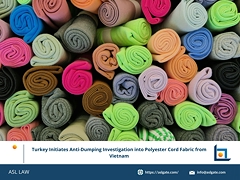
On June 16, 2026, the Ministry of Trade of Turkey issued Communiqué No. 2026/9, officially initiating an anti-dumping investigation into polyester cord fabric used in tire manufacturing originating from Viet Nam and China.
This is the latest trade remedy case affecting Vietnamese exports in the Turkish market. Should the investigation result in an unfavorable outcome, Vietnamese enterprises may become subject to anti-dumping duties, reducing their competitiveness and significantly affecting future export activities.
Product Subject to Investigation
According to the notice issued by the Turkish investigating authority, the product under investigation from Viet Nam is:
● Polyester Cord Fabric;
● Reference HS Code: 5902.20.10.00.00;
● Rubber-impregnated fabric made from high-tenacity polyester yarn, used in the manufacture of various types of tires.
The petition was filed by Kordsa Teknik Tekstil A.Ş., representing the domestic industry of Turkey.
Investigating Authority Alleges Injury to the Turkish Domestic Industry
Based on its preliminary examination, the investigating authority found that imports of polyester cord fabric from Viet Nam increased during the period from January 1, 2022, to September 30, 2025.
In addition, the authority alleged that imports from Viet Nam exerted pressure on domestic prices and contributed to the deterioration of several key economic indicators of the Turkish domestic industry, including:
● Production;
● Sales volume;
● Profitability;
● Capacity utilization;
● Employment;
● Market share;
● Productivity;
● Cash flow; and
● Return on investment.
Accordingly, the Board for the Evaluation of Unfair Competition in Imports of Turkey decided to initiate an anti-dumping investigation into polyester cord fabric originating from Viet Nam.
Which Vietnamese Enterprises May Be Affected?
Not only exporters shipping directly to Turkey, but various enterprises throughout the supply chain may also be impacted, including:
● Manufacturers of polyester cord fabric;
● Producers of raw materials and industrial polyester yarn;
● Exporters selling through intermediaries or trading companies; and
● Tire manufacturers and enterprises involved in the automotive supply chain.
In practice, many enterprises that do not directly export to the market concerned may nevertheless be identified as interested parties and may need to provide information to the investigating authority.
Urgent Response Required – Enterprises Have Only 37 Days to Submit Questionnaire Responses
Under Turkish regulations, interested parties have 37 days from the publication date of the notice to submit questionnaire responses and relevant comments.
Notably, if a company fails to cooperate, refuses to provide information, or provides incomplete information, the investigating authority may base its findings on the facts available. This often results in significantly higher anti-dumping duty rates than would be imposed on fully cooperative companies.
Furthermore, Turkish law allows provisional measures to be imposed during the course of the investigation, and under certain circumstances, definitive anti-dumping duties may be applied retroactively.
Early Participation Is Essential
Experience from numerous trade remedy cases has demonstrated that active participation from the earliest stage of an investigation is crucial to achieving favorable outcomes.
Affected enterprises should promptly:
● Determine whether their products fall within the scope of the investigation;
● Assess the extent of potential impacts;
● Prepare the data and documentation required for questionnaire responses; and
● Develop an appropriate defense strategy to minimize the risk of being subjected to unfavorable duty rates.
Source: ASLGate
Các tin khác
- Following the imposition of the highest tariff of 37.13%, the Ministry of Industry and Trade is reviewing galvanized steel from China (19/06/2026)
- Official tariffs have been imposed on colorless float glass imported from Indonesia and Malaysia (19/06/2026)
- India seeks to continue anti-dumping duties on Bangladesh’s jute products (19/06/2026)
- Chinese dumping in Brazil affected the entire garlic supply chain (19/06/2026)
- Exports to US rise nearly 22% in Jan-May, driven by electronics (19/06/2026)