Home
Home
 About Us


Russia plans tariff rise on car imports
06/09/2010 12:00
Russia’s bid to join the World Trade Organisation received a blow on Monday after Russian prime minister Vladimir Putin announced plans to raise car tariffs in order to encourage foreign motor companies to invest in the country.
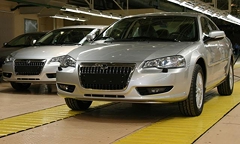
Mr Putin made the remarks on the Vest 24 television channel while test-driving a new Lada produced by one of the country’s few remaining car producers, the Avtovaz factory. He said foreign car companies had been warned that they could face increases in import customs duties if they do not manufacture in Russia.
“We have told our partners: ‘Let's agree – we now will do nothing to increase import customs duties, but here is a schedule, here in such and such a year we will start to raise custom duties gradually....
‘We don't want to undermine your business in Russia, so come here and manufacture’” he said. “It’s is called localisation.”
Foreign competition has decimated Russia’s domestic car industry since the fall of the Soviet Union. Avtovaz is the only significant producer remaining in the market. Some foreign companies have already begun producing in Russia. Germany’s Volkswagen has built a factory producing cars in the city of Kaluga, while French carmaker Renault has bought a 25 per cent stake in Avtovaz.
But Mr Putin’s plan threatens Russia’s bid to join the WTO, which has been under way since 1993. Under terms agreed with the Geneva-based trade body, Russia must reduce import tariffs on cars from the current rate of 30 per cent to 15 per cent over seven years from the time it joins.
Trade experts were seeking clarification on what Mr Putin’s remarks meant. Earlier this summer, top bureaucrats were predicting they would be toasting Russia’s entry into the WTO by early next year.
“I was very surprised to see that,” said Aleksei Portansky, at the trade policy institute of Moscow's Higher School of Economics. “It is okay to raise tariffs with respect to old automobiles, but not with new ones, according to the agreements which have been worked out with the WTO.
“Perhaps he [Mr Putin] got mixed up. I’m not sure, but this statement needs some elaboration.”
The Russian government did not immediately respond to requests for clarification.
“It could clash with some agreements which have been signed with some WTO members” said a western official close to the WTO.
Only a few obstacles remain to Russia’s bid to join the WTO, but a commitment to raise duties on auto imports could reverse years of progress. Russia last raised auto import duties in December 2008 from 25 per cent to 30 per cent in what was seen as a temporary measure against the global economic crisis.
However, Mr Putin’s attitude towards WTO membership is difficult to read. In June last year he derailed membership talks for a year by insisting that Russia join the WTO together with customs union partners Kazakhstan and Belarus. Last spring that position was overturned and Russia resumed negotiating.
Mr Putin is known as a champion of the domestic auto industry, which accounts for over 1m jobs throughout Russia, according to studies. Last year he gave Avtovaz over $1bn in cheap credits and aid to help it through the global economic crisis, when domestic demand fell by half.
Source: www.ft.com
Các tin khác
- Following the imposition of the highest tariff of 37.13%, the Ministry of Industry and Trade is reviewing galvanized steel from China (19/06/2026)
- Official tariffs have been imposed on colorless float glass imported from Indonesia and Malaysia (19/06/2026)
- India seeks to continue anti-dumping duties on Bangladesh’s jute products (19/06/2026)
- Turkey Initiates Anti-Dumping Investigation into Polyester Cord Fabric from Viet Nam (19/06/2026)
- Chinese dumping in Brazil affected the entire garlic supply chain (19/06/2026)