Home
Home
 About Us



EU tax decision leaves Vietnamese shoemakers on verge of bankruptcy
29/12/2009 12:00
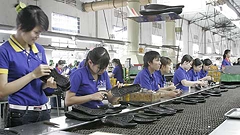
VietNamNet Bridge – Vietnamese shoemakers, who have been suffering due to the EU’s recent removal of the Generalized System of Preferences (GSP), may now face collapse due to a new decision on extending anti-dumping tariffs for 15 more months.
The double blow
Diep Thanh Kiet, deputy chairman of the Vietnam Leather and Footwear Association, said that together with the removal of GSP, the tax extension has dealt a double blow to Vietnam’s shoes industry, which employs 650,000 workers.
EU countries now consume some 50 percent of Vietnam’s total shoe exports. Leather capped shoes, which are subject to the anti-dumping tariff, account for 60 percent of exports to the EU
Khuong Manh Tan, Chairman of Tan Thanh Company, said his company specializes in making leather capped shoes for women for export to the EU, therefore, his company will suffer most from the EU decision.
In fact, Tan said the anti-dumping duty of 10 percent over the last three years has become a continued hindrance. During that time, Tan Thanh has been facing so many difficulties that the factory has been running at only moderate levels and Tan’s ambition has been merely to break even.
Nguyen Van Khanh, secretary general of the HCM City Leather and Footwear Association, said that the average income of shoe workers in the EU is some 3,000 Euro a month, or $4,000 a month, while the average income of a Vietnamese worker is 15 times lower, which explains why the production costs are much less.
According to Khanh, in the last three years, Vietnam exported some two billion pairs of leather capped shoes. With the anti-dumping tariff of 10 percent, every pair of shoes has to bear the additional cost of 10-15 cent. As such, since the EU imposed the anti-dumping tariff, the shoes industry has lost some $200 million.
Living with anti-dumping tariffs
Truong Thuy Lien, director of Lien Phat Shoes Company in Binh Duong province, says enterprises have no other choice than to diversify in export markets instead of relying on the EU. He says Japan and the US could be good alternatives.
Lien said that in the first five months of the year, Lien Phat did not receive any orders. Orders have just arrived since June, and the revenue of the company in 2009 is expected to decrease by 40 percent over the previous year.
In fact, Lien has been considering trying to boost sales in the domestic market. However, it is not an easy task for companies that specialize in making products for export like Lien Phat. To date, Lien Phat has lost 500 workers.
Lien said that her company is considering relocating the factory while cutting the scale of production in Binh Duong province. She says it is too difficult to seek workers in larger provinces nowadays.
VietNamNet, NLD
16:07' 25/12/2009 (GMT+7)
Source: english.vietnamnet.vn
Các tin khác
- Following the imposition of the highest tariff of 37.13%, the Ministry of Industry and Trade is reviewing galvanized steel from China (19/06/2026)
- Official tariffs have been imposed on colorless float glass imported from Indonesia and Malaysia (19/06/2026)
- India seeks to continue anti-dumping duties on Bangladesh’s jute products (19/06/2026)
- Turkey Initiates Anti-Dumping Investigation into Polyester Cord Fabric from Viet Nam (19/06/2026)
- Chinese dumping in Brazil affected the entire garlic supply chain (19/06/2026)