Home
Home
 About Us



China trade surplus rises amid U.S. calls for import protection
15/10/2010 12:00
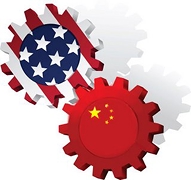
China is expected to report a US$17.8-billion trade surplus for September that would cap the biggest quarterly excess since the financial crisis in 2008, adding fuel to U.S. calls for import protection.
The median estimate of 24 economists surveyed by Bloomberg News compares with an August surplus of US$20-billion. That would take the third-quarter total to US$66.5-billion, the largest since the fourth quarter of 2008.
The U.S. Senate will consider legislation that would allow duties to be imposed on Chinese imports because of the nation's failure to allow bigger currency gains, according to Senator Charles Schumer of New York. Yuan forwards surged to the highest level in more than two years yesterday on speculation that Premier Wen Jiabao's government will yield to U.S. and European pressure.
"China's trade surplus may reach US$200-billion this year, giving the U.S. and Europe more ammunition," said Shen Jianguang, a Hong Kongbased economist at Mizuho Securities Asia Ltd. who formerly worked for the International Monetary Fund and the European Central Bank. Policymakers should speed gains by the yuan "because a currency war would be most damaging to China," Mr. Shen said.
By comparison, the trade surplus was US$196-billion in 2009.
China may also this week announce the third-quarter increase in the nation's foreign-currency reserves, which climbed US$48-billion to a record US$2.5trillion, according to the median estimate in an economists' survey.
Inflows of capital from trade and foreign investment and so-called hot money betting on gains by the Chinese currency are complicating management of the fastest-growing major economy. Besides keeping inflation in check,policymakers want to cool the real-estate market to prevent asset bubbles.
China's central bank unexpectedly and temporarily raised reserve requirements for six large commercial lenders, reining in liquidity as the economy stabilizes, according to a Reuters report Sunday.
The ratio will increase 50 basis points and for two months, the news agency said, citing four people who weren't identified by name. The current level is 17% for the biggest banks and 15% for smaller ones. Market News cited traders, also not identified by name, to the same effect. The People's Bank of China and the six banks declined to comment.
LiShanshan, aBeijing-based banking analyst at BoCom International Holdings Co., said the reported move may be to drain liquidity because of 570-billion yuan (US$86-billion) of central bank bills maturing in October.
Isaac Meng, a Beijing-based economist at BNP Paribas, said that the central bank may have acted in anticipation of extra money flowing into China because of quantitative easing in the United States and investors betting on the yuan.
"To combat rising inflation concerns, the best option would be to raise interest rates, but apparently the Chinese government cannot do that for fear of more capital inflows," said Dorris Chen, a Shanghaibased bank analyst who also works for BNP Paribas.
Twelve-month non-deliverable forwards jumped 0.8% to 6.4390 per dollar as of 5:30 p.m. in Hong Kong yesterday, indicating the currency may strengthen 3.6% against the U.S. dollar from the spot rate. The yuan yesterday touched 6.6610, the highest since 1993.
China's exports probably grew 26% last month from a year earlier, compared with a gain of 34.4% in August, according to the economists' survey. Import growth may have slowed to 25% from 35.2%.
Debate about competitive devaluations dominated International Monetary Fund meetings last week. U.S. Treasury Secretary Timothy Geithner renewed his call for China to let its currency rise and Luxembourg Prime Minister Jean-Claude Juncker, who chairs a panel of euro-area finance ministers, said the yuan is "more than undervalued."
Chinese central bank governor Zhou Xiaochuan said his nation needs to avoid the "shock therapy" of excessive yuan appreciation and "very fast" gains probably wouldn't end global economic imbalances.
Source: nationalpost.com
Các tin khác
- Following the imposition of the highest tariff of 37.13%, the Ministry of Industry and Trade is reviewing galvanized steel from China (19/06/2026)
- Official tariffs have been imposed on colorless float glass imported from Indonesia and Malaysia (19/06/2026)
- India seeks to continue anti-dumping duties on Bangladesh’s jute products (19/06/2026)
- Turkey Initiates Anti-Dumping Investigation into Polyester Cord Fabric from Viet Nam (19/06/2026)
- Chinese dumping in Brazil affected the entire garlic supply chain (19/06/2026)