Home
Home
 About Us



China Rare Earths Report Addresses WTO Concerns
22/06/2012 12:00
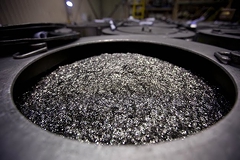
Following the request by several countries in March this year for consultations at the World Trade Organization (WTO) on what they consider to be China’s unfair export restraints on rare earths, the State Council has published a white paper on the Chinese rare earth industry, in an attempt to explain and justify the government’s policies.
The various minerals that make up ‘rare earths’ are incorporated into many high technological goods, including superconductors, hybrid car components (primarily batteries and magnets), flat-screen televisions, mobile phones, lasers and many defence-related products.
China produced more than 90% of the world's rare earths total output in 2011, but points out in the white paper that it only holds 23% of global reserves. In addition, despite its rapid development, China's rare earth industry also faces many problems.
In recent years, investment in China's rare earth industry has experienced rapid growth. State-owned, privately-owned and foreign-invested sectors coexist, and the value of the rare earth metal market is already approaching RMB100bn (USD15.7bn).
However, in consequence, the white paper adds, after more than 50 years of excessive mining, China's rare earth reserves have kept declining and the years of guaranteed rare earth supply have been reducing. The decline of rare earth resources in major Chinese mining areas is accelerating, as most of the original resources are depleted.
There is also said to have been severe damage to the ecological environment, together with an irrational industrial structure. China's rare earth industry has huge over-capacity in smelting and separating, and, as a result, low-end products overflow while high-end products are in short supply. It is considered that China's rare earths industry features a low concentration rate with numerous businesses, but lacks large enterprises with core competitiveness.
Therefore, the Chinese government has tightened supervision over the sector. For example, from 2006, China began to exercise total-amount control over the exploitation of rare earths. In 2008, the state issued the National Plan for Mineral Resources (2008-2015) to exercise planned regulation and control, and restrictive exploitation, and, in 2011, China adjusted the tax rates on mining of rare earths.
The adjusted new tax rate for light rare earths is RMB60 per tonne, and for middle and heavy rare earths RMB30 per tonne, much higher than the rates before the adjustment, which ranged from RMB0.4 per tonne to RMB2 per tonne. The government has also established a strategic reserve system.
In addition, the state sets a “reasonable quota for annual rare earth exports that basically satisfies the normal demand of the international market”. Meanwhile, China tightens customs control, regulates the management of declarations to be filed by enterprises, and orders rare earth export enterprises to comply with the industrial policies, industry access and environmental standards.
The white paper stresses that the Chinese government will continue its rare earth supplies to the international market. The tightened control over rare earth is, however, “in alignment with China's sustainable development” and the government “is willing to strengthen dialogue and cooperation with other rare earth producers and consumers in a constructive and responsible manner, to work together with them in preventing excessive speculation in the rare earth market and solving the resource and environmental problems in the development of the industry".
It is also emphasized that the countries and regions with abundant rare earth reserves should themselves make active efforts in developing their own resources to diversify the supply and expand rare earth trade in the international market. In the meantime, it is disclosed that enterprises from the United States, Germany, France, Canada and Japan have invested a total of RMB6.1bn in China's rare earth industry, with their products being mainly for export.
The State Council hopes that the white paper will provide a reply to those WTO members who have argued that the use by China of export restraints creates scarcity and causes higher prices in global markets, and provides Chinese domestic industry with a significant advantage by way of a sufficient supply, and lower and more stable prices, for the raw materials. Instead, the Chinese government looks to the white paper to provide confirmation that it applies international standards and WTO rules.
21 June 2012
By Mary Swire
Source: Tax-News.com
Các tin khác
- Following the imposition of the highest tariff of 37.13%, the Ministry of Industry and Trade is reviewing galvanized steel from China (19/06/2026)
- Official tariffs have been imposed on colorless float glass imported from Indonesia and Malaysia (19/06/2026)
- India seeks to continue anti-dumping duties on Bangladesh’s jute products (19/06/2026)
- Turkey Initiates Anti-Dumping Investigation into Polyester Cord Fabric from Viet Nam (19/06/2026)
- Chinese dumping in Brazil affected the entire garlic supply chain (19/06/2026)