Home
Home
 About Us



China Official Says No Plans to Cut Rare Earth Quotas
20/10/2010 12:00
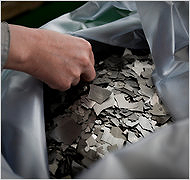
Oct. 19 (Bloomberg) -- China has no plans to cut its export quota for rare earths next year, a senior official at the department responsible for the minerals said at a conference in Xiamen today.
“There is no such thing,” Jiang Fan, deputy director general of the department of foreign trade at the Ministry of Commerce, told Bloomberg News. “I haven’t heard any policy that China will reduce rare earth exports by 30 percent next year.”
She was responding to a China Daily newspaper report citing an unidentified official from the ministry as saying rare earth export quotas for 2011 would be cut by as much as 30 percent.
China cut its export quota of rare earths, metals used to make parts of hybrid cars, missiles and televisions, by 40 percent this year to boost prices and reduce pollution.
“It’s obvious that China has cut the export quota year on year and the trend is most likely to continue,” Peng Bo, an analyst at Guosen Securities Co., said today.
Export prices of some rare earths oxides have surged as much as tenfold this year from 2009, according to the website of Lynas Corp., which is building a rare earth project in Australia. Cerium oxide, which is used in automotive catalytic converters, has jumped from $7.49 a kilogram in the second quarter, to $40 as of Oct. 18, according to Lynas Corp.
Rare earths are 17 chemically similar elements, including neodymium and dysprosium. The oxides are used in the production of equipment for General Dynamics Corp.’s M1A2 Abrams tank and Aegis SPY-1 radar made by Lockheed Martin Corp.
China Reserves
China has the largest share of worldwide reserves, about 36 percent, and the U.S. is second, with 13 percent, according to the U.S. Geological Survey.
China’s medium and heavy rare earths reserves may last 15 years to 20 years at the current rate of production, possibly requiring imports, the Ministry of Commerce said on Oct. 16.
Production and export quota cuts are to protect the environment and in line with WTO rules, Yao Jian, spokesman for China’s Ministry of Commerce, said last week. China “cannot rule out the possibility that China may need to rely on imports” sometime in the future, the ministry’s Chao said Oct. 16.
Japanese Dispute
In September, China imposed a “de facto” ban on exports of rare earth to Japan, Japanese Economy Minister Banri Kaieda said Sept. 28. That followed Japan’s detention of a Chinese fishing boat captain whose ship collided with two Japanese Coast Guard vessels. Japan later released the man.
No such ban exists, China’s Ministry of Commerce spokesman Chen Rongkai said. Japanese Foreign Minister Seiji Maehara said yesterday that trading of rare earth metals with China remains “far from normal.”
Disruption of supply to Japan would leave China as the sole supplier of magnetic material components used in U.S. military manufacturing, Molycorp Inc., owner of the world’s largest non- Chinese deposit of rare-earth metals, said on its website. The U.S. was self-sufficient in the materials until the mid-1980s, when lower labor and regulatory costs helped China’s climb to dominance, the U.S. Geological Survey said in a report.
The U.S. has asked business groups and labor unions to provide evidence that China is hoarding these elements for a case that might be filed at the World Trade Organization.
By Xiao Yu
Editors: Alan Soughley, Andrew Hobbs
Source: bloomberg.com
Các tin khác
- Following the imposition of the highest tariff of 37.13%, the Ministry of Industry and Trade is reviewing galvanized steel from China (19/06/2026)
- Official tariffs have been imposed on colorless float glass imported from Indonesia and Malaysia (19/06/2026)
- India seeks to continue anti-dumping duties on Bangladesh’s jute products (19/06/2026)
- Turkey Initiates Anti-Dumping Investigation into Polyester Cord Fabric from Viet Nam (19/06/2026)
- Chinese dumping in Brazil affected the entire garlic supply chain (19/06/2026)