Home
Home
 About Us



Australia: Reduced barriers to entry and anti-competitive behavior best means to tackle manufacturing crisis.
10/10/2011 12:00
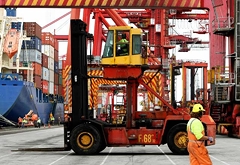
Treasury has warned that Australians risk higher taxes and steeper prices if Canberra goes too far in protecting manufacturers from global competition.
But it has acknowledged the mining boom has failed to deliver a boost to three-quarters of the economy, burdening some businesses with a high Australian dollar instead.
It argued in a submission to a Senate inquiry into food processing that cutting red tape to reduce barriers to entry and using existing laws to reduce anti-competitive behavior are the two best means of tackling Australia's manufacturing crisis.
"Government actions to protect industries from exposure to the global market can impact adversely on other industries, taxpayers and consumers," it says.
"This can be manifested through higher domestic prices from consumers and businesses, higher taxes to finance such government action and through adverse impacts on Australia's overall productivity."
The government is facing calls from business, unions and crossbenchers to do more to support local manufacturing, with reform proposals ranging from mandating local content requirements to imposing tougher anti-dumping laws and lobbying China to appreciate its currency.
At last week's Jobs Forum, Julia Gillard made more than $6 billion in federal grants contingent on Australian companies being given a "fair" chance to bid for the projects funded, but stopped short of making local content compulsory for grant applicants.
Manufacturing has shed about 50,000 jobs over 12 months, with layoffs announced this year at Heinz and SPC Ardmona factories adding to the industry's angst.
Food and beverage is the largest Australian manufacturing sector, but it is struggling with a cripplingly high Australian dollar.
Its historically strong inflow of foreign capital has fallen away to less than half its level before the global financial crisis, the Treasury submission reveals.
Treasury conceded mining-related sectors were not only driving up the exchange rate, but drawing production inputs such as land and skilled labor from other parts of the economy.
"Despite strong growth of the mining and mining-related industries, around three-quarters of the economy's output is not being boosted directly from the mining boom," it says.
The Food Processing Industry Strategy Group, set up by the Gillard government, identified an unco-ordinated approach to red tape, the use of regulation for health promotion purposes and "technophobia" over genetically modified organisms as among the risks to the sector, according to a separate submission that has been lodged by the federal department for innovation.
By Siobhain Ryan
Source: theaustralian.com.au
Các tin khác
- Following the imposition of the highest tariff of 37.13%, the Ministry of Industry and Trade is reviewing galvanized steel from China (19/06/2026)
- Official tariffs have been imposed on colorless float glass imported from Indonesia and Malaysia (19/06/2026)
- India seeks to continue anti-dumping duties on Bangladesh’s jute products (19/06/2026)
- Turkey Initiates Anti-Dumping Investigation into Polyester Cord Fabric from Viet Nam (19/06/2026)
- Chinese dumping in Brazil affected the entire garlic supply chain (19/06/2026)