Home
Home
 About Us


Analysis of steel export in August and future impact
18/09/2008 12:00
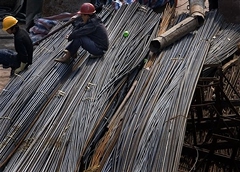
China's August steel export has again beaten market speculations at a record high of 7.68 million tonnes an increase of 0.47 million tonnes from the previous month or up 43% YoY.
According to Mysteel analyst Mr Liu Yuan the flying rumor of a stiffer export policy has sparked the record export in August since exporters are eager to rush out shipments before the tougher policy sets in. Meanwhile, the widening price spread between home and global markets also spurred steel exports. The price fall in international market in August is narrower than the sharp decline at home. And the price premium with US for CR has added to USD 393 per tonne in August from USD 309 per tonne in middle July.
Mr Liu suggests relative departments to offer a clear timing for the export tax change, for the ongoing worry would whip steel producers to export, leading to shipment increase, and that is not wanted by the central government. He said that moreover, export rebate removal would tip in favor of the sustainable development for Chinese steel industry, and he listed the following facts to support his idea.
1. Export rebate cut will not check Chinese steel sector's strong growth. China's steel sector has experienced a swift developing period following the export rebate cut since Jan 2004. And crude steel output has soared 74.4% to 489 million tons in 2007 from that in 2004; steel products production also climbed 88.8% in the period.
Crude steel production keeps the high growth so far this year despite the moderated growth rate. As a result, to remove export rebate might in some degree promote the country's steel sector's expansion instead of holding it back.
2. Gradual export rebate cancellation would help improve Chinese steel industry's competitiveness at the time of the current swift export growth, which represents in several aspects.
I. Rebate removal would change the feeling of "cheap" Chinese steel products. The removal will help lift export offers and improve "China-Made" image in international market. And offer price rises would help check the steel export growth and control it in a certain proportion.
II. The removal will help stabilize domestic steel market. Reduced export means less supply to global markets, which will be conducive to haul up steel prices in international market amidst the current slack market, and which will in turn lend a support to domestic steel prices.
III. The cancellation will help ease the pressure of AD & CVD from EU and U.S. in particular. The lower Chinese export prices and the expanding price gap with global market are very likely to be used by those countries as an excuse for anti-dumping and anti-subsidy probes.
The increasing dual probes so far this year has dented Chinese steel export substantially, welded pipes in particular, and only export offer rises can pull China out of the mire.
IV. The phase out of export rebate would help increase steel products competitiveness. Domestic steel mills will suffer profit squeeze and face direct competition with foreign rivals by then.
Therefore, they have to increase spending on R&D to improve added-value for their products to secure a favorable competitive position in global market. High value-added products have more risk-hedge capabilities than those low-added ones amid a quiet market.
V. The rebate removal will boost domestic steel consolidation. A host of smaller mills relying on export subsidy will find it hard to survive after the cancellation of export rebate, particularly under current weak market.
Some large and-medium scale mills will also see profit decline resulted from irrational product mix by then. Thus, some first tier mills like Baosteel, Wuhan Steel will grab the chance to speed up domestic merger and acquisitions to strengthen their presence.
According to Mysteel analyst Mr Liu Yuan the flying rumor of a stiffer export policy has sparked the record export in August since exporters are eager to rush out shipments before the tougher policy sets in. Meanwhile, the widening price spread between home and global markets also spurred steel exports. The price fall in international market in August is narrower than the sharp decline at home. And the price premium with US for CR has added to USD 393 per tonne in August from USD 309 per tonne in middle July.
Mr Liu suggests relative departments to offer a clear timing for the export tax change, for the ongoing worry would whip steel producers to export, leading to shipment increase, and that is not wanted by the central government. He said that moreover, export rebate removal would tip in favor of the sustainable development for Chinese steel industry, and he listed the following facts to support his idea.
1. Export rebate cut will not check Chinese steel sector's strong growth. China's steel sector has experienced a swift developing period following the export rebate cut since Jan 2004. And crude steel output has soared 74.4% to 489 million tons in 2007 from that in 2004; steel products production also climbed 88.8% in the period.
Crude steel production keeps the high growth so far this year despite the moderated growth rate. As a result, to remove export rebate might in some degree promote the country's steel sector's expansion instead of holding it back.
2. Gradual export rebate cancellation would help improve Chinese steel industry's competitiveness at the time of the current swift export growth, which represents in several aspects.
I. Rebate removal would change the feeling of "cheap" Chinese steel products. The removal will help lift export offers and improve "China-Made" image in international market. And offer price rises would help check the steel export growth and control it in a certain proportion.
II. The removal will help stabilize domestic steel market. Reduced export means less supply to global markets, which will be conducive to haul up steel prices in international market amidst the current slack market, and which will in turn lend a support to domestic steel prices.
III. The cancellation will help ease the pressure of AD & CVD from EU and U.S. in particular. The lower Chinese export prices and the expanding price gap with global market are very likely to be used by those countries as an excuse for anti-dumping and anti-subsidy probes.
The increasing dual probes so far this year has dented Chinese steel export substantially, welded pipes in particular, and only export offer rises can pull China out of the mire.
IV. The phase out of export rebate would help increase steel products competitiveness. Domestic steel mills will suffer profit squeeze and face direct competition with foreign rivals by then.
Therefore, they have to increase spending on R&D to improve added-value for their products to secure a favorable competitive position in global market. High value-added products have more risk-hedge capabilities than those low-added ones amid a quiet market.
V. The rebate removal will boost domestic steel consolidation. A host of smaller mills relying on export subsidy will find it hard to survive after the cancellation of export rebate, particularly under current weak market.
Some large and-medium scale mills will also see profit decline resulted from irrational product mix by then. Thus, some first tier mills like Baosteel, Wuhan Steel will grab the chance to speed up domestic merger and acquisitions to strengthen their presence.
MySteel.net
Sep 12, 2008
Source: steelguru.com
Sep 12, 2008
Source: steelguru.com
Các tin khác
- Following the imposition of the highest tariff of 37.13%, the Ministry of Industry and Trade is reviewing galvanized steel from China (19/06/2026)
- Official tariffs have been imposed on colorless float glass imported from Indonesia and Malaysia (19/06/2026)
- India seeks to continue anti-dumping duties on Bangladesh’s jute products (19/06/2026)
- Turkey Initiates Anti-Dumping Investigation into Polyester Cord Fabric from Viet Nam (19/06/2026)
- Chinese dumping in Brazil affected the entire garlic supply chain (19/06/2026)