Home
Home
 About Us



Trump approves tariffs on $50 billion of Chinese goods and takes his trade war to a whole new level
19/06/2018 12:00
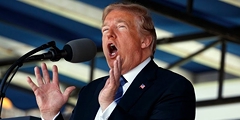
President Donald Trump imposed fresh tariffs on $50 billion worth of imports from China in a step that further escalates the president's burgeoning trade offensive that has targeted many of the US's closest partners.
"In light of China’s theft of intellectual property and technology and its other unfair trade practices, the United States will implement a 25 percent tariff on $50 billion of goods from China that contain industrially significant technologies," Trump said in a statement.
"This includes goods related to China’s Made in China 2025 strategic plan to dominate the emerging high-technology industries that will drive future economic growth for China, but hurt economic growth for the United States and many other countries."
"Made in China 2025" is an important economic initiative undertaken by the Chinese government to promote the development of key industries, particularly in the tech sector, over the next seven years.
According to the US Trade Representative's (USTR) office, the tariffs will come in two parts. The first section will be implemented on July 6 and apply to 818 goods with a total value of $34 billion. The second set, which includes 284 goods equal to $16 billion worth of imports, will come later and be subject to additional public comments.
The list generally hits industrial goods rather than consumer items according to the USTR statement.
The US's initial list of Chinese goods facing tariffs included a wide array of products such as raw materials, construction machinery, agricultural equipment, electronics, medical devices, and consumer goods.
China has said it would retaliate against any tariffs.
"If the United States takes unilateral, protectionist measures, harming China's interests, we will quickly react and take necessary steps to resolutely protect our fair, legitimate rights," a Chinese Foreign Ministry spokesman, Geng Shuang, told a regular daily news briefing, according to the Associated Press.
Trump threatened to impose further tariffs, should China decide to retaliate.
The White House said it is considering an additional set of tariffs on another $100 billion of Chinese goods. In the statement, Trump said those measures would be implemented only if the Chinese strike back at Friday's move.
"The United States will pursue additional tariffs if China engages in retaliatory measures, such as imposing new tariffs on United States goods, services, or agricultural products; raising non-tariff barriers; or taking punitive actions against American exporters or American companies operating in China," Trump said.
The trade war escalates
Gary Cohn, Trump's former top economic adviser, warned Thursday that the trade spat could boost prices for raw materials and food, leading to higher rates of inflation and possibly recession.
"If you end up with a tariff battle, you will end up with price inflation, and you could end up with consumer debt — those are all historic ingredients for an economic slowdown," Cohn said at an event sponsored by The Washington Post.
At the same event, Cohn also said, however, that the US needed to "enforce the rule of law" on what it has described as Chinese theft of US intellectual property.
Greg Valliere, chief global strategist at Horizon Investments, called the tariffs "a significant escalation of the trade war" and warned that there were four primary outcomes from the increasing tensions.
"Our take is that a trade war would bring four negatives – somewhat higher inflation; growing anxiety in the U.S. farm belt; uncertainty that could complicate long-term corporate planning; and a growing estrangement of the U.S. on the global stage.
Louis Kujis, head of Asia economics at Oxford Economics, said that the back-and-forth trade measures will be a modest drag on economic growth but despite the relatively minor hit the tariffs still make a difference.
"Such numbers still matter, and the increased uncertainty and risks will weigh on business confidence and investment, especially cross-border investment," Kujis wrote. "Thus, there will be an impact on growth, in China, the US and elsewhere, at a sensitive time for the global economy."
"In light of China’s theft of intellectual property and technology and its other unfair trade practices, the United States will implement a 25 percent tariff on $50 billion of goods from China that contain industrially significant technologies," Trump said in a statement.
"This includes goods related to China’s Made in China 2025 strategic plan to dominate the emerging high-technology industries that will drive future economic growth for China, but hurt economic growth for the United States and many other countries."
"Made in China 2025" is an important economic initiative undertaken by the Chinese government to promote the development of key industries, particularly in the tech sector, over the next seven years.
According to the US Trade Representative's (USTR) office, the tariffs will come in two parts. The first section will be implemented on July 6 and apply to 818 goods with a total value of $34 billion. The second set, which includes 284 goods equal to $16 billion worth of imports, will come later and be subject to additional public comments.
The list generally hits industrial goods rather than consumer items according to the USTR statement.
The US's initial list of Chinese goods facing tariffs included a wide array of products such as raw materials, construction machinery, agricultural equipment, electronics, medical devices, and consumer goods.
China has said it would retaliate against any tariffs.
"If the United States takes unilateral, protectionist measures, harming China's interests, we will quickly react and take necessary steps to resolutely protect our fair, legitimate rights," a Chinese Foreign Ministry spokesman, Geng Shuang, told a regular daily news briefing, according to the Associated Press.
Trump threatened to impose further tariffs, should China decide to retaliate.
The White House said it is considering an additional set of tariffs on another $100 billion of Chinese goods. In the statement, Trump said those measures would be implemented only if the Chinese strike back at Friday's move.
"The United States will pursue additional tariffs if China engages in retaliatory measures, such as imposing new tariffs on United States goods, services, or agricultural products; raising non-tariff barriers; or taking punitive actions against American exporters or American companies operating in China," Trump said.
The trade war escalates
Gary Cohn, Trump's former top economic adviser, warned Thursday that the trade spat could boost prices for raw materials and food, leading to higher rates of inflation and possibly recession.
"If you end up with a tariff battle, you will end up with price inflation, and you could end up with consumer debt — those are all historic ingredients for an economic slowdown," Cohn said at an event sponsored by The Washington Post.
At the same event, Cohn also said, however, that the US needed to "enforce the rule of law" on what it has described as Chinese theft of US intellectual property.
Greg Valliere, chief global strategist at Horizon Investments, called the tariffs "a significant escalation of the trade war" and warned that there were four primary outcomes from the increasing tensions.
"Our take is that a trade war would bring four negatives – somewhat higher inflation; growing anxiety in the U.S. farm belt; uncertainty that could complicate long-term corporate planning; and a growing estrangement of the U.S. on the global stage.
Louis Kujis, head of Asia economics at Oxford Economics, said that the back-and-forth trade measures will be a modest drag on economic growth but despite the relatively minor hit the tariffs still make a difference.
"Such numbers still matter, and the increased uncertainty and risks will weigh on business confidence and investment, especially cross-border investment," Kujis wrote. "Thus, there will be an impact on growth, in China, the US and elsewhere, at a sensitive time for the global economy."
Source: Business Insider
Các tin khác
- MoIT tightens 'Made in Viet Nam' criteria to combat trade fraud (12/06/2026)
- Viet Nam receives AD petition against Chinese prestressed steel bars (12/06/2026)
- India’s anti-dumping shield on Asian aluminium foil to stay up through 2026 (12/06/2026)
- Amended Customs Law: Removing 'bottlenecks' to help businesses accelerate import and export (12/06/2026)
- Expanding export markets in the era of integration (12/06/2026)