Home
Home
 About Us


S. Korea calls for China's fair anti-dumping probes
20/12/2017 12:00
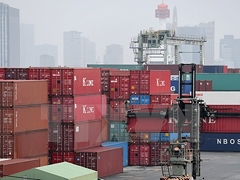
South Korea called on China on Tuesday to carry out its ongoing anti-dumping investigations into South Korean chemical products in a fair manner.
The commerce ministry said it made the request at a bilateral free trade meeting here, which was attended by senior trade officials from both countries. A bilateral free trade agreement took effect in December 2015.
In June, China launched an anti-dumping probe into South Korean exports of styrene monomer (SM) used to make polystyrene, which in turn is used to make plastics and foam containers.
Last month, Beijing began an anti-dumping investigation into South Korean exports of nitrile butadiene rubber (NBR), raw material for fuel hoses, gaskets, rollers and other products in which oil resistance is required. In November, China imposed anti-dumping duties of 29.9 percent on Kumho P&B Chemicals' exports of ethyl isobutyl ketone (MIBK), a compound widely used in coatings, pesticides and solvents.
"The South Korean government delivered local companies' concerns over China's moves and asked Beijing to make an objective decision through fair investigations," the Ministry of Trade, Industry and Energy said in a release.
Beijing has begun its investigations into the chemicals at the request of Chinese petrochemical companies, which claim cheap imports from South Korea and other countries are hurting the domestic industry.
Petrochemicals exporters have been facing growing protectionism in China, which has launched anti-dumping probes into imports of major materials.
Currently, China is carrying out 15 trade remedies, such as anti-dumping investigations and safeguards, on South Korean products, as the third-largest regulator of South Korean imports after the United States and India.
At the meeting, both sides also agreed to establish a civilian consultative body on trade remedies and trade policy tools that allow governments to take remedial action against imports hurting domestic industries.
The agreement is a follow-up for a memorandum of understanding on trade remedies signed by the nations' commerce ministers on the margins of a bilateral summit in Beijing last week.
In the summit, the two nations' leaders agreed to launch follow-up negotiations to include the service and investment sectors and expand the scope of the trade deal, which is largely focused on reducing tariffs on goods.
Ahead of the start of talks, the ministry said it plans to hold a public hearing on the proposed FTA negotiations on Jan. 5 at the Convention and Exhibition Center in Seoul.
China is South Korea's largest trading partner with two-way volume at $227.4 billion in 2015 and the second-largest destination of South Korean investment.
South Korea's exports to China totaled $128.3 billion in the first 11 months of this year, up 14.1 percent from a year earlier, the ministry said.
The latest figure recovered from the downward trend in the previous two years, but it lagged behind the nation's average export growth of 16.5 percent due to strained diplomatic ties with Beijing following Seoul's deployment of the American missile system, called THAAD, earlier this year.
"Exports remained sluggish as China shifted its focus to domestic consumption, tepid consumer sentiment and THAAD issues," the ministry said in a release.
Hit by the negative consumer sentiment, South Korean carmakers suffered in the major export market, with their market share in China slipping below 10 percent in October for the first time in three years.
South Korea's foreign direct investment in China dropped 20.2 percent to $2.18 billion in the third quarter. In the same three-month period, Chinese investments arriving in South Korea tumbled 63.4 percent to $68 million, the ministry noted.
Source: Yonhap
Các tin khác
- MoIT tightens 'Made in Viet Nam' criteria to combat trade fraud (12/06/2026)
- Viet Nam receives AD petition against Chinese prestressed steel bars (12/06/2026)
- India’s anti-dumping shield on Asian aluminium foil to stay up through 2026 (12/06/2026)
- Amended Customs Law: Removing 'bottlenecks' to help businesses accelerate import and export (12/06/2026)
- Expanding export markets in the era of integration (12/06/2026)