Home
Home
 About Us


Japan, South Korea clash at WTO over trade dispute
26/07/2019 12:00
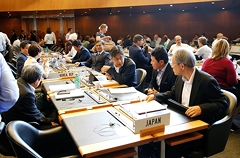
South Korea tried to bring international pressure to bear on Japan by airing its complaint at the World Trade Organization (WTO) on Wednesday, the latest move in a festering dispute that has seen Washington's two biggest Asian allies lobbing accusations at each other.
Japan has enraged South Korea with a plan to "normalize" trade procedures that are currently "simplified", effectively curbing exports to South Korea and erecting a barrier that could disrupt the global supply of semiconductors.
That followed a ruling last year by a South Korean court that Japanese companies had to pay compensation to South Koreans forced to work in Japanese factories during Japan's occupation of the Korean peninsula from 1910 to 1945. Japan believes the issue was settled under a 1965 treaty and the court ruling violated international law.
Japanese ambassador Junichi Ihara told the WTO meeting that the change in trade procedures was Japan's prerogative, was nothing unusual, and reflected Seoul's failure to maintain dialogue on the mutual streamlining of trade procedures.
It also was also based on national security concerns, following "some cases of inappropriate export" to South Korea, the ambassador said.
That national security claim could make it exempt from the rules of the WTO, where South Korea chose to raise the issue on Wednesday, sending deputy trade minister Kim Seung-ho to address the WTO's top-level meeting short of a ministerial conference.
"It's not at all a trade measure, it's not at all a security measure, it's purely strategically planned to gain the upper hand in the diplomatic rows, I mean the forced labour issues," Kim told reporters.
Japan sent the director-general of economic affairs at its Foreign Ministry, Shingo Yamagami, and Kim said he had asked for a face-to-face meeting with Yamagami but had been flatly turned down.
"That clearly shows that Japan has not confidence or even courage to face what Japan has done," he said. "This evasive attitude shows that Japan tries to close its eyes to what it has done and Japan tries to close its ears to... Japanese actions' victims."
Kim said Japan risked causing disruption to the world economy and undermining the WTO, and called on Japan to return to bilateral talks.
Ihara said Japanese officials had already briefed their South Korean counterparts for five hours and although Japan was not refusing further talks, Yamagami said he had not received an official request for dialogue.
"There is apparently a paucity of dialogue between export control agencies between the two countries, maybe that is where they should start," Yamagami told reporters.
South Korea had brought the dispute to the WTO's General Council, hoping to rally international opposition to Japan's move.
But no other WTO members took the floor, and diplomats from several other countries told Reuters they preferred not to get involved in the dispute between two nations with an intertwined and complex history.
Meanwhile, in Seoul, South Korea protested against a Japanese plan to remove it from a list of countries that face minimum trade restrictions, saying it would undermine their decades-old economic and security cooperation and threaten free trade.
South Korea's industry ministry said in a statement Japan's removal of South Korea from the list would undermine their economic and security partnership.
It asked Japan to scrap the plan, flagging concerns over wider disruptions of global supply chains involving South Korean chip and screen makers.
"It is a very grave matter that shakes the foundation of South Korea-Japan economic partnership and Northeast Asian security cooperation that has been maintained and developed for more than 60 years," Sung Yoon-mo, the South Korean industry minister, told a briefing. "Removal of South Korea from the white list of countries is against international norms and we are worried about its serious negative impact on global value chains and free trade."
Japan is due to decide on a revision of its list after canvassing public opinion, which was due to be done by Wednesday.
Japan will "steadily progress" with the removal process, Japanese Trade Minister Hiroshige Seko told reporters, adding that each country can make its own decision regarding the white list.
Japanese broadcaster NHK reported that an unusually large number of opinions had been submitted - more than 10,000 - and most were in favor of dropping South Korea.
The government was looking to implement the change as early as next month, NHK said.
U.S. tech industry groups with members including Apple sent an open letter on Tuesday to Japan and South Korea calling for a quick resolution of their dispute.
"Non-transparent and unilateral changes in export control policies can cause supply chain disruptions, delays in shipments, and ultimately long-term harm to the companies that operate within and beyond your borders and the workers they employ," the groups said.
Apple is a major customer of South Korean memory chip giants Samsung Elec and SK Hynix.
South Korea has stepped up diplomatic efforts to get Japan to scrap its trade controls, asking the United States to help, though it has not rushed to step in.
South Korean Foreign Minister Kang Kyung-wha discussed the problem with visiting U.S. national security adviser John Bolton in Seoul on Wednesday.
They agreed to continue discussions on a U.S. role in finding a diplomatic solution, Kang's ministry said in a statement.
For years, the United States counted on a united stand with Japan and South Korea to stand up to what all three have seen as North Korean aggression.
Over the past year, U.S. President Donald Trump has sought to resolve the North Korea dispute with a personal approach to its leader, Kim Jong Un.
Source: Japan Today
Japan has enraged South Korea with a plan to "normalize" trade procedures that are currently "simplified", effectively curbing exports to South Korea and erecting a barrier that could disrupt the global supply of semiconductors.
That followed a ruling last year by a South Korean court that Japanese companies had to pay compensation to South Koreans forced to work in Japanese factories during Japan's occupation of the Korean peninsula from 1910 to 1945. Japan believes the issue was settled under a 1965 treaty and the court ruling violated international law.
Japanese ambassador Junichi Ihara told the WTO meeting that the change in trade procedures was Japan's prerogative, was nothing unusual, and reflected Seoul's failure to maintain dialogue on the mutual streamlining of trade procedures.
It also was also based on national security concerns, following "some cases of inappropriate export" to South Korea, the ambassador said.
That national security claim could make it exempt from the rules of the WTO, where South Korea chose to raise the issue on Wednesday, sending deputy trade minister Kim Seung-ho to address the WTO's top-level meeting short of a ministerial conference.
"It's not at all a trade measure, it's not at all a security measure, it's purely strategically planned to gain the upper hand in the diplomatic rows, I mean the forced labour issues," Kim told reporters.
Japan sent the director-general of economic affairs at its Foreign Ministry, Shingo Yamagami, and Kim said he had asked for a face-to-face meeting with Yamagami but had been flatly turned down.
"That clearly shows that Japan has not confidence or even courage to face what Japan has done," he said. "This evasive attitude shows that Japan tries to close its eyes to what it has done and Japan tries to close its ears to... Japanese actions' victims."
Kim said Japan risked causing disruption to the world economy and undermining the WTO, and called on Japan to return to bilateral talks.
Ihara said Japanese officials had already briefed their South Korean counterparts for five hours and although Japan was not refusing further talks, Yamagami said he had not received an official request for dialogue.
"There is apparently a paucity of dialogue between export control agencies between the two countries, maybe that is where they should start," Yamagami told reporters.
South Korea had brought the dispute to the WTO's General Council, hoping to rally international opposition to Japan's move.
But no other WTO members took the floor, and diplomats from several other countries told Reuters they preferred not to get involved in the dispute between two nations with an intertwined and complex history.
Meanwhile, in Seoul, South Korea protested against a Japanese plan to remove it from a list of countries that face minimum trade restrictions, saying it would undermine their decades-old economic and security cooperation and threaten free trade.
South Korea's industry ministry said in a statement Japan's removal of South Korea from the list would undermine their economic and security partnership.
It asked Japan to scrap the plan, flagging concerns over wider disruptions of global supply chains involving South Korean chip and screen makers.
"It is a very grave matter that shakes the foundation of South Korea-Japan economic partnership and Northeast Asian security cooperation that has been maintained and developed for more than 60 years," Sung Yoon-mo, the South Korean industry minister, told a briefing. "Removal of South Korea from the white list of countries is against international norms and we are worried about its serious negative impact on global value chains and free trade."
Japan is due to decide on a revision of its list after canvassing public opinion, which was due to be done by Wednesday.
Japan will "steadily progress" with the removal process, Japanese Trade Minister Hiroshige Seko told reporters, adding that each country can make its own decision regarding the white list.
Japanese broadcaster NHK reported that an unusually large number of opinions had been submitted - more than 10,000 - and most were in favor of dropping South Korea.
The government was looking to implement the change as early as next month, NHK said.
U.S. tech industry groups with members including Apple sent an open letter on Tuesday to Japan and South Korea calling for a quick resolution of their dispute.
"Non-transparent and unilateral changes in export control policies can cause supply chain disruptions, delays in shipments, and ultimately long-term harm to the companies that operate within and beyond your borders and the workers they employ," the groups said.
Apple is a major customer of South Korean memory chip giants Samsung Elec and SK Hynix.
South Korea has stepped up diplomatic efforts to get Japan to scrap its trade controls, asking the United States to help, though it has not rushed to step in.
South Korean Foreign Minister Kang Kyung-wha discussed the problem with visiting U.S. national security adviser John Bolton in Seoul on Wednesday.
They agreed to continue discussions on a U.S. role in finding a diplomatic solution, Kang's ministry said in a statement.
For years, the United States counted on a united stand with Japan and South Korea to stand up to what all three have seen as North Korean aggression.
Over the past year, U.S. President Donald Trump has sought to resolve the North Korea dispute with a personal approach to its leader, Kim Jong Un.
Source: Japan Today
Các tin khác
- MoIT tightens 'Made in Viet Nam' criteria to combat trade fraud (12/06/2026)
- Viet Nam receives AD petition against Chinese prestressed steel bars (12/06/2026)
- India’s anti-dumping shield on Asian aluminium foil to stay up through 2026 (12/06/2026)
- Amended Customs Law: Removing 'bottlenecks' to help businesses accelerate import and export (12/06/2026)
- Expanding export markets in the era of integration (12/06/2026)