Home
Home
 About Us



India: Government widens scope for anti-dumping duty on jute yarn, sacks from Bangladesh
15/11/2019 12:00
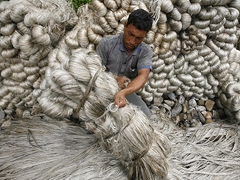
The government has widen the scope of antidumping duty imposed on jute yarn and sacking bags by including more companies of Bangladesh to protect domestic players from cheap inbound shipments.
In a notification, the Central Board of Indirect Taxes and Customs has said it has amended a notification dated January 1, 2017 to include more companies under the ambit of antidumping duties.
The duties are in the range of $97.19 per tonne and $125.21 per tonne.
It was in 2017, when it was first imposed on imports of jute yarn and sacking bags coming from Bangladesh to guard domestic players from cheap imports.
The anti-dumping duty is imposed on specific companies of a country.
Based on complaint of local players, the Directorate General of Trade Remedies, (erstwhile DGAD) had initiated a probe into imports of the products in 2015.
West Bengal is the major player in the jute industry, with 3.5-4 lakh people being employed in the sector.
Countries carry out anti-dumping probe to determine whether their domestic industries have been hurt because of a surge in cheap imports.
As a counter measure, they impose duties under the multilateral regime of the World Trade Organization.
The duty is aimed at ensuring fair trade practices and creating a level-playing field for domestic producers with regard to foreign producers and exporters.
In a notification, the Central Board of Indirect Taxes and Customs has said it has amended a notification dated January 1, 2017 to include more companies under the ambit of antidumping duties.
The duties are in the range of $97.19 per tonne and $125.21 per tonne.
It was in 2017, when it was first imposed on imports of jute yarn and sacking bags coming from Bangladesh to guard domestic players from cheap imports.
The anti-dumping duty is imposed on specific companies of a country.
Based on complaint of local players, the Directorate General of Trade Remedies, (erstwhile DGAD) had initiated a probe into imports of the products in 2015.
West Bengal is the major player in the jute industry, with 3.5-4 lakh people being employed in the sector.
Countries carry out anti-dumping probe to determine whether their domestic industries have been hurt because of a surge in cheap imports.
As a counter measure, they impose duties under the multilateral regime of the World Trade Organization.
The duty is aimed at ensuring fair trade practices and creating a level-playing field for domestic producers with regard to foreign producers and exporters.
Source: Business Standard
Các tin khác
- MoIT tightens 'Made in Viet Nam' criteria to combat trade fraud (12/06/2026)
- Viet Nam receives AD petition against Chinese prestressed steel bars (12/06/2026)
- India’s anti-dumping shield on Asian aluminium foil to stay up through 2026 (12/06/2026)
- Amended Customs Law: Removing 'bottlenecks' to help businesses accelerate import and export (12/06/2026)
- Expanding export markets in the era of integration (12/06/2026)