Home
Home
 About Us



WTO Panel to Hear US, New Zealand Challenge of Indonesia Agriculture Import Restrictions
28/05/2015 12:00
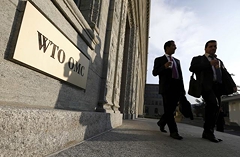
The past two weeks have marked a busy period for the global trade arbiter, with a new WTO panel being established to hear the complaints of the US and New Zealand over claims of illegal agricultural import restrictions by Indonesia. Appeals were also filed by China and Japan, respectively, in their dispute over steel anti-dumping duties, while Tokyo has also launched a separate case against Seoul over alleged import restrictions.
US, New Zealand granted panel in agriculture dispute
A dispute panel is now set to hear complaints from New Zealand and the US (DS477 and 478, respectively)against Indonesia’s alleged measures on importing horticultural products, animals, and animal products, after both complainants tabled second requests for a panel.
Both countries had already requested the establishment of a single panel to hear their complaints, which are identical in content. However, these prior requests had been rejected by Jakarta at an April meeting of the WTO’s Dispute Settlement Body (DSB).
Washington and Wellington claim that Jakarta’s import licensing regime is trade-restrictive and imposes prohibitions and restrictions on imports of the relevant products that are not allowed under global trade rules, such as Article XI:1 of the General Agreement on Tariffs and Trade (GATT) 1994, and Article 4.2 of the Agreement on Agriculture. (See Bridges Weekly, 23 April 2015)
The alleged restrictions include, for example, pre-conditions and processes that must be met before an import can enter the Asian island country, as well as prohibitions and restrictions involving the use, sale, offering for sale, distribution, storage, or transportation of imported products.
The US and New Zealand also claim that Indonesia’s import licensing scheme imposes limits on imports should the domestic market price of these goods fall below a government-established reference price. Furthermore, they say, some prohibitions or restrictions are placed on imported animal products in cases where local production is deemed sufficient to meet domestic demand.
Japan, China appeal panel reports in steel case
Also last week, Japan and China both filed notices of appeal against certain panel findings regarding Chinese anti-dumping duties on imported “high-performance stainless steel seamless tubes” (HP-SSST), which are used mainly in boilers for coal-fired power stations.
China’s Ministry of Commerce (MOFCOM), which conducts trade remedy probes, had imposed those anti-dumping measures three years ago following investigations against Tokyo and Brussels. Beijing said at the time that it had found evidence of dumping, which it said also caused injury to its domestic industry.
The duties applied to Japan’s imports, according to Tokyo’s Ministry of Economy, Trade, and Industry, ranged from 9.2 to 14.4 percent. In the case of the EU, the duties ranged from 9.7 to 11.1 percent. (See Bridges Weekly, 16 January 2013 and 5 September 2013)
In the original disputes, the complainants had tabled nearly identical claims regarding how the Chinese government agency determined domestic injury and dealt with certain procedural issues, with Brussels also raising various substantive claims regarding the dumping determination. A WTO panel had issued a mixed ruling in both cases this past February. (See Bridges Weekly, 19 February 2015)
While China’s appeal addresses the panel report specific to its dispute (DS460) with the EU on the subject, only Japan filed an appeal in DS454 by the end of the agreed appeal deadline.
Among Tokyo’s complaints in its appeal is that the panel erred in deeming that investigating authorities may complete their analysis of dumped imports’ effect on prices just by determining that price undercutting exists, solely on the basis of mathematically calculating the difference in price between imported and domestic like products.
Japan has also raised other concerns regarding some of the panel’s findings. For instance, the panel found it sufficient for the Chinese investigating agency to determine that import prices are lower than for domestic like products on the basis of information taken from only one point in time during the investigation period. Tokyo also cited questions over the panel’s findings regarding how MOFCOM conducted its analysis of dumping’s alleged impact on Chinese domestic industry.
Meanwhile, China is challenging other panel findings that upheld the EU’s claims, such as if it was within the panel’s terms of reference to rule whether Beijing had violated trade rules in failing to determine an amount for selling, general, and administrative expenses based on production and sales data in the ordinary course of trade of the like product “by the exporter or producer under investigation.”
Beijing has also taken issue with the panel's findings that MOFCOM improperly relied on the market share of subject imports in determining a causal link between those same imports and material injury to domestic industry. A separate issue China has raised is the panel’s finding that MOFCOM failed to ensure that injury caused by the decrease in apparent consumption and the increase in production capacity was “not attributed to subject imports.”
Furthermore, Beijing disagrees with the panel’s findings that MOFCOM violated trade rules in its treatment of confidential information, including that the agency permitted some petitioner information “to remain confidential without objectively assessing ‘good cause’ or scrutinising the petitioners' showing of ‘good cause’.”
Under WTO rules, the Appellate Body now has 90 days to issue its reports. While it can review aspects of law – such as legal interpretation – it generally will not interfere with factual findings.
Japan challenges Korea over food import restrictions
Last Thursday, Japan notified the WTO that it would be challenging South Korea over its alleged bans and additional testing and certification requirements for certain imported Japanese food products (DS495).
According to sources familiar with the consultations request, which marks the first step in WTO dispute settlement proceedings, Tokyo has specifically taken issue with measures that Seoul implemented following Japan’s 2011 earthquake and accident at the Fukushima Daiichi nuclear power station.
These measures were reportedly taken due to alleged radiation contamination concerns following the accident. However, Japan argues that Korea has not provided sufficient information about such measures, and has challenged their actual justification and consistency with trade rules.
In response, Seoul’s trade ministry told reporters that it would “explain in future consultations with Japan that import restrictions have been placed to secure the safety of people,” according to comments reported by the Wall Street Journal.
The two sides must now hold consultations for at least 60 days in a bid to resolve the dispute. Should these talks fail, Japan can then request the establishment of a WTO dispute panel to hear this complaint.
Source: ictsd.org
Các tin khác
- New-generation FTAs open wider export opportunities to Middle East and South Asia (15/06/2026)
- Updated regulations on foreign trade management and import quotas (15/06/2026)
- Mandatory traceability for high-risk goods from July 1st: What should businesses prepare for? (15/06/2026)
- Tariff pressure is forcing businesses to restructure in order to adapt. (15/06/2026)
- Coffee Citizens model aims to lift Vietnamese value chain (15/06/2026)