Home
Home
 About Us



Weak euro keeps EU pangasius market slow
01/06/2015 12:00
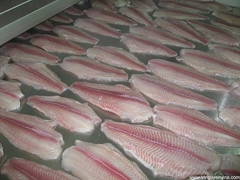
The weak euro is keeping the European pangasius market slow, with importers buying only what they need to keep inventories ticking over, two major Dutch firms told Undercurrent News.
Thanks in part again to currency effects, the US market is the stronger of the two, sources agreed. Import data seemed to suggest the US was importing considerably less seafood from Vietnam in 2015, though these figures were skewed slightly by the effects of anti-dumping rates looming over the market towards the end of 2014, Don Kelley, procurement manager with Western Edge Seafood, told Undercurrent.
“Prices in Vietnam are decreasing cent by cent, based on FOB [freight on board] price, and factories are begging for new orders,” said Frans Zeeman, Seafood Connection's purchase manager.
“The market in general is slow, caused by the weak euro. Although there are low prices in Vietnam, selling prices are still ‘higher’ compared to some months,” he added.
Price out of Ho Chi Minh City have been steady at between $2.45 and $2.65 per kilogram for 100% net weight product, he said, with factories “just offering in between these levels”.
Back in January, both Zeeman and Anova Seafood senior sourcing and account manager for frozen – Rens Elderkamp – believed ex-farm prices would be coming down over the first quarter.
As the dollar to euro exchange rate continued dropping, importers faced spending more to import in the former and sell on to retail in the latter currency. However, the pressure would be on Vietnamese producers to lower their prices, the importers said.
Falling ex-farm prices are largely down to the weak euro, and less about retailer pressure on importers, Zeeman said in May 2015. “Everybody is facing ‘higher’ prices now after exchanging dollar to euro. Retailers will all face higher prices, while buying prices in USD are going down.”
“They close contracts for one year, whereas we are closing contracts every day. My feeling is that demand is not strong; we are more careful now, because we see prices are going down cent by cent, week by week. We are not doing ‘big things’ now, but try ingto keep the stock at a low level and buy what we need.”
Elderkamp confirmed prices continue to creep down, though added there was not much room left for it to fall. “Prices in Europe will have to increase at some point. Market demand is very stable, and production is relatively the same as it has been for past months.”
Until the end of July – when a decision is expected in Vietnam in terms of EU legislation requiring moisture content in products to be disclosed on packaging – There's likely to be little change in the market situation, said Elderkamp.
“Strong EU pressure may push prices down a little more. The US is the most important market, and remains number one now based on FX – the currency is worth more, so those companies that are licensed to sell to the US, will.”
US is number one choice
In March 2015, Vietnam's Ministry of Agriculture and Rural Development (MARD) had seafood export revenue to the US down 36.77% year-on-year.
Shrimp and pangasius exports got off to a rocky start in January, on the back of a US Department of Commerce (DOC) decision to impose anti-dumping duties on imports late last year.
The ban on imports by the DOC for excessive antibiotics pulled overall seafood exports for January down sharply by 27% year-on-year, to $425 million.
“Swai has become more about quality than chasing the lower price. Buyers seem to have learned that swai is an easy species to 'screw up' in the factory, so the strategy is to be loyal trusted brands"
“There is some risk to being misled by the import data,” warned Kelley. “Consumption is strong, as normal, but because of changes in anti-dumping rates that were looming over the markets in Q4 2014, there was a rush of imports into the USA late last year.”
“This affects the amounts left to buy in Q1 2015. It should normalize as we go through 2015.”
Exchange rates would be dictating Vietnamese export policy now, if it weren't for limits on the number of plants that can sell to the US, he said.
“The dollar is very strong against the euro, up 30% y-o-y, but seems to be up only 2% y-o-y against the Vietnamese dong.”
“I would say this affects exporter’s thinking, that they would rather sell into the USA than the EU. That is the normal expectation, but since we have anti-dumping in the USA, that leaves a limited number of exporters with the ability to sell here – so I would say that the effects are tempered.”
“The way that it was once explained to me is that once a plant decided to be a 'USA-centric' exporter, and invests in the substantial legal costs of gaining a low anti-dumping rate, they do not actively switch between markets.”
Meanwhile, non- 'US-focused plants' cannot make a quick switch to serve the US market.
“The main effect of this may be at the farm-plant level; the plants are probably getting some good deals from farmers right now,” said Kelley.
On the selling side, US importers are seeing stable prices, minus a cent or two, he said.
“Swai has become more about quality than chasing the lower price. Buyers seem to have learned that swai is an easy species to 'screw up' in the factory, so the strategy is to be loyal trusted brands.”
The anti-dumping also serves to add stability, he pointed out, preventing exporters from dipping the price too fast.
Meanwhile, he does not expect the EU's moisture labelling legislation to have much of an effect for the US market.
Source: Under Current News
Các tin khác
- New-generation FTAs open wider export opportunities to Middle East and South Asia (15/06/2026)
- Updated regulations on foreign trade management and import quotas (15/06/2026)
- Mandatory traceability for high-risk goods from July 1st: What should businesses prepare for? (15/06/2026)
- Tariff pressure is forcing businesses to restructure in order to adapt. (15/06/2026)
- Coffee Citizens model aims to lift Vietnamese value chain (15/06/2026)