Home
Home
 About Us



Vietnamese pangasius production on track after harsh drought
01/07/2016 12:00
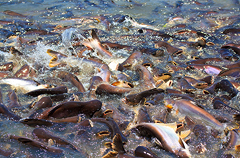
A harsh period for pangasius farmers in Vietnam seems to have come to an end, leaving raw material prices to drop back to where they were earlier this year.
Sources agreed that while events conspired to form a worse drought period than farmers usually experience, the main packers still received plenty of fish from a variety of options.
“The time of increased prices seems to be gone,” Kristen Nguyen, salesperson with Mekong Seafood Connection, told Undercurrent News. “Buyers are more comfortable bargaining now, and they can find many sources for good rates.”
Another sales executive – Trinh Tuyen, with exporter Hung Hau – confirmed supplies were up again compared with April, and the price for typical frozen pangasius fillets, freight on board out of Ho Chi Minh, was back to around £2.10 per kilogram. They had risen to as much as $2.30/kg.
She added that the EU was showing slightly improved demand, and that the sector is hoping for an improvement in prices before the end of the year.
One further source, an executive with a large Vietnamese exporter, told Undercurrent many farmers were still holding out for better prices – though given the plentiful supply, he does not expect them to be able to get them.
Sources note that the dry season has impacted production of young pangasius, meaning that over the next few months there may be fewer of those fish best-suited for use as retail fillets.
“The salinity and drought situation was worse than usual certainly, but it's on the recovery now,” said Rens Elderkamp, strategic sourcing manager with Anova Seafood. “The larger, vertically integrated players in Vietnam were less effected, as they farm across many areas. They had fish throughout the situation, and have plenty now.”
While larger fish are in plentiful supply, those producing 100- 200 gram fillets are not; Elderkamp predicts price rises on those sizes in the coming months, though “packers will continue to recover fine”.
The executive with the Vietnamese exporter confirmed this, adding that while he did not expect much to change by way of pricing in the next few months, there would be fewer 120- 170g fillets around to meet the demand. Instead, there are plenty of 220- 280g fish on the market, which are actually a little harder to sell, he said.
Demand up in US, Asia
The Vietnam Association of Seafood Exports and Processors (Vasep) recently noted thatmarket demand for pangasius in the US and from Asia was up in 2016.
This latter point was echoed by the exporting executive, who said that globally his company was seeing quite a bit of interest in pangasius as an alternative to Alaskan pollock, at the lower end of that species' scale.
“It's something of a trend now, we're seeing interesting opportunities for the use of pangasius in foodservice in northern Asia, which certainly hasn't been the case for long – they traditionally prefer wild-caught fish, but seem more open to breaded and marinated goods now.”
According to Vasep, exports of pangasius from Vietnam to China and Hong Kong rocketed 93.7% year-on-year in April 2016, to $22.98 million.
Overall, according to Vasep, Vietnamese companies earned export revenue of $507.54m for pangasius exports in the first four months of 2016, up 5.2% y-o-y.
The figure in April 2016 is estimated at $142.08m, up 13% y-o-y.
In January-April 2016, “pangasius consumption in the global market began to recover, especially in large markets”, wrote Vasep, in an export report.
US felt no 'shortage'
Don Kelley, procurement manager with US importer Western Edge Seafood, told Undercurrentthat while he'd heard about the damage done by drought in Vietnam, the US market did not feel any impact from a shortage.
A $0.10/kg rise on frozen fillets did come in while the farming issues were occurring, and is “mostly still in place”, he said.
“I think it is accurate to say that the US gets what it wants in terms of quantity and size, generally speaking, because the competing markets pay less. We are the ones with the anti-dumping regime in place.”
In terms of outlook he expects a stable situation, with perhaps some small increases for product packed later in the year as production slots fill up.
This has come as the US looks at changing which government body has oversight for the import of pangasius into the country.
At the end of May the Senate passed a bill that would nullify a controversial 2014 change in the way the US regulates the imports, and the measure could become law soon, which would stave off a likely trade dispute with Vietnam.
In a 55 to 43 vote on May 25, senators passed a resolution that would employ an infrequently used law, the Congressional Review Act, to repeal a clause in the 2014 farm bill. The clause transferred regulation of fish in the scientific order Siluriformes, including pangasius and catfish, from the Food and Drug Administration (FDA), which has traditionally regulated seafood imports, to the US Department of Agriculture (USDA), which typically regulates meat.
The change was spearheaded by Mississippi Senator Thad Cochran, who has said the USDA can better review catfish for food safety.
But critics including the National Fisheries Institute have called the change 'wasteful' and 'protectionist', designed to help a handful of Mississippi catfish producers.
Criticisms of having the USDA oversee pangasius imports include the fact that it means higher prices for consumers, meaning shoppers in 45 states would be paying more to benefit catfish firms in just five states.
One source emphasized to Undercurrent that after discussions with his own, he found that House representatives were keen to hear from companies who had input on this topic, and encourages others to do so.
In the meantime, the US Food Safety and Inspection Service has allowed an additional 12 Vietnamese pangasius companies to export to the US, raising the total number of exporters to 57.
Sources agreed that while events conspired to form a worse drought period than farmers usually experience, the main packers still received plenty of fish from a variety of options.
“The time of increased prices seems to be gone,” Kristen Nguyen, salesperson with Mekong Seafood Connection, told Undercurrent News. “Buyers are more comfortable bargaining now, and they can find many sources for good rates.”
Another sales executive – Trinh Tuyen, with exporter Hung Hau – confirmed supplies were up again compared with April, and the price for typical frozen pangasius fillets, freight on board out of Ho Chi Minh, was back to around £2.10 per kilogram. They had risen to as much as $2.30/kg.
She added that the EU was showing slightly improved demand, and that the sector is hoping for an improvement in prices before the end of the year.
One further source, an executive with a large Vietnamese exporter, told Undercurrent many farmers were still holding out for better prices – though given the plentiful supply, he does not expect them to be able to get them.
Sources note that the dry season has impacted production of young pangasius, meaning that over the next few months there may be fewer of those fish best-suited for use as retail fillets.
“The salinity and drought situation was worse than usual certainly, but it's on the recovery now,” said Rens Elderkamp, strategic sourcing manager with Anova Seafood. “The larger, vertically integrated players in Vietnam were less effected, as they farm across many areas. They had fish throughout the situation, and have plenty now.”
While larger fish are in plentiful supply, those producing 100- 200 gram fillets are not; Elderkamp predicts price rises on those sizes in the coming months, though “packers will continue to recover fine”.
The executive with the Vietnamese exporter confirmed this, adding that while he did not expect much to change by way of pricing in the next few months, there would be fewer 120- 170g fillets around to meet the demand. Instead, there are plenty of 220- 280g fish on the market, which are actually a little harder to sell, he said.
Demand up in US, Asia
The Vietnam Association of Seafood Exports and Processors (Vasep) recently noted thatmarket demand for pangasius in the US and from Asia was up in 2016.
This latter point was echoed by the exporting executive, who said that globally his company was seeing quite a bit of interest in pangasius as an alternative to Alaskan pollock, at the lower end of that species' scale.
“It's something of a trend now, we're seeing interesting opportunities for the use of pangasius in foodservice in northern Asia, which certainly hasn't been the case for long – they traditionally prefer wild-caught fish, but seem more open to breaded and marinated goods now.”
According to Vasep, exports of pangasius from Vietnam to China and Hong Kong rocketed 93.7% year-on-year in April 2016, to $22.98 million.
Overall, according to Vasep, Vietnamese companies earned export revenue of $507.54m for pangasius exports in the first four months of 2016, up 5.2% y-o-y.
The figure in April 2016 is estimated at $142.08m, up 13% y-o-y.
In January-April 2016, “pangasius consumption in the global market began to recover, especially in large markets”, wrote Vasep, in an export report.
US felt no 'shortage'
Don Kelley, procurement manager with US importer Western Edge Seafood, told Undercurrentthat while he'd heard about the damage done by drought in Vietnam, the US market did not feel any impact from a shortage.
A $0.10/kg rise on frozen fillets did come in while the farming issues were occurring, and is “mostly still in place”, he said.
“I think it is accurate to say that the US gets what it wants in terms of quantity and size, generally speaking, because the competing markets pay less. We are the ones with the anti-dumping regime in place.”
In terms of outlook he expects a stable situation, with perhaps some small increases for product packed later in the year as production slots fill up.
This has come as the US looks at changing which government body has oversight for the import of pangasius into the country.
At the end of May the Senate passed a bill that would nullify a controversial 2014 change in the way the US regulates the imports, and the measure could become law soon, which would stave off a likely trade dispute with Vietnam.
In a 55 to 43 vote on May 25, senators passed a resolution that would employ an infrequently used law, the Congressional Review Act, to repeal a clause in the 2014 farm bill. The clause transferred regulation of fish in the scientific order Siluriformes, including pangasius and catfish, from the Food and Drug Administration (FDA), which has traditionally regulated seafood imports, to the US Department of Agriculture (USDA), which typically regulates meat.
The change was spearheaded by Mississippi Senator Thad Cochran, who has said the USDA can better review catfish for food safety.
But critics including the National Fisheries Institute have called the change 'wasteful' and 'protectionist', designed to help a handful of Mississippi catfish producers.
Criticisms of having the USDA oversee pangasius imports include the fact that it means higher prices for consumers, meaning shoppers in 45 states would be paying more to benefit catfish firms in just five states.
One source emphasized to Undercurrent that after discussions with his own, he found that House representatives were keen to hear from companies who had input on this topic, and encourages others to do so.
In the meantime, the US Food Safety and Inspection Service has allowed an additional 12 Vietnamese pangasius companies to export to the US, raising the total number of exporters to 57.
Source: UnderCurrentNews
Các tin khác
- New-generation FTAs open wider export opportunities to Middle East and South Asia (15/06/2026)
- Updated regulations on foreign trade management and import quotas (15/06/2026)
- Mandatory traceability for high-risk goods from July 1st: What should businesses prepare for? (15/06/2026)
- Tariff pressure is forcing businesses to restructure in order to adapt. (15/06/2026)
- Coffee Citizens model aims to lift Vietnamese value chain (15/06/2026)