Home
Home
 About Us


Vietnamese Exports to Northern Europe Face Challenges, Gain New Opportunities
04/04/2025 01:24
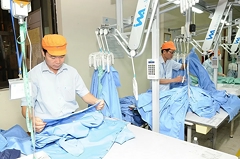
Reciprocal tariffs imposed by the United States on imported goods are presenting both opportunities and challenges for Vietnamese exports to the Northern European market.
Favorable Exchange Rates May Improve Price Competitiveness of Vietnamese Goods
In a brief exchange with the Industry and Trade Newspaper reporter on the morning of April 4th, Ms. Nguyen Thi Hoang Thuy - Director, Head of the Vietnam Trade Office in Sweden, concurrently responsible for the Northern European market - stated that on April 2, 2025, US President Donald Trump announced a series of large-scale reciprocal tariffs on imports from over 100 countries. The European Union (EU) also faces a 20% tariff rate.
With this move, Ms. Nguyen Thi Hoang Thuy noted that a significant positive factor is the favorable shift in exchange rates for Vietnamese goods. Specifically, the USD has depreciated while the Swedish krona (SEK) has strengthened significantly, with the current exchange rate at 9.85 SEK/USD - the highest since June 2022. This means Vietnamese goods priced in USD are becoming cheaper for Swedish consumers, helping to improve price competitiveness.
However, the extent of this benefit depends on the ability of Vietnamese businesses to maintain stable prices and not increase their USD output prices. Additionally, caution is still needed for certain sectors such as textiles and apparel, footwear, seafood, furniture, and handicrafts. These are industries with low profit margins, easily affected by fluctuations in raw material costs, logistics, and consumer demand. Particularly, amid rising inflation in European and Nordic markets, consumers tend to tighten spending, making non-essential or low value-added goods vulnerable to order reductions or price pressure.
Therefore, although the exchange rate is creating favorable conditions, businesses still need to proactively control costs, maintain stable selling prices, and simultaneously enhance product quality and standards to sustain and expand market share in high-end markets like Northern Europe.
Competition Intensifies as Asian Countries Shift Exports to the EU
Alongside the aforementioned advantages, Ms. Nguyen Thi Hoang Thuy believes that with difficulties entering the US market, China, Cambodia, Bangladesh, and many other Asian countries will redirect their exports towards the EU and Northern Europe – markets that maintain open trade and high consumer demand.
For instance, China might increase its presence in the electronics, home appliances, and machinery sectors in Europe. Bangladesh and Cambodia – major competitors in the textile and apparel industry – could intensify the flow of low-cost goods into the EU. Notably, the pressure comes not only from low prices but also from delivery speed, the ability to meet flexible orders, and the stringent standards of the European market.
"Amidst the rising wave of trade barriers and protectionism, the EU-Vietnam Free Trade Agreement (EVFTA) serves as a strategic shield helping Vietnamese goods maintain their foothold in Europe," affirmed Ms. Nguyen Thi Hoang Thuy. She also highlighted the sectors directly benefiting, including textiles and apparel, footwear; seafood, processed agricultural products; furniture, handicrafts; electrical equipment, and electronics.
Particularly in Northern Europe – where consumers prioritize sustainable, green, and transparent products – Vietnamese businesses can gain an advantage by investing in certifications such as eco-labels, traceability, or carbon footprint verification.
Ms. Nguyen Thi Hoang Thuy further assessed that the new US tariff policy, while a major challenge, also presents an opportunity for Vietnam to diversify markets, reduce dependence on the US and short-term orders. Furthermore, it encourages a shift in the competitive model from low price to quality, sustainability, and traceability. Investing in European standards like eco-labels, carbon footprint verification, or CSR certificates can enhance trust among Nordic consumers. Importantly, optimizing the EVFTA – leveraging tax preferences and positioning Vietnamese goods as a "reliable alternative" in the global supply chain – is key.
"The US reciprocal tariff policy is creating a systemic volatility in global trade, potentially leading to a widespread recession and profound global disruptions. While major countries are still debating how to react, Vietnamese businesses need to adapt proactively and early," Ms. Nguyen Thi Hoang Thuy pointed out.
The EU and Northern Europe – thanks to political stability and the EVFTA cooperation framework – are emerging as strategic gateways for Vietnamese exports. The crucial point is for businesses not just to "weather the storm" but also to leverage opportunities to reposition Vietnamese goods on the global trade map – not merely as cheap, but as quality – green – reliable.
Source: Congthuong.vn
Các tin khác
- U.S. to Impose Duties on Mexican, Thai, Vietnamese Chassis (03/06/2026)
- Mexican sugar producers push to scrap U.S. import quotas (03/06/2026)
- Japan launched an anti-dumping investigation into flat steel imports from three countries (03/06/2026)
- Eurochem challenges anti-dumping duties in the EU (03/06/2026)
- Pangasius prices in Viet Nam surge due to high export demand (03/06/2026)