Home
Home
 About Us


Vietnamese agriculture maintains its pivotal role, with exports reaching nearly 70 billion USD
23/01/2026 04:28
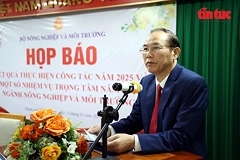
In 2025, Viet Nam's exports of agricultural, forestry, and aquatic products are estimated to reach nearly 70 billion USD, with a trade surplus of approximately 21 billion USD, further affirming their role as a pillar of the economy amidst numerous fluctuations. This information was announced by the Ministry of Agriculture and Environment at a press conference on January 23rd in Ho Chi Minh City, while also setting an export target of 73-74 billion USD for 2026.
According to Deputy Minister of Agriculture and Environment Phung Duc Tien, from 2021 to the present, despite complex global changes due to epidemics, geopolitical conflicts, and climate change, Viet Nam's agricultural sector has maintained its growth momentum and high adaptability. Export turnover of agricultural, forestry, and aquatic products increased from US$48.6 billion in 2021 to US$62.5 billion in 2024 and is estimated to reach approximately US$70 billion in 2025; the trade surplus reached over US$20 billion, further affirming its role as a pillar of the economy.
Deputy Minister of Agriculture and Environment Phung Duc Tien stated: “In 2025, the agricultural sector faced particularly severe impacts from natural disasters, with estimated losses from storms and floods of approximately 100,900 billion VND, significantly affecting people's lives, production, and the economy . However, despite numerous difficulties and challenges, the entire sector still achieved positive results, clearly demonstrating its resilience, management capacity, and ability to withstand adversity.”
Specifically, the export value of agricultural, forestry, and aquatic products in 2025 is estimated to reach nearly 70 billion USD, with a trade surplus of nearly 21 billion USD, an increase of nearly 17% compared to the previous year and higher than the overall trade surplus of the entire economy. The entire sector has 10 export items with a value exceeding 1 billion USD, including 3 product groups surpassing the 8 billion USD mark: wood and wood products at 17.32 billion USD; coffee at 8.57 billion USD; and fruits and vegetables at 8.56 billion USD.
In terms of markets, Asia continues to be the largest export region for Vietnamese agricultural, forestry, and aquatic products, accounting for 45.2% of the market share; followed by the Americas (22.8%) and Europe (13.2%). Compared to 2024, exports to Europe increased by 34.2%, and to Africa by 68.1%, indicating significant potential for market expansion. China, the United States, and Japan are the three largest export markets, with market shares of 22.3%, 20.6%, and 7.1%, respectively.
Within the export structure, many commodities recorded high growth in value thanks to improved export prices. Coffee reached US$8.57 billion, up 52.5%; cashew nuts reached US$5.19 billion, up 19.6%; pepper reached US$1.64 billion, up 24.9%; and fruits and vegetables reached US$8.56 billion, up 19.8%. Seafood exports reached US$11.32 billion, up 12.7%; and wood and wood products reached US$17.32 billion, up 6.4%.
Conversely, the import value of agricultural, forestry, and aquatic products in 2025 is estimated at US$49.36 billion, an increase of 10.1% compared to the previous year, mainly serving production, processing, and re-export. The largest supplier markets include China, the United States, and Argentina.
Looking ahead to 2026, the Ministry of Agriculture and Environment anticipates that the agricultural sector will continue to face numerous difficulties and challenges due to climate change, resource depletion, environmental pollution, and the increasing demands for green development, emission reduction, and biodiversity conservation.
Against this backdrop, the Ministry of Agriculture and Environment aims for a total export value of agricultural, forestry, and aquatic products of 73-74 billion USD; of which, agricultural products will account for approximately 40 billion USD, aquatic products approximately 12 billion USD, and forestry products and wood products approximately 18.8 billion USD.
Deputy Minister of Agriculture and Environment Phung Duc Tien expressed confidence that, with the results achieved in 2025, along with the solutions identified for 2026 and the consensus of the entire sector under the leadership of the Party and the State, the agriculture and environment sector will overcome difficulties and challenges to achieve the set goals.
According to Deputy Minister Phung Duc Tien, 2026 is identified as a pivotal year, laying the foundation for the 2026-2030 period. Viet Nam aims to be among the top 15 agricultural exporting countries in the world, with approximately 40% of exported products being processed goods, thereby increasing the added value and position of Vietnamese agricultural products in the international market.
In the context of deep integration and increasingly fierce competition, the agricultural sector aims for ecological, sustainable, and modern development; enhancing the competitiveness and position of Vietnamese agricultural products in the global value chain. During the period 2026-2030, the entire sector strives to achieve an export turnover of agricultural, forestry, and aquatic products of 95-100 billion USD, with an average growth rate of 6-8% per year.
To achieve this goal, the Ministry of Agriculture and Environment continues to improve mechanisms and policies for market development and international integration; remove bottlenecks in production organization and goods circulation; and form and develop sustainable agricultural supply chains. It will strengthen information dissemination, forecasting, and production orientation based on market signals; and strictly control the expansion of cultivated areas, avoiding unsustainable and rapid development.
Alongside this, the industry is strengthening quality management, developing deep processing industries, reducing post-harvest losses; building and developing agricultural product brands associated with cultural values and local products. It is effectively utilizing free trade agreements (FTAs) to expand export markets, especially potential markets such as ASEAN, South Korea, and the Middle East; focusing on developing Halal, organic, processed, and high-value products.
Promote the application of science and technology, innovation, and digital transformation throughout the agricultural value chain; develop a modern agricultural logistics system, closely integrated with processing and chain linkages to reduce intermediary costs and enhance competitiveness.
With a solid foundation built over more than 40 years of reform, and with the support of the State, businesses, and farmers, Viet Nam's agricultural, forestry, and aquatic product exports have the basis to continue to break through and make a positive contribution to the country's socio-economic development in the coming period.
Source: Tin Tuc News
Các tin khác
- U.S. to Impose Duties on Mexican, Thai, Vietnamese Chassis (03/06/2026)
- Mexican sugar producers push to scrap U.S. import quotas (03/06/2026)
- Japan launched an anti-dumping investigation into flat steel imports from three countries (03/06/2026)
- Eurochem challenges anti-dumping duties in the EU (03/06/2026)
- Pangasius prices in Viet Nam surge due to high export demand (03/06/2026)