Home
Home
 About Us



Vietnamese agriculture is experiencing stable growth and continues to shift along the value chain
06/04/2026 02:59
Despite challenges from the international market due to disruptions in global supply chains and soaring logistics costs, Viet Nam's agricultural sector concluded the first quarter of 2026 with substantial growth results.
With export turnover reaching 16.69 billion USD, the agricultural sector not only recorded growth in scale but also demonstrated a shift in development thinking: from purely agricultural production to the development of integrated value chains, adapting flexibly to international markets.
All sectors are growing.
In the first three months of 2026, Viet Nam's agricultural sector witnessed a clear structural shift aimed at optimizing value per unit area. According to a report from the Digital Transformation Department ( Ministry of Agriculture and Environment ), the area planted with winter-spring rice nationwide is estimated at 2.92 million hectares, a slight decrease of 1.3% compared to the same period in 2025.
This decline is part of the proactive plan implemented by localities to convert inefficient rice-growing areas to higher - value annual crops, perennial crops, or aquaculture. Despite a 5.6% decrease in harvested area, thanks to the application of advanced techniques, rice yields remained stable at 68.7 quintals/hectare, resulting in a total harvest of 3.64 million tons.
A notable highlight in the agricultural production picture of the first quarter of 2026 is the growth of perennial crops and fruit trees. Thanks to persistently high selling prices, farmers have been further motivated to expand production scale and invest in care, resulting in increased yields for many key fruit varieties.
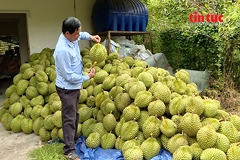
Accordingly, dragon fruit production reached 341.3 thousand tons, an increase of 3.1%; oranges reached 333.2 thousand tons, an increase of 1.2%; and mangoes reached 207.6 thousand tons, an increase of 1.8% compared to the same period last year. Notably, durian production recorded a 15% increase, reaching 212.9 thousand tons, as many newly planted areas officially entered the stable harvesting phase. Along with that, jackfruit production also increased by 12.8% thanks to the expansion of planted area and increased planting density in key regions.
For perennial industrial crops, coconut production reached 593.8 thousand tons (up 6%), and cashew nuts reached 208.7 thousand tons (up 5.4%) thanks to favorable weather conditions that helped the trees flower and bear fruit on time. Pepper also maintained its growth momentum of 5.3% thanks to improved production area and yield.
The livestock sector in the first quarter of 2026 continued its stable recovery, especially in the pig and poultry groups. The total pig herd nationwide is estimated to increase by 2.9%, bringing the output of live pigs for slaughter to 1.44 million tons, an increase of 4.9%. Similarly, poultry farming developed steadily with the total herd estimated to increase by 3.3%, live meat output reaching 660.8 thousand tons (an increase of 5.8%) and egg production reaching nearly 5.46 billion eggs (an increase of 4.8%). The application of biosafety farming models and supply chain linkages with large enterprises have become important factors helping the livestock industry overcome the challenges of disease outbreaks.
In the fisheries sector, aquaculture continues to play a key role as the main growth driver thanks to the expansion of intensive farming areas and the application of high technology. Total fisheries production in the first three months of the year is estimated at 2.18 million tons, an increase of 3.2%. Aquaculture production dominated with nearly 1.3 million tons (an increase of 5.4%), of which pangasius reached 450.4 thousand tons (an increase of 5.9%) and whiteleg shrimp reached 128.9 thousand tons (an increase of 8.5%). Conversely, marine fishing activities faced difficulties due to high fuel costs, resulting in only a slight increase of 0.2%, reaching 887.2 thousand tons.
Exports continue to grow despite difficulties.
March 2026 saw significant price fluctuations for agricultural products and inputs due to complex geopolitical factors. Conflicts in the Middle East disrupted fertilizer supply chains. The blockade of the Strait of Hormuz – a vital shipping route for global fertilizer supplies – drove up logistics costs.
In the domestic market, the price of Korean DAP fertilizer has increased by 50,000 VND/bag compared to the average of the first two months of the year. Livestock feed prices are also under upward pressure, rising by 7,000-12,000 VND/bag due to rising global raw material prices (corn, soybeans, wheat). This directly impacts producers' profits, while live pig prices in some areas have decreased due to sluggish consumer demand.
On the world market, white sugar prices have surged, rising nearly 30% in a month to their highest level in five months due to supply disruptions in the Strait of Hormuz. Vietnamese export rice prices remain stable at $360-$365 per ton (5% broken rice), despite a slight decrease in Indian rice prices.
Foreign trade in the agricultural sector in the first quarter of 2026 recorded a positive growth rate of 5.9%, reaching US$16.69 billion. China continued to be the largest consumer market, with its market share increasing to 22.1% and export value growth reaching 37.6%.
Among the key product groups, livestock products recorded an increase in value of US$197.7 million, up 54.3% compared to the same period last year. The production input group also reached US$834.3 million, up 56.7%. Notably, fruits and vegetables generated US$1.54 billion, up 32.1%, while seafood exports reached US$2.62 billion, up 13.3% compared to the same period last year.
Looking at individual commodities, pepper recorded increases in both volume (up 36.8%) and value (up 28.8%). Cassava and cassava products increased by 26.4% in value, with the Chinese market accounting for 94% of the market share.
On the import side, Viet Nam spent $11.91 billion (a 3.6% increase) on importing raw materials. Notably, corn imports increased by 83.4% (reaching $1 billion), soybean imports by 54.6%, and wheat imports by 40.3% to meet domestic processing needs. The United States, China, and Brazil were the three largest suppliers.
A key achievement of the industry in the first quarter was a trade surplus of US$4.78 billion, a 12% increase compared to the same period last year. Forestry, fisheries, and agricultural products were the three main export-oriented sectors. The largest surpluses were in wood and wood products (US$3.03 billion), coffee (US$2.63 billion), and shrimp (US$995.3 million).
However, the risks from input costs, especially fertilizers and animal feed, remain a challenge that needs to be addressed. Overcoming logistical disruptions in the Strait of Hormuz and diversifying export markets, reducing dependence on imported raw materials, will be crucial for Viet Nam's agriculture to maintain sustainable growth in the future.
Source: TinTucNews
Các tin khác
- U.S. to Impose Duties on Mexican, Thai, Vietnamese Chassis (03/06/2026)
- Mexican sugar producers push to scrap U.S. import quotas (03/06/2026)
- Japan launched an anti-dumping investigation into flat steel imports from three countries (03/06/2026)
- Eurochem challenges anti-dumping duties in the EU (03/06/2026)
- Pangasius prices in Viet Nam surge due to high export demand (03/06/2026)