Home
Home
 About Us


Vietnam takes advantage of FTAs for exporting agricultural products
12/12/2023 12:18
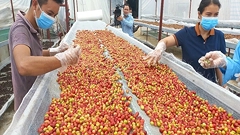
According to the Ministry of Industry and Trade, the EU-Vietnam Free Trade Agreement (EVFTA) has opened a big door for Vietnamese agricultural products to penetrate deeply into the EU market.
Specifically for rice products, Vietnam has a huge competitive advantage compared to other rice-exporting countries, such as Cambodia, Thailand, and India, thanks to preferential tariffs from EVFTA.
Besides rice, vegetables and fruits should also be mentioned that in the first eight months of 2023, exports to the EU reached 199.7 million USD, reaching 85.9% of 2022 revenue.
Thanks to EVFTA, Vietnam has eliminated up to 94% of tax lines for fruits and vegetables (there was a tax rate of 10-20%), creating a competitive advantage compared to Thailand and China.
In addition, the Comprehensive and Progressive Agreement for Trans-Pacific Partnership (CPTPP), the UK-Vietnam Free Trade Agreement (UKVFTA) and the Regional Comprehensive Economic Partnership (RCEP) agreement have also created many advantages for Vietnamese agricultural products.
The UKVFTA has helped increase the advantage of Vietnamese goods compared to ASEAN countries because many ASEAN agricultural products are similar to Vietnam's, so there is clear competition in price towards Vietnamese goods when implementing commitments in the UKVFTA.
Recently, an FTA with Israel, the first partner in West Asia, was also signed, opening up many prospects for agricultural products to exploit new markets.
However, the challenge facing Vietnamese agricultural products when exported to countries that have signed FTAs is to meet technical trade barriers (TBT), including a system of high standards and technical regulations, with many standards related to product quality, labour, the environment, reducing greenhouse gas emissions, anti-deforestation and green growth.
In the coming time, when products such as coffee and forest products are affected by the EU Anti-Deforestation Regulation (EUDR), it will create many new difficulties for export, requiring these industries to change and adapt quickly and effectively.
As for state agencies, the Ministry of Industry and Trade has proposed that the Government consider dedicating private capital to support businesses in exploiting FTAs more effectively, specifically banks with appropriate credit sources and preferential interest rates; at the same time, increasing access to green credit capital sources for businesses, to promptly meet increasing standards from export markets.
Source:Nhandan.vn
Các tin khác
- Viet Nam extends anti-dumping duties on some Thai sugar products to 2031 (05/06/2026)
- Hong Kong: Ministry of Commerce Rules on Inheritance of Anti-dumping Duty Rates for Copolymer Polyoxymethylene Imports Originating from S Korea, Thailand and Malaysia (05/06/2026)
- Early-season Vietnamese lychees conquer US consumers (05/06/2026)
- Global rubber prices surge, raising hopes for Vietnamese exporters (05/06/2026)
- Modern logistics creates new growth opportunities for Lang Son’s border-gate economy (05/06/2026)