Home
Home
 About Us



Viet Nam's textile and garment industry: What can be done to overcome the challenges from the EU market?
10/12/2025 02:15
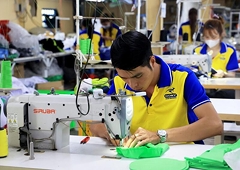
"Greening" production is a solution for Vietnamese textile and garment businesses to improve quality and competitiveness in order to sustainably "conquer" the European market.
Viet Nam's textile and garment industry, which has an export turnover of more than 40 billion USD/year and creates jobs for more than 2.5 million workers, is facing higher requirements on origin and environment from demanding markets such as the EU. Mr. Hoang Xuan Hiep - Principal of Hanoi University of Industry and Commerce shared about this issue with Cong Thuong Newspaper.
There is ample room for Vietnamese textiles and garments to enter the EU market.
- Sir, in the context of strict requirements and demands on product quality from international markets such as the US and EU, what do you think about the competitiveness of Viet Nam's textile and garment industry?
Mr. Hoang Xuan Hiep : It can be clearly seen that the Vietnamese textile industry is competing fairly with the world textile industry. This is clearly shown when textile exports in July and August 2025 grew strongly, reaching a 2-month export level of more than 4.4 billion USD.
In the US market, the market share of the Vietnamese textile and garment industry has risen to about 21-22%, while China's market share has decreased. Considering the data of 9-10 months in 2025, the US market still accounts for over 40% of Viet Nam's textile and garment export turnover. This shows that the competitiveness of the Vietnamese textile and garment industry in the US has not decreased but is on an upward trend.
In the EU market alone, annual imports are about 250 billion USD (excluding intra-bloc imports of nearly 100 billion USD). The market share of the Vietnamese textile and garment industry exported to the EU is about 4.5 - 4.7 billion USD, equivalent to 10 - 11% of the market share. Meanwhile, the market share of other countries in the EU is still very large, such as China over 22% or Bangladesh about 21 - 23%. This shows that the room for the Vietnamese textile and garment industry to enter the EU is still very good.
- For the EU market, the EVFTA has "paved the way" for textiles and garments to conquer this potential market, but many small and medium enterprises still face barriers regarding rules of origin, labor and environment. What is your opinion on this issue?
Mr. Hoang Xuan Hiep : Of the total of more than 14,000 enterprises in the textile and garment industry, 80-88% are enterprises with less than 200 employees. With such a scale, limited capital, finance and human resources, they will face great difficulties when exporting to demanding markets such as the EU.
However, there is a solution. Many countries with developed textile and garment industries such as China have used the model of large textile and garment industrial parks to solve the difficulties of exporting to any market, including the European market. If Viet Nam has 5-7 industrial parks, with an export level of about 7 billion USD/year, it will help us achieve the export target of 70 billion USD by 2030.
Accordingly, we can organize a concentrated model of garment enterprises, yarn enterprises, and textile enterprises with a scale of about 500 hectares, 70,000 workers, and a capacity of 1 billion meters of fabric/year (equivalent to 700 million shirts). When entering the industrial park, small enterprises will benefit from centralized wastewater treatment, logistics infrastructure, human resource training, BSCI standards on social responsibility... Thus, they will easily satisfy European standards of origin, labor, and environment.
However, if we want to have such a large industrial park or want to invest in green production, we must have capital and many support policies, because investment in green production must be higher than normal investment. Thus, the cost will be pushed up, on the other hand, investment will increase but if we cannot establish risk management at the output, businesses, especially small and medium enterprises, will face even more risks.
Applying new technologies to improve productivity.
- In the context of increasingly strict "green" requirements from the European market, in your opinion, what solutions should textile and garment enterprises prioritize to promote exports and maintain competitiveness?
Mr. Hoang Xuan Hiep : To take advantage of the EVFTA Agreement, promote textile and garment exports to the EU market, we must improve productivity and quality. In fact, compared to the competitiveness of some countries such as Bangladesh, we have very little advantage when Bangladesh's tax on the EU market is 0 while Viet Nam's tax is 9.6%. In addition, the income of Bangladeshi workers is only about 100 USD/month, while the income of Vietnamese garment workers is now nearly 400 USD/month.
Thus, businesses must apply tools to demonstrate green transformation, focusing on investing in factories that meet green standards. For example, using 30% renewable energy, or using water engines, using small engines to reduce emissions... Along with that, businesses must also prepare a digital passport system, which requires garment enterprises to have a certain digital platform at the level of being able to trace all raw materials from input, production process, and export to be able to meet the requirements of the European market.
- In the face of the trend of "greening" the supply chain, does the School have any specific programs or action plans on training, research, and support for textile and garment enterprises to meet EU criteria?
Mr. Hoang Xuan Hiep : Training must come from the human resource needs of businesses and the economy, especially in the context of strong digital transformation and green transformation. Accordingly, human resource training today needs to focus on three factors: innovating training programs, improving the capacity of teaching staff and training facilities.
Regarding the training program, the School has integrated many digital and green skills into the student curriculum. For example, fashion students learn 3D design with recycled materials in a virtual environment, from which they can work directly with foreign customers. For the fiber, weaving and dyeing industry, students are trained in low-emission technologies in line with sustainable production trends.
For teaching activities, the teaching staff is required to fully update regulations related to the origin of goods, quality requirements from design, color to strict standards of the European market. At the same time, the lecturers also carry out research activities, apply digital transformation, digital technology and green transformation to improve productivity, meet the requirements of sustainable supply chains, including the European market.
In terms of facilities, the School focuses on building a modern training foundation. Smart factory models are included in the curriculum, along with competitions on recycling, product design or building a sharing economy model. These are all important foundations to help students access practice, form digital skills and green skills, essential requirements for human resources in the current period.
Source: Industry and Trade News
Các tin khác
- U.S. to Impose Duties on Mexican, Thai, Vietnamese Chassis (03/06/2026)
- Mexican sugar producers push to scrap U.S. import quotas (03/06/2026)
- Japan launched an anti-dumping investigation into flat steel imports from three countries (03/06/2026)
- Eurochem challenges anti-dumping duties in the EU (03/06/2026)
- Pangasius prices in Viet Nam surge due to high export demand (03/06/2026)