Home
Home
 About Us



Viet Nam's low-emission rice conquers many demanding markets
03/11/2025 11:14
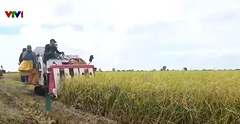
Emission-reducing rice cultivation helps farmers increase profits, Vietnamese green rice achieves high prices and expands export markets.
Low-emission farming - A trend in rice cultivation
Reducing 8 - 11 million tons of CO₂ equivalent/year - this is the goal of the Project "Production of emission reduction in the crop sector in the period 2025-2035, vision to 2050" that the Ministry of Agriculture and Environment has just announced. To achieve the above figures, consensus and implementation from the farmers themselves is needed. The models of emission reduction farming in the fields of the West are proof of that.
Mr. Nguyen Danh Dung (Director of Tien Dung Cooperative, Can Tho City) boldly participated in the project of rice cultivation to reduce emissions to serve the sustainable development of the rice export area of the Mekong Delta. By synchronously applying solutions to reduce seeds, cluster sowing, and burying fertilizer - which were previously considered impossible, he and other participating households have significantly reduced input costs.
"The normal cost for 1,300 square meters is 3 million. The cost of my model is about 2 million," said Mr. Dung.
The project was coordinated by the National Agricultural Extension Center in the provinces and cities of the Mekong Delta. After 2 years of implementation, the amount of seeds sown was reduced by nearly half compared to the traditional amount. The amount of fertilizer was reduced by 19 - 35%. Meanwhile, the average yield of 2 crops reached nearly 7.5 tons/ha, increasing over the control area and exceeding the project's plan of 1.3 tons/ha. Combining all factors, the average profit reached nearly 32 million VND/ha.
The project implemented 6 models with 300 hectares in 2 consecutive crops: Winter-Spring and Summer-Autumn. In addition to economic efficiency and profits, greenhouse gas emissions were significantly reduced. With 100% of straw collected mechanized, ending the burning of fields; combined with reasonable water regulation, there was a model that reduced nearly 12 tons of CO2/ha.
Mr. Luong Van Nhon - Member of Vinacam Cooperative, An Giang province said: "I like this model because it produces high quality rice and reduces emissions. In the past, we used to burn the fields, but now we have straw rolling and chopping machines."
"People are very excited about mechanization. I think that applying high and advanced technology like now in farming will reduce emissions very well and bring high profits to people," said Ms. Huynh Kim Dinh - Deputy Director of the National Agricultural Extension Center.
Piloting and expanding the area of high-quality, low-emission rice is the goal that the project aims for. This also contributes to the early replication of the 1 million hectare project that the Ministry of Agriculture and Environment is implementing in the Mekong Delta. This is an inevitable trend, helping rice cultivation develop sustainably, meeting the demand for high-value rice exports.
Low-emission rice sells for a high price
820 USD/ton is an impressive figure for a batch of low-emission rice from Viet Nam that was recently exported to Japan. According to the Ministry of Agriculture and Environment, when agricultural products are produced in a way that reduces emissions, has environmental certification and traceability, Vietnamese agricultural products can access high-value markets such as the EU, Japan, and North America, with prices 10 to 25% higher than conventional products.
In addition to Japan, Viet Nam's low-emission rice has also conquered many other demanding markets. This not only affirms the effectiveness of the green - clean - circular production process but also demonstrates the strong commitment of the Vietnamese rice industry to international friends in developing in a sustainable direction.
Currently, there are 7 units granted Certificates of Right to Use the Low Emission Green Vietnamese Rice Brand, under the program of one million hectares of high-quality rice, with an output of more than 19,000 tons this year.
Green rice increases competitiveness in the market
Over the years, Vietnamese rice has established a certain position in the world market in terms of both output and quality. With the certification of green, low-emission Vietnamese rice, it will further enhance its reputation and increase its competitiveness in the coming time.
Tan Long Group is one of the units that has been granted the label of low-emission green Vietnamese rice. This is the result of many years of pursuing clean and safe production processes. All stemming from the needs of world consumers.
Mr. Truong Manh Linh - Executive Director of Rice Industry, Tan Long Group shared: "The requirement is to have a stable source of goods and the quality as well as the standard requirements are very strict. For example, Japan must pass tests on pesticide residues with nearly 600 substances".
When ensuring standards, the selling price must also be high and stable. This is also a way to increase the value of Vietnamese rice. In fact, although the output of this type of rice is still modest, it has created a great opportunity for businesses to expand the market in the high-end segment.
"Businesses have the right to be proud that our products have been certified, so our quality is better, and we have the right to put prices on rice products. Rice farmers also have better incomes," said Mr. Do Ha Nam - Chairman of the Viet Nam Food Association.
Mr. Le Thanh Tung - Vice President of Viet Nam Rice Industry Association shared: "Enterprises participating here will have links, cooperation, and contracts with cooperatives according to the requirements set out to get the product. This product will be certified".
Farmers are now accustomed to cultivating according to the requirements of businesses. Thanks to that, the quality of goods meets the standards of partners, no matter how strict. In return, the value of rice grains and the income of rice growers themselves will be raised and sustainable.
Source: VTV
Các tin khác
- U.S. to Impose Duties on Mexican, Thai, Vietnamese Chassis (03/06/2026)
- Mexican sugar producers push to scrap U.S. import quotas (03/06/2026)
- Japan launched an anti-dumping investigation into flat steel imports from three countries (03/06/2026)
- Eurochem challenges anti-dumping duties in the EU (03/06/2026)
- Pangasius prices in Viet Nam surge due to high export demand (03/06/2026)