Home
Home
 About Us



Viet Nam's coffee industry is transitioning to a green ecosystem, with exports reaching $8.92 billion
08/04/2026 08:26
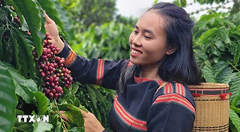
With record export revenue of $8.92 billion in 2025, Viet Nam's coffee industry is shifting from a linear model to a circular and regenerative ecosystem.
The Vietnamese coffee industry is facing a historic opportunity to comprehensively transform its production model, shifting from a traditional exploitation mindset to a green coffee ecosystem. This is a core strategy aimed at optimizing value through a circular economy and repositioning Vietnamese coffee on the global trade map.
Record growth in export value
2025 marks a significant milestone as Viet Nam's coffee exports are expected to reach approximately 1.6 million tons, generating revenue of up to US$8.92 billion. Notably, the average export price has exceeded US$5,600 per ton, indicating a clear shift towards focusing on high value-added products rather than simply selling raw materials.
Europe is currently Viet Nam's main consumer market. Countries such as Germany, Italy, and Spain are not only increasing import volumes but also accepting higher prices to ensure stable supply and meet stringent sustainability standards.
Blue ecosystems: Circular thinking and regeneration
The blue coffee ecosystem is built on Gunter Pauli's economic model, shifting from a "harvest-process" logic to a "regeneration-circulation" one. Instead of focusing solely on coffee beans, this model maximizes the utilization of the entire biomass of the coffee plant.
- Optimizing by-products:Coffee grounds, husks, and wastewater are transformed into resources for the food, biomaterials, energy, and organic fertilizer industries.
- Reduce emissions:Implementing circular processes significantly reduces greenhouse gas emissions and environmental waste.
- Increase your competitive advantage:Products from the recycling model meet the green consumer trend, helping businesses penetrate deeper into high-end market segments.
Challenges from climate change in the Central Highlands
Despite achieving impressive figures, the coffee industry is still facing significant risks from climate change, especially in the Central Highlands region. Prolonged droughts and extreme weather events are directly threatening yields and increasing farming costs.
The old linear production model with its overuse of chemical fertilizers is gradually revealing serious limitations. To maintain its position as a coffee powerhouse, adopting a green economic model is no longer an option but a pressing requirement for adaptation and sustainable development.
Global strategic vision
The transition to a green ecosystem not only helps protect natural resources but also allows Viet Nam to participate more deeply in shaping the rules of the game in the global coffee industry. The combination of regenerative agriculture, advanced processing technology, and international sustainability standards will be the foundation for Vietnamese coffee to reach new milestones in value in the future.
Source: NgheAnNews
Các tin khác
- U.S. to Impose Duties on Mexican, Thai, Vietnamese Chassis (03/06/2026)
- Mexican sugar producers push to scrap U.S. import quotas (03/06/2026)
- Japan launched an anti-dumping investigation into flat steel imports from three countries (03/06/2026)
- Eurochem challenges anti-dumping duties in the EU (03/06/2026)
- Pangasius prices in Viet Nam surge due to high export demand (03/06/2026)