Home
Home
 About Us



US And India Make Their Citizens Poorer With Anti-Dumping Steel Tariffs
10/08/2016 12:00
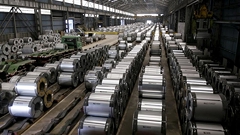
It shouldn’t be that a government does this, takes an action which deliberately and specifically makes its own citizens poorer, but it’s a remarkably common action that governments do take. For such is the power of the misundertanding of trade that protectionism will win out.The essential point to understand about trade is that it is the imports which make us richer. And the cheaper those imports are the richer we become. Placing import tariffs upon things which make us richer is thus somewhere between very stupid and lunatic. And yet that is what the governments of both the US and India have just done. Placed import duties upon certain types of steel on the grounds that it is too cheap, makes their own citizens too much richer. This is not sensible:
NEW YORK (Scrap Register): Final anti-dumping duties on hot rolled coil steel imports were imposed by The US Department of Commerce from seven countries. The duty investigation results for South Korea in 2015, jumped in the final result from the preliminary ruling in January.
Those who make steel in the US are now richer as they are protected from the competition. Those who consume steel in the US are now poorer as they are now cut off from thatcheaper steel.
In order to shield the domestic steel industry from cheap imports from Japan, China, Korea, Russia, Brazil and Indonesia, the government on Monday put in place an anti-dumping duty on imports of hot-rolled flat products from these countries.
The duty has been imposed for a period of six months starting 8 August.
The Directorate General of Anti-Dumping and Allied Duties (DGAD), which operates under the ministry of commerce and industry, on 1 August had recommended an anti-dumping duty of up to $557 per tonne on imports of hot-rolled flat products, made of alloy or non-alloy steel, from the above-mentioned countries.
The same is true in India:
India on Tuesday slapped anti-dumping duty on import of hot-rolled steel products from six nations, including China and South Korea, in a bid to shield domestic manufacturers against cheaper inward shipments.
An anti-dumping duty of $474-557 per tonne was imposed on ‘hot-rolled flat products of alloy or non-alloy steel’ import from China, Japan, South Korea, Russia, Brazil and Indonesia, the Department of Revenue in the Ministry of Finance said in a notification.
We also know that the aggregate losses to consumers are higher than the aggregate gains to producers. So this really does make the country poorer as a whole. However, we also know why this happens. The political process is very much better attuned to the interests of concentrated groups than it is to the interests of the general population. And those concentrated groups are very much more interested in the subject than the general population. If you’re the owner of, or a worker at, a marginal American steel plant then you are vitally interested in cheap foreign competition and will make that interest known. If you’re one of 320 million people who will merely lose a few dollars a year from this then there are other more important things to worry about.
Thus politics bows to the concentrated interest and not the dispersed one. It is still true though that the aggregate losses are higher than the gains. Such import tariffs really do make all poorer. And thus, of course, we shouldn’t be imposing them. For making the population poorer is not a known aim of government nor politics.
NEW YORK (Scrap Register): Final anti-dumping duties on hot rolled coil steel imports were imposed by The US Department of Commerce from seven countries. The duty investigation results for South Korea in 2015, jumped in the final result from the preliminary ruling in January.
Those who make steel in the US are now richer as they are protected from the competition. Those who consume steel in the US are now poorer as they are now cut off from thatcheaper steel.
In order to shield the domestic steel industry from cheap imports from Japan, China, Korea, Russia, Brazil and Indonesia, the government on Monday put in place an anti-dumping duty on imports of hot-rolled flat products from these countries.
The duty has been imposed for a period of six months starting 8 August.
The Directorate General of Anti-Dumping and Allied Duties (DGAD), which operates under the ministry of commerce and industry, on 1 August had recommended an anti-dumping duty of up to $557 per tonne on imports of hot-rolled flat products, made of alloy or non-alloy steel, from the above-mentioned countries.
The same is true in India:
India on Tuesday slapped anti-dumping duty on import of hot-rolled steel products from six nations, including China and South Korea, in a bid to shield domestic manufacturers against cheaper inward shipments.
An anti-dumping duty of $474-557 per tonne was imposed on ‘hot-rolled flat products of alloy or non-alloy steel’ import from China, Japan, South Korea, Russia, Brazil and Indonesia, the Department of Revenue in the Ministry of Finance said in a notification.
We also know that the aggregate losses to consumers are higher than the aggregate gains to producers. So this really does make the country poorer as a whole. However, we also know why this happens. The political process is very much better attuned to the interests of concentrated groups than it is to the interests of the general population. And those concentrated groups are very much more interested in the subject than the general population. If you’re the owner of, or a worker at, a marginal American steel plant then you are vitally interested in cheap foreign competition and will make that interest known. If you’re one of 320 million people who will merely lose a few dollars a year from this then there are other more important things to worry about.
Thus politics bows to the concentrated interest and not the dispersed one. It is still true though that the aggregate losses are higher than the gains. Such import tariffs really do make all poorer. And thus, of course, we shouldn’t be imposing them. For making the population poorer is not a known aim of government nor politics.
Source: Forbes.com
Các tin khác
- New-generation FTAs open wider export opportunities to Middle East and South Asia (15/06/2026)
- Updated regulations on foreign trade management and import quotas (15/06/2026)
- Mandatory traceability for high-risk goods from July 1st: What should businesses prepare for? (15/06/2026)
- Tariff pressure is forcing businesses to restructure in order to adapt. (15/06/2026)
- Coffee Citizens model aims to lift Vietnamese value chain (15/06/2026)