Home
Home
 About Us



Urgent anti-dumping policy needed to save Bangladesh’s spinning
27/10/2025 09:57
Bangladesh’s spinning industry — the backbone of the country’s textile value chain — is grappling with mounting challenges caused by high gas prices, rising production costs, and the growing dominance of imported Indian yarns in local markets.
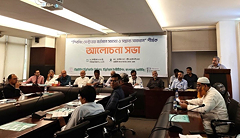
Speakers at a high-profile discussion held at the Institution of Engineers, Bangladesh (IEB) on 25 October warned that without immediate and coordinated policy support, the sector could face an existential crisis.
The event, titled “Current Challenges and Possible Solutions for the Spinning Sector,” was organized by the Textile Engineering Division of IEB at its Ramna headquarters.
The session was chaired by Engr. Mahiuddin Ahmed Selim, Chairman of the Division, while Engr. Khan Manjur Morshed, Acting President of IEB, attended as the Chief Guest.
Mosharraf Hossain, Director of BTMA and Chairman, Mosharraf Group said, “At present, Indian yarn prices are deliberately kept low — but once our spinning mills collapse, those prices will rise sharply, creating a foreign monopoly. Our spinning industry has been built brick by brick since independence, with immense risk and sacrifice from local entrepreneurs. If this sector is destroyed, the entire textile value chain will suffer. We urge policymakers to understand this reality and take immediate steps to protect our national industry.”
“The key problems of our spinning sector are high gas prices and the growing dominance of Indian yarn,” said Engr. Morshed.
“While spinning mill owners seek restrictions on Indian yarn imports, garment manufacturers prefer them for cost efficiency. A collective discussion involving all stakeholders is essential to reach a sustainable solution,” Engr. Khan Manjur Morshed added.
Unfair trade and high production costs
In his keynote presentation, Engr. Md. Abul Kalam Azad, Director of Armada Spinning Mills Ltd., emphasized that unfair trade practices, including duty-free yarn imports from India, are crippling domestic spinners.
“Bangladesh may be a leading textile exporter, but we are not among the top 15 suppliers to Europe. Indian yarn dumping is eroding our competitiveness. The government must act now to prevent the collapse of local spinning mills,” he urged.
Echoing similar concerns, Engr. Nasiruddin Mia, Director of One Composite Ltd., pointed out that the industry’s production cost has surpassed profitability.
“We are selling shirts for $1.20 when our cost is $1.55 — an unsustainable gap. The government should restore the 25% incentive for spinning mills to survive,” he said.
Efficiency, energy, and sustainability
Mahbub Milton, Executive Director of Masco Group, stressed efficiency and cost control as the way forward.
“Competition will always exist. But without lowering utility and transportation costs, sustainability will remain a distant goal,” Mahbub Milton noted.
Former Akij Group Executive Director Engr. Jamil Tipu blamed recurring crises on poor management and policy inconsistency.
“Post-independence state mills failed due to inefficiency. Today, Indian yarn dumping and gas price hikes are pushing private mills to the same fate. Renewable energy, such as solar, must now be part of the solution,” he added.
Engr. Enamul Haque, Director of Operations, Bengal NFK Textiles Ltd., highlighted financial constraints:
“Interest rates jumped from around 10% to over 13%. If loans were released before factory operations begin, mills could ease cash flow pressure significantly.”
Engr. Ahsanul Rasel, Chairman of Rah Spinning Mills Ltd., emphasized that energy instability remains the biggest bottleneck.
“Frequent power cuts cause massive wastage. If the government ensures uninterrupted utilities, our competitiveness will naturally improve,” Engr. Ahsanul Rasel said.
Afzal Hossain, Chairman of Lablu-Babul Composite Mills Ltd., warned that unregulated yarn imports threaten billions invested in backward linkage industries.
“We built our capacity to reduce import dependence, yet foreign yarns are flooding the market. Immediate policy correction is vital,” Afzal Hossain stressed.
Mosharraf Hossain, Chairman of Mosharraf Group, added:
“Gas price hikes went ahead despite our repeated concerns. Now the entire industry is paying the price. When India lowers yarn prices, our spinning mills stand idle — this must change.”
Policy and Leadership for the Future
Other key contributors included Engr. Md. Azhar Ali, CEO of Salma Group, and Engr. Ehsanul Karim Kayser, Convener of ITET, echoed the call for coordinated government support and stakeholder unity.
Distinguished guests included Dr. Julhas Uddin, Vice Chancellor of Bangladesh University of Textiles (BUTEX); Dr. Ayub Nabi Khan, Acting Vice Chancellor of BGMEA University of Fashion & Technology (BUFT); Engr. Sheikh Al Amin and Engr. Niaz Uddin Bhuiyan, Vice President of IEB; Engr. Sabbir Ahmed Osmani, Honorary Assistant General Secretary (Human Resources Development); and Engr. A.T.M. Samsuddin Khan, President of the Textile Engineers Forum.
The event concluded with a vote of thanks by Engr. Md. Saidur Rahman, Vice Chairman of the Textile Engineering Division, while Engr. Sumayel Md. Mallik conducted the session.
As participants agreed, Bangladesh’s spinning sector — once a pillar of textile self-reliance — now stands at a crossroads. Without urgent policy reform, energy relief, and protection from unfair competition, one of the nation’s most crucial value-chain segments risks unraveling.
Source: Textile Today
Các tin khác
- U.S. to Impose Duties on Mexican, Thai, Vietnamese Chassis (03/06/2026)
- Mexican sugar producers push to scrap U.S. import quotas (03/06/2026)
- Japan launched an anti-dumping investigation into flat steel imports from three countries (03/06/2026)
- Eurochem challenges anti-dumping duties in the EU (03/06/2026)
- Pangasius prices in Viet Nam surge due to high export demand (03/06/2026)