Home
Home
 About Us



Tuna exports face pressure from technical barriers and costs
20/03/2026 02:33
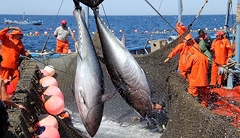
Following positive growth in January, Viet Nam's tuna exports began to show signs of slowing down in February 2026. The industry is facing a period of significant volatility, simultaneously under pressure from stringent technical barriers, escalating logistics costs, and fierce tariff competition in key markets.
Exports to the US have fallen sharply.
According to data from the General Department of Customs, after recording a 13% growth in January, tuna export turnover in February 2026 reached only over 53 million USD, a decrease of nearly 15% compared to the same period last year. Overall, in the first two months of the year, turnover remained almost unchanged, reflecting the tug-of-war in the market.
According to the Viet Nam Association of Seafood Processing and Export (VASEP), the US remains Viet Nam's largest tuna import market with $42 million, accounting for nearly 33% of total export value. However, this figure decreased by 15% compared to the same period in 2015. This decline in this key market has put significant pressure on the overall export pace of the entire industry.
Conversely, Vietnamese businesses are demonstrating their acumen by aggressively diversifying their markets to fill the gap. New markets are emerging with impressive growth figures: exports to Russia increased by 27%, Germany by 10%, Mexico by 36%, and notably Israel by 61%, and Chile by a staggering 111%. This shows that the strategy of exploring niche markets and regions with remaining potential is yielding positive results.
In terms of product structure, a clear shift is taking place. The group of fresh, live, and frozen tuna products (HS code 03) still accounts for the largest share (over 55%) but has decreased by nearly 4% in value.
Meanwhile, processed and canned products (HS code 18) increased by 5%. This is a general trend in the global tuna market as consumers tighten spending and prioritize products with reasonable prices, long shelf life, and high convenience.
Policy pressures and logistics costs
According to VASEP's assessment, the tuna industry's growth is currently facing three major challenges. Firstly, technical barriers from the US. From January 1, 2026, the stringent regulations of the Marine Mammal Protection Act (MMPA) from NOAA will begin to have a direct impact. Viet Nam's rejection of equivalent results for some of its fisheries means many shipments must include a Certificate of Aquatic Product (COA). This not only increases documentation costs but also prolongs customs clearance times, making US importers more cautious when choosing Vietnamese suppliers.
Secondly, logistics costs are increasing. Conflicts in the Middle East have caused war risk insurance premiums for maritime transport to skyrocket, in some cases increasing by more than 1,000%. Combined with soaring fuel prices, business profit margins are being significantly eroded due to higher freight rates and surcharges, especially on routes to Europe and North Africa.
Thirdly, there is pressure on raw materials. The decline in catch yields at major fishing grounds in the first quarter of the year has kept the price of skipjack tuna raw materials high (US$1,600–1,700/ton). This puts processing plants in a difficult position as input costs are high but output demand has not yet recovered uniformly.
Furthermore, in the long term, a variable to consider is the completion of the trade agreement between the EU and India by the end of January 2026. The roadmap to reduce tariffs to 0% over the next seven years for Indian seafood will directly threaten Viet Nam's tariff advantages in the EU. As the tariff gap narrows, price competition will become more intense than ever.
"Overall, the first two months of 2026 show that the Vietnamese tuna market is in a state of fluctuation. The upward trend in January indicates that the market still has room for growth, but the slowdown in February is a reminder that the growth of the tuna industry this year will increasingly depend on the ability of businesses to adapt to policies, control costs, and restructure the market, rather than simply on a recovery in demand," VASEP assessed.
Source: Vietnam Business News
Các tin khác
- U.S. to Impose Duties on Mexican, Thai, Vietnamese Chassis (03/06/2026)
- Mexican sugar producers push to scrap U.S. import quotas (03/06/2026)
- Japan launched an anti-dumping investigation into flat steel imports from three countries (03/06/2026)
- Eurochem challenges anti-dumping duties in the EU (03/06/2026)
- Pangasius prices in Viet Nam surge due to high export demand (03/06/2026)