Home
Home
 About Us



The US has postponed tariff increases on timber, much to the relief of many Vietnamese businesses
05/01/2026 11:16
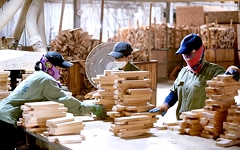
According to information from the Ministry of Industry and Trade, President Trump has signed a Proclamation adjusting import tariff policies on timber, lumber, and wood-derived products into the United States under Section 232 of the Trade Expansion Act of 1962.
Accordingly, the US decided to postpone the tariff increase on certain finished wood products, including upholstered chairs, kitchen cabinets, and bathroom cabinets, from January 1, 2026, to January 1, 2027.
According to Declaration 10976 issued in September 2025, wood products are currently subject to a 10% tariff on raw wood and a 25% tariff on processed items; this is expected to increase sharply from the beginning of 2026 to 30% and 50%, respectively.
Therefore, postponing the implementation of higher tariffs means that current tariffs will remain in place. The US stated that this decision aims to create room for ongoing trade negotiations, while also serving the goals of ensuring economic security and supply chain stability.
Notably, future tariff adjustments will depend directly on the outcome of negotiations, indicating that tariffs continue to be used as a strategic bargaining tool, rather than simply as a protectionist measure.
The Ministry of Industry and Trade believes it's important to understand that this is not a postponement of tariff imposition , but merely a postponement of tariff increases . Imported wood products into the US will still be subject to tariffs under Section 232 at rates of 10% and 25%.
Despite facing numerous challenges, Viet Nam's wood product exports to the US are expected to maintain positive growth momentum in 2025.
Therefore, this decision is significant in helping businesses in the industry avoid the tax shock right from the beginning of the year. This allows businesses to maintain orders, stabilize prices, and have more time to adjust their market strategies.
Specifically, according to information from the Ministry of Industry and Trade, the decision to postpone the tariff increase under Section 232 is completely unrelated to the final rulings of the US Supreme Court on the reciprocal tariff order, which are expected to be issued in the coming weeks.
This is because the tax under Section 232 is enacted on national security grounds and falls under executive authority, making it legally and mechanically separate from the reciprocal tax measures under the International Emergency Economic Powers Act (IEEPA).
Therefore, regardless of any judicial adjustments relating to reciprocal taxes, the timber tariffs under Section 232 remain in effect independently.
In the medium term, the picture remains fraught with risks. This is especially true given the ongoing expansion of investigations and the application of Section 232 to many other import categories, and the possibility that tariffs will continue to be adjusted in 2026 to serve negotiating objectives or to address internal economic and political pressures.
Regarding Viet Nam's timber industry, the ministry believes that 2026 should be viewed as a period of "relative stability but not yet security," requiring close monitoring of policies, proactive dialogue with the US side, and preparation of long-term response scenarios.
Source: Tuoi Tre News
Các tin khác
- U.S. to Impose Duties on Mexican, Thai, Vietnamese Chassis (03/06/2026)
- Mexican sugar producers push to scrap U.S. import quotas (03/06/2026)
- Japan launched an anti-dumping investigation into flat steel imports from three countries (03/06/2026)
- Eurochem challenges anti-dumping duties in the EU (03/06/2026)
- Pangasius prices in Viet Nam surge due to high export demand (03/06/2026)