Home
Home
 About Us



The textile and garment industry is shifting its focus to quality growth
13/02/2026 04:14
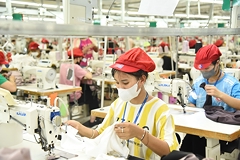
This year, the textile and garment industry aims for export turnover of 49-49.5 billion USD, an increase of approximately 8% compared to 2025. The industry's orientation is to maintain reasonable growth in production volume, focusing on improving added value, product quality, service quality, and the brand position of Vietnamese textiles and garments in the international market.
Increase productivity, maintain market share.
2025 is considered a significant milestone for the textile and garment industry, with total export turnover estimated at approximately US$46 billion, a 5.6% increase compared to 2024, thus continuing to maintain its position as the world's second-largest textile and garment exporter.
According to Truong Van Cam, Vice President of the Viet Nam Textile and Garment Association (Vitas), among the key export industries, textiles and garments currently have the highest domestic value-added ratio. It is estimated that nearly $23 billion in value is retained domestically through wages, business profits, budget contributions, and spillover effects on supporting industries.
The United States continues to be the largest export market, accounting for approximately 40% of the industry's total export value. Amidst fluctuating reciprocal tariff policies, many businesses were concerned about the risk of high tariffs. However, according to Vitas representatives, proactive adaptation and maintaining production momentum have helped businesses not only maintain market share but also capitalize on market opportunities. In 2025, textile and garment exports to the United States are still expected to reach approximately $18.6 billion, an increase of over 11% compared to the previous year.
From a business perspective, the Chairman of the Board of Directors of Viet Nam Textile and Garment Group (Vinatex), Le Tien Truong, stated that 2025 will see a clear shift towards improving the quality of growth. With approximately 150,000 employees, Vinatex achieved a combined export turnover of approximately US$4.5 billion, equivalent to about 10% of the total export turnover of the entire industry, while only employing about 6% of its workforce. This shows that the average labor productivity at Vinatex is about 30-40% higher than the industry average.
According to Vinatex leaders, this foundation for in-depth growth is creating conditions for businesses to proactively implement digital transformation and green transformation, linking economic efficiency with sustainable development, instead of merely chasing environmental standards in a formal or reactive manner.
Find motivation from internal strengths and added value.
This year, the government has set a target of 15-16% growth in export turnover. Based on the actual developments in global trade, Mr. Truong Van Cam believes that this overall target poses a significant challenge for the textile and garment industry. Currently, global trade growth only fluctuates around 2-5%, while the global textile and garment industry itself is only growing by 2-3%, leaving little room for further export expansion.
In this context, many countries that directly compete with Viet Nam are stepping up policies to support the textile and garment industry, especially those economies that are heavily dependent on this sector. This is increasing competitive pressure in the international market.
According to the Vice President of the Viet Nam Textile and Garment Association, continuing to pursue growth primarily in production volume is no longer a sustainable strategy. The textile and garment industry aims for export turnover of $49-49.5 billion in 2026, equivalent to an increase of approximately 8%. However, the focus is no longer on expanding scale, but rather on improving the quality of growth.
According to the Association's representative, the industry's direction for the coming period is to maintain reasonable growth in production volume, while focusing on increasing added value, product quality, service quality, and the brand position of Vietnamese textiles and garments in the international market.
According to Mr. Le Tien Truong, in order to contribute to the country's economic growth target of approximately 10%, the textile and garment industry's export surplus needs to reach over $24 billion by 2026. To achieve this goal, the textile and garment industry is believed to need to implement two key groups of solutions simultaneously.
First, it is necessary to develop policies and mechanisms to encourage businesses to prioritize the use of domestically sourced raw materials instead of relying on imports. Currently, importing raw materials is more advantageous because businesses do not have to pay VAT and import/export procedures are relatively simple. Conversely, when purchasing raw materials domestically, businesses have to advance VAT, pay additional purchase tax, and go through more complex procedures, reducing the incentive to use domestic sources.
Therefore, it is necessary to study and design appropriate tax policies for domestically produced raw materials used in exports. Previously, Viet Nam applied several tax incentive mechanisms, such as a 50% reduction in revenue tax for businesses, which significantly supported production and export activities.
Furthermore, to directly contribute to GDP growth, textile and garment businesses need to increase workers' incomes by approximately 10%. This requires businesses to accelerate the transformation of their production models towards automation and improve labor productivity, rather than simply expanding their workforce as before.
Mr. Le Tien Truong proposed researching a mechanism to allow a partial reduction in corporate income tax for businesses that increase employee wages by more than 10%. According to him, this policy would create more room for businesses, especially those with a large workforce and high export turnover, to both increase employee income and expand the use of domestically sourced raw materials and components.
According to industry representatives, the textile and garment industry can only make a more substantial and sustainable contribution to national economic growth when export surpluses are maintained at a high level and workers' wages increase by more than 10%.
Source: People's Deputies News
Các tin khác
- U.S. to Impose Duties on Mexican, Thai, Vietnamese Chassis (03/06/2026)
- Mexican sugar producers push to scrap U.S. import quotas (03/06/2026)
- Japan launched an anti-dumping investigation into flat steel imports from three countries (03/06/2026)
- Eurochem challenges anti-dumping duties in the EU (03/06/2026)
- Pangasius prices in Viet Nam surge due to high export demand (03/06/2026)