Home
Home
 About Us



The paradox of exporting construction materials: Freight costs are higher than the cost of the goods
06/04/2026 03:06
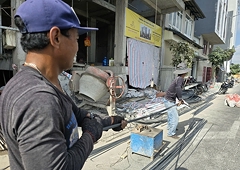
Despite recording impressive export growth, Viet Nam's construction materials industry is facing existential challenges.
A recent report from Viet Nam Report has shown that from logistics costs eroding profits to trade defense lawsuits, construction material businesses are being forced to change their management mindset.
Ironic paradox
The export materials industry is facing a paradoxical situation: goods are being produced in large quantities but cannot be transported, or are transported at exorbitant costs. According to figures, exports of cement and clinker reached over 37.3 million tons (equivalent to $1.3 billion, a 25.6% increase in volume).
While the wood and furniture product group also achieved billions of USD in export value, the joy of growth is not complete as geopolitical "missile barrages" in the Middle East are disrupting vital shipping lanes.
Particularly in the Strait of Hormuz, the need for shipping companies to take detours and the imposition of wartime surcharges have driven logistics costs to exorbitant levels. For high-volume goods with low unit value, such as cement, construction stone, or concrete, this is a "fatal blow."
According to expert analysis, the price of one ton of cement at Vietnamese ports used to be around 41-42 USD, but if freight costs to the Middle East rise to 60 USD/ton, the transportation costs would exceed the actual value of the goods. For construction stone, freight costs could even be dozens of times higher than the product value, putting the supply chain at risk of immediate disruption due to its lack of economic viability.
Besides transportation difficulties, Vietnamese construction materials also face stringent legal barriers. A prime example is the US imposing preliminary anti-dumping duties on Vietnamese reinforcing steel at very high rates, ranging from 122% to over 130%. This figure is many times higher than that of other countries under investigation, such as Egypt (34% - nearly 53%) or Bulgaria (approximately 52.8%).
The dramatic increase in steel exports to the US (from 43 tons in 2022 to 56,400 tons in 2024) has prompted local authorities to tighten safeguard measures to protect domestic production. This serves as a costly lesson about the dangers of rapid expansion without sustainable safeguard strategies and market diversification.
Response method: digital transformation and greening are mandatory
Faced with the turbulent global market, construction material businesses are being forced to reshape their strategies. A prominent trend is the shift from a growth model based on economies of scale to one based on efficiency and technology.
The survey revealed an impressive figure: 100% of participating businesses reported implementing digital transformation. Of these, 22.4% have completed the process and are now in the optimization phase, integrating technology comprehensively into their operations.
The fact that 88.9% of businesses expect to increase investment in technology in 2026 shows that digital transformation has become a vital foundation for managing costs and data.
A more effective and sustainable solution is to pursue and adhere to ESG standards, viewing them as a "passport to success." Sustainable development is no longer a distant slogan, as 92.3% of businesses identify ESG (environmental, social, and governance) as a strategic priority.
For an industry that consumes a lot of energy and resources, meeting green standards and ensuring information transparency are prerequisites for participating in global supply chains and overcoming technical barriers in demanding markets.
Speaking to Tuoi Tre Online , Mr. Dinh Hong Ky, Chairman of the Ho Chi Minh City Association of Construction and Building Materials (SACA), commented that the Vietnamese building materials industry is facing a rigorous test. Businesses capable of optimizing their supply chains, proactively responding to trade protection measures, and boldly investing in green technology will be the ones to weather the current global geopolitical and economic storm.
Internal pressures and the input cost problem.
A survey conducted by Viet Nam Report in March 2026 clearly painted a "gloomy picture" of the difficulties that construction material businesses are facing.
91.7% of businesses are concerned about force majeure events (natural disasters, epidemics). Meanwhile, 88.9% are under pressure from fluctuations in raw material prices and input costs. 66.7% face intense competition within the industry and from substitute materials, and 51.1% report an imbalance between supply and demand in the market.
The upward trend in energy prices (gasoline, diesel) due to geopolitical tensions not only drives up transportation costs but also directly increases production costs, significantly narrowing business profit margins.
Source: TuoiTreNews
Các tin khác
- U.S. to Impose Duties on Mexican, Thai, Vietnamese Chassis (03/06/2026)
- Mexican sugar producers push to scrap U.S. import quotas (03/06/2026)
- Japan launched an anti-dumping investigation into flat steel imports from three countries (03/06/2026)
- Eurochem challenges anti-dumping duties in the EU (03/06/2026)
- Pangasius prices in Viet Nam surge due to high export demand (03/06/2026)