Home
Home
 About Us



Southern industrial enterprises accelerate their operations amid supply chain pressures
15/05/2026 04:46
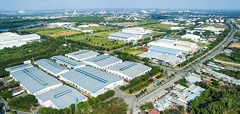
From smart factories to green manufacturing, businesses in the South are shifting their investment focus towards advanced technology.
Shifting from outsourcing to investing in advanced technology.
In many industrial plants in Southern Viet Nam today, automated robots, digital management systems, and smart production lines are gradually replacing traditional operating models. This production atmosphere shows that Vietnamese industry is entering a new phase, not just competing on cheap labor and simple outsourcing. The pressure to improve its position in the global value chain is forcing many industrial enterprises to shift strongly towards investing in technology, automation, and green production.
Speaking with a reporter from the Industry and Trade Newspaper, Mr. Bui Ta Hoang Vu, City Party Committee member and Director of the Department of Industry and Trade of Ho Chi Minh City, stated that domestic and FDI enterprises are no longer two separate sectors of development but should be viewed as two complementary components within the same industrial ecosystem.
According to Mr. Bui Ta Hoang Vu, the FDI sector continues to play a leading role in technology, modern management, international standards, and expanding export markets. However, to improve the quality of industrial growth in a sustainable direction, the long-term decisive factor remains the capacity of Vietnamese enterprises.
" If growth is based solely on processing, assembly, or dependence on the FDI sector, then domestic added value will not be high, " emphasized the Director of the Ho Chi Minh City Department of Industry and Trade.
From the perspective of industrial development businesses, Mr. Nguyen The Duy, Vice Chairman of the Board of Directors and Deputy General Director of Becamex Group, believes that Vietnamese businesses cannot continue to compete based on short-term advantages but must invest in technology, automation, digital management, and ESG standards.
When the European Union implements mechanisms like CBAM, businesses that do not reduce emissions will gradually lose their competitive advantage. This is why many businesses are stepping up energy saving, digital transformation, and building low-emission production models.
The Ministry of Industry and Trade is currently focusing on strongly promoting smart manufacturing, applying AI, IoT, and digital data in industry to increase productivity, reduce emissions, and enhance the ability of Vietnamese businesses to participate in global value chains.
In the new global industrial "race," ESG, Net Zero, and carbon emission traceability are gradually becoming the "ticket" for businesses to maintain international order chains. This forces many factories to invest more heavily in clean energy, green production, and digital management if they don't want to be left behind.
FDI enterprises expand high-tech production chains.
Alongside domestic businesses, the FDI sector continues to play a crucial role in expanding high-tech production chains and forming new industrial ecosystems in Viet Nam.
Mr. Lu Chinh Minh, General Director of Tripod Electronics Viet Nam, stated that Viet Nam has become one of the world's important centers for electronics and PCB (printed circuit board) manufacturing thanks to its stable political environment, young workforce, and advantages from free trade agreements. PCB factories are now strongly shifting towards green manufacturing models with standards such as ESG, RBA, ISO 14001, and ISO 45001; while also promoting automation, energy management, and carbon emission monitoring to meet the requirements of global customers.
Currently, the company is focusing its investment on PCBs for AI servers, high-end HDI, high-speed PCBs, and smart factory models. It is projected that by 2026, the company will recruit approximately 2,500 highly skilled and specialized technical workers, while investing around $250 million in production equipment. Annual export value is expected to reach around $200 million, contributing to enhancing Viet Nam's role in the global electronics and AI supply chain.
According to Mr. Bui Ta Hoang Vu, one of the major "bottlenecks" today is that domestic enterprises have not yet mastered core technologies and source technologies in many key industries; the technological content in products remains mainly at a medium to low level. The ability to link domestic enterprises with FDI enterprises is also limited, while Viet Nam still lacks large-scale enterprises capable of leading production chains and supply networks.
The Director of the Ho Chi Minh City Department of Industry and Trade stated that the important thing in the coming period is not choosing between domestic and FDI enterprises, but rather forming a truly interconnected ecosystem between the two sectors to increase the localization rate and enhance the value retained for the economy. It can be seen that, in the "flow" of global industrial restructuring, the transformation of industrial enterprises in the South not only reflects new competitive pressures but also demonstrates efforts to elevate the position of Vietnamese industry in the international value chain.
Source: Vietnam.vn
Các tin khác
- U.S. to Impose Duties on Mexican, Thai, Vietnamese Chassis (03/06/2026)
- Mexican sugar producers push to scrap U.S. import quotas (03/06/2026)
- Japan launched an anti-dumping investigation into flat steel imports from three countries (03/06/2026)
- Eurochem challenges anti-dumping duties in the EU (03/06/2026)
- Pangasius prices in Viet Nam surge due to high export demand (03/06/2026)