Home
Home
 About Us



Solar trade battle rejoined as European firms call on Commission to lift Chinese panel import tariffs
12/08/2015 12:00
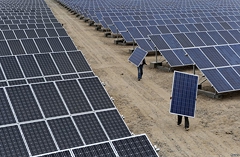
The long-running row over the EU's controversial decision to impose a Minimum Import Price (MIP) on Chinese solar panels coming into the bloc looks set to reignite, after a group of solar installers wrote to Trade Commissioner Cecilia Malmström urging the Commission to ditch its "anti-Chinese mindset".
The EU introduced anti-dumping tariffs in late 2013 in response to complaints from European solar manufacturers they were facing unfair competition from heavily subsidised Chinese solar panel producers.
The rules required Chinese manufacturers to honour a minimum import price of €0.56 per watt and annual import quota of up to 7GW. However, solar installers across Europe argued the tariffs artificially increased the price of solar panels in the bloc by 20 per cent to 30 per cent, landing a further blow on a market struggling to adapt to sharp reductions in subsidies in key markets, while doing little to aid European manufacturers.
Concern is now mounting the MIP, which was due to expire in December, will continue into 2016 and potentially 2017, if as expected the Commission launches a full review of whether to allow the policy to expire.
Fears the MIP is to be extended prompted a group of leading installers to last week write to Malmström urging her to "think again before inflicting more pain on a now fragile European sector".
The letter, which is signed by senior executives at Solarcentury, Solar Clarity, Sungevity International, BNRG Renewables Ltd, Ergo Home Energy Ltd, and Soventix GmbH, argues the policy has "put great strain on solar service providers like ourselves".
"Figures from SolarPower Europe illustrate that during the first year that the MIP raised prices, total newly-installed solar capacity in the EU shrank from 21 to 7 Gigawatts, with MIP responsible for accelerating this downward growth spiral," the letter states. "Ironically, European countries cited steep drops in prices of solar panels as justification for dismantling or cutting their feed-in tariffs; a justification only made possible by Chinese manufacturers. But as soon as these cuts were delivered, policy makers in Brussels undermined the most important element responsible for these savings by artificially boosting the price of solar panels."
It also aims criticism at those European-based solar manufacturers who led the campaign for the introduction of anti-dumping tariffs through the EU ProSun lobby group.
"The reality is that the sluggish EU solar panel industry cannot compete with the huge economies of scale of Chinese companies, even if EU policy makers give them an unfair advantage," the letter states. "What is shocking is that the EU keeps swallowing EU ProSun's narrative, so much so that the expected expiry of the MIP by the end of 2015 now looks to have been undermined again by the actions of a handful of European manufacturers to the great detriment of the vast majority of the European solar sector."
Industry insiders expect ProSun to trigger a review of the MIP before a deadline on September 6th, by submitting an appeal against the current expiry date of December 6th.
The group of solar installers also warned the MIP threatens to sour relations between the EU and China at a crucial point for international climate change negotiations. "Scapegoating China for the woes of the EU solar panel industry doesn't make any more sense than the earlier scapegoating of the renewable energy sector by traditional utilities," it states. "Given that China is absolutely pivotal for a successful conclusion of the Paris climate negotiations, nor does it make any sense to inflame the current situation further by extending the MIP into 2016."
The letter echoes a similar missive sent earlier this year to Commissioner Malmström by Dr James Watson, chief executive of the European Photovoltaic Industry Association, in which he requested a meeting to discuss the group's call for the MIP policy to be shelved at the end of this year. "You may be aware that the rate of solar installations has slowed considerably in recent years, and we are estimating that the European Union installed less than 7GW in 2014," he wrote. "We are now looking at how we can boost our sector and believe that a return to normal trade relations with China on these products could support us to achieve this." Malmström declined the request for a meeting.
As one industry insider observed, the EU is now in the "bonkers" position of calling on the renewables sector to cut costs in order to allow for ever steeper subsidy cuts, while stopping lower cost solar panels from entering the market. In addition, solar installers are being forced to develop business and investment plans without any long term certainty over precisely when the MIP will be expire. "Expiry inquiries can, and do, take over a year," said our source. "Which means this could drag on into 2017."
Meanwhile, EU ProSun appears to maintain the MIP is necessary to tackle "destructive dumping and illegal subsidies" that undermine fair trade in the solar market. It also recently called for an EU investigation into alleged breaches of the MIP rules to be extended, warning flouting of the minimum pricing rules by diverting panels through third countries could prove to be widespread.
ProSun failed to respond to a request for comment at the time of going to press. However, a European Commission spokesman confirmed Commissioner Malmström had received the latest letter and would respond in due course. He added that the MIP measures would "expire in December, unless the Commission decides to open an expiry review based on a request, which has to be duly substantiated".
It looks as if the long running row over solar subsidies, dumping, and EU-China trade relations could be about to enter a whole new phase.
The EU introduced anti-dumping tariffs in late 2013 in response to complaints from European solar manufacturers they were facing unfair competition from heavily subsidised Chinese solar panel producers.
The rules required Chinese manufacturers to honour a minimum import price of €0.56 per watt and annual import quota of up to 7GW. However, solar installers across Europe argued the tariffs artificially increased the price of solar panels in the bloc by 20 per cent to 30 per cent, landing a further blow on a market struggling to adapt to sharp reductions in subsidies in key markets, while doing little to aid European manufacturers.
Concern is now mounting the MIP, which was due to expire in December, will continue into 2016 and potentially 2017, if as expected the Commission launches a full review of whether to allow the policy to expire.
Fears the MIP is to be extended prompted a group of leading installers to last week write to Malmström urging her to "think again before inflicting more pain on a now fragile European sector".
The letter, which is signed by senior executives at Solarcentury, Solar Clarity, Sungevity International, BNRG Renewables Ltd, Ergo Home Energy Ltd, and Soventix GmbH, argues the policy has "put great strain on solar service providers like ourselves".
"Figures from SolarPower Europe illustrate that during the first year that the MIP raised prices, total newly-installed solar capacity in the EU shrank from 21 to 7 Gigawatts, with MIP responsible for accelerating this downward growth spiral," the letter states. "Ironically, European countries cited steep drops in prices of solar panels as justification for dismantling or cutting their feed-in tariffs; a justification only made possible by Chinese manufacturers. But as soon as these cuts were delivered, policy makers in Brussels undermined the most important element responsible for these savings by artificially boosting the price of solar panels."
It also aims criticism at those European-based solar manufacturers who led the campaign for the introduction of anti-dumping tariffs through the EU ProSun lobby group.
"The reality is that the sluggish EU solar panel industry cannot compete with the huge economies of scale of Chinese companies, even if EU policy makers give them an unfair advantage," the letter states. "What is shocking is that the EU keeps swallowing EU ProSun's narrative, so much so that the expected expiry of the MIP by the end of 2015 now looks to have been undermined again by the actions of a handful of European manufacturers to the great detriment of the vast majority of the European solar sector."
Industry insiders expect ProSun to trigger a review of the MIP before a deadline on September 6th, by submitting an appeal against the current expiry date of December 6th.
The group of solar installers also warned the MIP threatens to sour relations between the EU and China at a crucial point for international climate change negotiations. "Scapegoating China for the woes of the EU solar panel industry doesn't make any more sense than the earlier scapegoating of the renewable energy sector by traditional utilities," it states. "Given that China is absolutely pivotal for a successful conclusion of the Paris climate negotiations, nor does it make any sense to inflame the current situation further by extending the MIP into 2016."
The letter echoes a similar missive sent earlier this year to Commissioner Malmström by Dr James Watson, chief executive of the European Photovoltaic Industry Association, in which he requested a meeting to discuss the group's call for the MIP policy to be shelved at the end of this year. "You may be aware that the rate of solar installations has slowed considerably in recent years, and we are estimating that the European Union installed less than 7GW in 2014," he wrote. "We are now looking at how we can boost our sector and believe that a return to normal trade relations with China on these products could support us to achieve this." Malmström declined the request for a meeting.
As one industry insider observed, the EU is now in the "bonkers" position of calling on the renewables sector to cut costs in order to allow for ever steeper subsidy cuts, while stopping lower cost solar panels from entering the market. In addition, solar installers are being forced to develop business and investment plans without any long term certainty over precisely when the MIP will be expire. "Expiry inquiries can, and do, take over a year," said our source. "Which means this could drag on into 2017."
Meanwhile, EU ProSun appears to maintain the MIP is necessary to tackle "destructive dumping and illegal subsidies" that undermine fair trade in the solar market. It also recently called for an EU investigation into alleged breaches of the MIP rules to be extended, warning flouting of the minimum pricing rules by diverting panels through third countries could prove to be widespread.
ProSun failed to respond to a request for comment at the time of going to press. However, a European Commission spokesman confirmed Commissioner Malmström had received the latest letter and would respond in due course. He added that the MIP measures would "expire in December, unless the Commission decides to open an expiry review based on a request, which has to be duly substantiated".
It looks as if the long running row over solar subsidies, dumping, and EU-China trade relations could be about to enter a whole new phase.
Aug 6, 2015
Source: businessgreen.com
Source: businessgreen.com
| Tải tài liệu | |
|---|---|
| 150806 Solar trade battle rejoined | |
Các tin khác
- New-generation FTAs open wider export opportunities to Middle East and South Asia (15/06/2026)
- Updated regulations on foreign trade management and import quotas (15/06/2026)
- Mandatory traceability for high-risk goods from July 1st: What should businesses prepare for? (15/06/2026)
- Tariff pressure is forcing businesses to restructure in order to adapt. (15/06/2026)
- Coffee Citizens model aims to lift Vietnamese value chain (15/06/2026)