Home
Home
 About Us


Shaping the approach to the South American market for Vietnamese businesses
08/04/2026 08:36
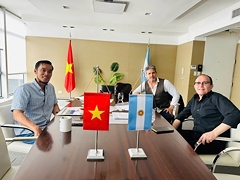
Amidst a volatile international market and Argentina's gradual opening up and adjustment of its economic policies towards greater openness, the Vietnamese Trade Office in Argentina continues to affirm its role as a strategic bridge, promoting bilateral trade cooperation in a proactive, substantive, and effective manner, with businesses at its center.
In an effort to expand market share and support Vietnamese businesses in penetrating deeper into the South American region, on April 1, 2026, the Trade Office held a meeting with Mr. Gustavo A. Maniera Diaz – an economic expert with over 40 years of experience in infrastructure and food projects in Europe, India, and the Mercosur bloc, and Mr. Arien Gosmez – Director of an oil and cosmetics business in Argentina. The meeting went beyond mere trade exchanges and opened up "green pathways" to help Vietnamese goods access multinational international supply networks.
At the meeting, Mr. Ngo Manh Khoi, Head of the Trade Office, stated that the Trade Office's role is to act as a bridge between the Government and businesses, promoting trade and investment cooperation, and supporting businesses in accessing markets by providing information, strategic guidance, market analysis, and guidance on import procedures and standards. In addition, the Trade Office provides information on market regulations, assists in partner due diligence, warns of risks; promotes trade, expands the network at Mercosur; and monitors and supports the assurance of transparent and secure transactions. In particular, the Trade Office plays a crucial role in building trust and providing long-term support, becoming a strategic partner for Vietnamese businesses in Argentina in particular and South America in general.
Sharing his views at the meeting, Mr. Gustavo A. Maniera Diaz stated that the opportunities in South America are clear, but the decisive factor lies not in the market itself but in the approach: “Businesses need to proceed step by step, starting with small orders, standardizing processes, and building trust before scaling up.” Concurring with this view, Mr. Arien Gosmez emphasized that transparency and professionalism in transactions, especially in technical and payment aspects, will be key for foreign businesses to sustainably participate in the regional supply chain.
From practical exchanges, it can be seen that Argentina, despite some remaining barriers such as logistics costs, domestic taxes, and price competition in agricultural products, is also opening up many noteworthy opportunities. The government is gradually removing difficulties and improving the investment and trade environment; logistics infrastructure, especially the port system, is being developed to serve large-scale exports. At the same time, the demand for international cooperation in the fields of agriculture, minerals, energy, and construction is increasing, creating a foundation for Argentina to enhance its position in the global supply chain. Logistics projects connecting to Asia, especially with large markets such as India, China, and Southeast Asia, are attracting the attention of many investors, opening up significant cooperation opportunities for Vietnamese businesses.
In this context, the Trade Office clearly demonstrates its central role by proactively connecting Vietnamese businesses with reputable partners, while also guiding them towards a systematic market access strategy. The Trade Office supports businesses in selecting supply sources and international transaction methods such as FOB (Free On Board – the buyer bears the costs and risks of transportation from the port of departure), CIF (Cost, Insurance, and Transportation to the port of destination), and secure payment mechanisms like L/C (Letter of Credit – the bank commits to paying the seller upon fulfillment of all contract conditions); it also recommends implementing strategies ranging from trial orders to long-term contracts to ensure stability and efficiency. This flexible approach, particularly in connecting multiple supply sources from Argentina, Brazil, Paraguay, Chile, etc., helps businesses optimize costs, enhance competitiveness, and minimize risks.
A key highlight is the consensus on long-term collaborative thinking: all parties recognize that this is a field requiring perseverance, transparency, and professionalism, not short-term profit. Implementation needs to proceed from small to large scale, with strict quality control, processes, and standardized technical information from the outset to mitigate risks and improve transaction efficiency.
Based on these guidelines, many specific cooperation prospects are gradually emerging, including the export of agricultural products (corn, sugar, nuts, processed foods), connecting multinational supply chains, logistics cooperation, port infrastructure development, as well as attracting investment in the construction, materials, and energy sectors. The Trade Office will continue to play a central role with a consistent orientation: connecting with the right partners, targeting the right markets, and implementing the right models, thereby supporting Vietnamese businesses to participate more deeply in the global value chain.
In addition to strategic discussions, the Vietnamese Trade Office in Argentina also introduced and invited partners to participate in the Sourcing Vietnam 2026 event, to be held in September. Mr. Gustavo A. Maniera Diaz and Mr. Arien Gosmez expressed interest and are in the process of registering, and also stated that they would forward the information to businesses in their network for further connection. The partners also requested the Trade Office to promptly provide a list of Vietnamese businesses participating in the fair to assess their suitability and optimize cooperation effectiveness.
Immediately after the meeting, the Trade Office and its partners established a joint working group to specify key product categories. Standardizing technical sheets, combined with secure international payment methods such as Letters of Credit (L/C) and CIF/FOB delivery terms, has created a transparent operational process, enabling domestic businesses to directly access raw materials at competitive costs. This is a practical step in supporting businesses, gradually transforming cooperation potential into concrete transactions, contributing to the stability of the supply chain and promoting sustainable development of Vietnam-Argentina trade.
Source: MOIT
Các tin khác
- U.S. to Impose Duties on Mexican, Thai, Vietnamese Chassis (03/06/2026)
- Mexican sugar producers push to scrap U.S. import quotas (03/06/2026)
- Japan launched an anti-dumping investigation into flat steel imports from three countries (03/06/2026)
- Eurochem challenges anti-dumping duties in the EU (03/06/2026)
- Pangasius prices in Viet Nam surge due to high export demand (03/06/2026)