Home
Home
 About Us


Seafood exports: Diversifying markets to minimize risks
03/04/2026 05:59
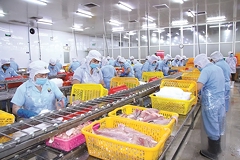
Viet Nam's seafood exports have room for growth in 2026 thanks to gradually recovering global consumer demand and advantages from free trade agreements (FTAs). However, this prospect largely depends on the ability of businesses to adapt to geopolitical fluctuations, logistics costs, and increasingly stringent requirements from importing markets.
Facing numerous challenges
According to information from the Import-Export Department ( Ministry of Industry and Trade ), Viet Nam's seafood export turnover in the first quarter of 2026 reached US$2.62 billion, an increase of 13.3% compared to the same period last year. This is a positive growth rate, showing that the recovery and expansion of the market is being maintained steadily.
In 2026, the fisheries sector aims to achieve export revenue of $11.5 billion. Although lower than the record level reached during the peak growth period, this figure is considered appropriate in the current international trade context, where many markets still apply technical barriers and strict requirements regarding traceability, sustainable development, and emission reduction.
The first challenge is the increased logistics costs due to geopolitical risks. Geopolitical conflicts in the Middle East have forced many international shipping routes to adjust their itineraries, especially those passing through the Red Sea region.
According to Le Hang, Deputy Secretary General of the Viet Nam Association of Seafood Processing and Export (VASEP), the shift in transportation routes has extended delivery times to Europe and the US East Coast by one to two weeks, leading to a significant increase in logistics costs. For seafood products, which are heavily reliant on the cold chain and international shipping, this increase in logistics costs not only raises product prices but also directly impacts the competitiveness of exporting businesses.
In addition, businesses are also facing pressure from trade barriers. For example, in the US market, key products such as shrimp and pangasius continue to face anti-dumping lawsuits. Although recent reviews have shown more positive signs, the tariffs applied to some businesses remain high.
Meanwhile, major markets such as the EU, Japan, and South Korea are increasingly tightening standards related to sustainable development, environmental protection, combating illegal, unreported, and unregulated (IUU) fishing, and traceability. This presents both a challenge and an impetus for businesses to improve the quality and transparency of their production chains.
Diversify markets and increase product added value.
In the context of volatile global trade, diversifying export markets is becoming a strategic requirement for Viet Nam's seafood industry. Currently, seafood exports remain heavily concentrated in a few key markets, such as the United States, the EU, China, Japan, and South Korea.
These are large markets, but they also carry risks from policy changes or declining demand. Therefore, expanding into new markets such as Brazil, South America, South Asia, or some Middle Eastern countries will help diversify risk and create more room for growth.
Given the impacts of the Middle East conflict and global trade fluctuations, experts believe the fisheries sector needs to implement a comprehensive set of solutions to maintain growth momentum. First, businesses need to proactively restructure export markets, reduce dependence on a few major markets, and simultaneously leverage FTAs to expand their markets.
Simultaneously, it is crucial to optimize logistics, diversify transportation routes and delivery methods to minimize the risk of supply chain disruptions. Close cooperation with shipping lines and logistics partners will help businesses be more flexible in the face of fluctuating transportation costs.
On the other hand, businesses need to prioritize increasing the added value of their products through deep processing and developing product lines that align with new consumer trends, such as convenience foods, green products, and sustainable products. In particular, strengthening their capacity to meet international standards on environmental protection, traceability, and social responsibility is crucial for maintaining market share in high-end markets.
According to Tran Thanh Hai, Deputy Director of the Import-Export Department (Ministry of Industry and Trade), the Department is coordinating with the system of Vietnamese trade offices abroad to continue providing market information, early warning of risks, and supporting businesses in connecting with international partners. Because, in the current volatile environment, early warning of risks, providing market information, and supporting businesses in accessing international partners will be crucial factors in helping Vietnamese seafood maintain export growth.
Close coordination between businesses, industry associations, and regulatory agencies is considered a key factor in helping the fisheries sector seize opportunities, overcome challenges, and maintain its position in the international market during this period of significant change.
Source: Vietnam.vn
Các tin khác
- U.S. to Impose Duties on Mexican, Thai, Vietnamese Chassis (03/06/2026)
- Mexican sugar producers push to scrap U.S. import quotas (03/06/2026)
- Japan launched an anti-dumping investigation into flat steel imports from three countries (03/06/2026)
- Eurochem challenges anti-dumping duties in the EU (03/06/2026)
- Pangasius prices in Viet Nam surge due to high export demand (03/06/2026)