Home
Home
 About Us



Seafood exports aim to reach $11.5 billion by 2026
09/01/2026 09:11
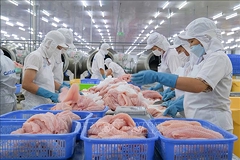
In 2026, the fisheries sector aims for a total fisheries output of over 10 million tons, an increase of 0.6% compared to 2025.
At the Conference summarizing the work of 2025 and implementing the work plan for 2026 of the Department of Fisheries and Fisheries Inspection on the afternoon of January 7th, Mr. Tran Dinh Luan, Director of the Department of Fisheries and Fisheries Inspection, emphasized that the fisheries sector will continue to reduce exploitation and increase aquaculture in a sustainable direction, adapting to climate change and enhancing competitiveness. The focus is on shifting from a production-oriented mindset to a fisheries-based economy , from single-value growth to integrated multi-value development; and effectively implementing digital transformation.
According to Mr. Tran Dinh Luan, the growth target for 2026 is set amidst many challenges, but the overarching principle of the sector is to identify each difficulty early in order to develop appropriate implementation plans. Furthermore, with the major resolutions issued, the Fisheries and Fisheries Inspection Department will continue to develop plans and coordinate closely with units within the Ministry of Agriculture and Environment to ensure the full completion of assigned tasks on schedule.
To proactively prepare for export-oriented raw material sources, the Fisheries and Fisheries Inspection Department will coordinate with localities to organize conferences to discuss solutions right from the beginning of the season, focusing on key aquaculture species and potential new species, in order to ensure the growth rate of the industry, said Mr. Tran Dinh Luan.
According to Mr. Pham Quang Toan, Deputy Director of the Department of Fisheries and Fisheries Inspection, the industry aims for a total fisheries production of over 10 million tons in 2026, an increase of 0.6% compared to 2025; of which approximately 3.75 million tons will be from fishing, a decrease of 2.1%; and 6.25 million tons from aquaculture, an increase of 2.2% compared to 2025. Fisheries export revenue is targeted at approximately 11.5 billion USD.
The fisheries sector is closely monitoring weather and market developments to promptly direct aquaculture production to achieve the 2026 targets. The focus is on developing key species such as tiger shrimp, whiteleg shrimp, and pangasius in concentrated production areas, linked to spatial planning and synchronized infrastructure; promoting industrial marine farming, offshore farming, cage farming with new materials, seaweed and mollusk farming according to green economic models. Simultaneously, it will strengthen environmental monitoring and warning systems, control diseases, expand high-tech farming, recirculating aquaculture, reduce emissions, and efficiently use water resources; tighten food safety control throughout the entire chain to meet domestic consumption and export demands.
In the fisheries sector, the industry will review and classify the system of fishing ports and mooring areas according to scale, function, and the level of compliance with requirements for managing fishing vessels, traceability, and combating illegal, unreported, and unregulated (IUU) fishing. It will assess the capacity to receive fishing vessels, unload catches, and monitor catches at designated fishing ports; in particular, it will pilot smart fishing port models linked to digital transformation in fisheries management.
The Department of Fisheries and Fisheries Inspection advises on effective management of seafood exploitation quotas, gradually reducing the number of fishing vessels, and promoting the transition of fishermen from fishing practices that harm aquatic resources and the environment to other fishing methods.
The industry continues to implement more concrete and vigorous changes from a production-oriented mindset to an economic-oriented one, shifting from single-value growth to integrated, multi-value growth. This involves focusing on reorganizing production, developing markets, building product brands, producing distinctive products, and combining with various sectors and industries to create integrated aquaculture product chains to elevate product quality. In particular, it involves gradually integrating new market demands such as circular economy, animal welfare, emission reduction, and environmental and social responsibility into aquaculture.
From an export perspective, Mr. Nguyen Hoai Nam, General Secretary of the Viet Nam Association of Seafood Processing and Export, stated that the market requires legally harvested products and aquaculture products to have registered farming areas. However, the issuance of farming area codes is still affected by planning and decentralization. Therefore, the association recommends that the Fisheries and Fisheries Inspection Department continue to cooperate and support in resolving obstacles, accelerating implementation progress, and promoting digitalization in the issuance of certificates and verification of harvested seafood, contributing to facilitating traceability.
According to the Fisheries and Aquaculture Inspection Department, the total fisheries production in 2025 is projected to reach 9.95 million tons, a 3% increase compared to 2024. Of this, fishing production will reach 3.83 million tons, equivalent to 99.8% of 2024; aquaculture production will reach 6.1 million tons, a 5.1% increase compared to 2024. Fisheries export revenue is estimated to exceed US$11 billion, a 12.7% increase compared to 2024.
Source: Tin Tuc News
Các tin khác
- U.S. to Impose Duties on Mexican, Thai, Vietnamese Chassis (03/06/2026)
- Mexican sugar producers push to scrap U.S. import quotas (03/06/2026)
- Japan launched an anti-dumping investigation into flat steel imports from three countries (03/06/2026)
- Eurochem challenges anti-dumping duties in the EU (03/06/2026)
- Pangasius prices in Viet Nam surge due to high export demand (03/06/2026)