Home
Home
 About Us



Rice export forecasts for 2026 present numerous challenges.
25/03/2026 03:16
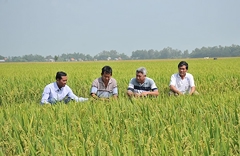
By mid-March 2026, the country is expected to export over 1.7 million tons of rice, worth approximately $826.2 million. Compared to the same period in 2025, both the export value and price have decreased. In particular, from March 2026 onwards, rice exports will face further difficulties due to conflicts in the Middle East, increasing costs by 20,000-30,000 VND per ton of rice.
On the afternoon of March 24th, in Can Tho City, the Ministry of Industry and Trade, in coordination with the People's Committee of Can Tho City, organized a conference to promote rice exports in 2026.
According to the Import-Export Department's report, as of March 15th, the country had exported over 1.7 million tons of rice, worth approximately 826.2 million USD, with an average export price of 477.6 USD/ton. Compared to the same period in 2015, this represents a 2.3% increase in volume, an 8.7% decrease in value, and a 10.7% decrease in the average export price of rice.
In the first two months of 2026, the main rice export markets were the Philippines, accounting for over 55.8% of the country's total rice exports; followed by China, accounting for approximately 14% of Viet Nam's total rice exports, reaching 178,165 tons, a 143.7% increase compared to the same period in 2025; and Ghana, accounting for over 6.8% of the country's total rice exports.
According to the Import-Export Department, some markets showed an increase, such as Malaysia and Australia. However, some markets experienced sharp declines, including Hong Kong (down over 16%), Singapore (down 31.2%), Senegal (down 53.11%), Ivory Coast (down 68.5%), and Indonesia (down 81.7%).
In the first two months of 2026, Viet Nam's rice exports were mainly white rice of various types, accounting for over 60% (of which 5% broken rice accounted for over 55.7%), with the remainder being other rice varieties; followed by fragrant rice of various types, accounting for over 25.9% of total exports, and in third place, glutinous rice, accounting for over 4.5% of total exports.
According to data from the Customs Department, Viet Nam's rice exports in early 2026 are expected to grow by approximately 2.3% compared to the same period in 2025. Rice exports are also driven by increased import demand (in the first two months of the year) from several of Viet Nam's traditional markets, such as the Philippines, China, and Malaysia.
Leaders of the Can Tho City People's Committee visited the rice exhibition booths at the conference.
However, rice exports in the first two months of 2026 recorded a decline from the African market after achieving impressive growth in 2025, such as: the Ivory Coast market decreased by 68.5%, and the Ghana market decreased by 22.7%.
According to the Import-Export Department, in the coming period, Viet Nam's rice export activities will be affected by many factors, such as: the Philippines, China, Bangladesh, and Africa resuming imports; competitive pressure from major rice exporting countries such as Thailand, India, and Pakistan; and the increasingly improved quality of Vietnamese rice exports, enhancing Vietnam's competitiveness in the world market .
In particular, since March, Vietnamese rice exports to markets affected by the recent conflict in the Middle East have led to increased international logistics costs (increased insurance, extended shipping times of 10-15 days), tighter input supply, increased costs (fertilizers, oil prices), and domestic transportation costs of 20,000-30,000 VND per ton of rice.
Viet Nam's rice exports have faced further difficulties since the Middle East conflict erupted at the end of February.
In response to this situation, the Prime Minister issued Official Dispatch No. 21 on managing rice production and consumption in the new context. The following day, the Ministry of Industry and Trade issued Directive No. 08 on strengthening the implementation of tasks and solutions to promote rice production and export in the new situation. Simultaneously, the Ministry of Industry and Trade is developing a plan and coordinating with the Ministry of Agriculture and Environment and the People's Committees of localities to inspect the implementation of rice procurement, import, and export.
This was also the central topic for experts, rice exporting businesses, and leaders of the Ministry of Industry and Trade and the People's Committees of localities in the Mekong Delta to focus on discussing and finding solutions to promote rice exports in 2026 to achieve expected results, such as: doing a good job of understanding the market and proactively expanding rice export markets; supporting preferential loan packages for rice exporting businesses; having loan programs to directly support rice farmers and cooperatives in a green, low-emission direction, contributing to the formation of a sustainable agricultural development linked to environmental protection…
The Ministry of Agriculture and Environment forecasts that in 2026, the amount of paddy rice available for export will be approximately 15.46 million tons, equivalent to 7.73 million tons of commercial rice.
In addition to the policies and plans mentioned above, the Ministry of Industry and Trade is reviewing the rice export activities of traders and will revoke the Certificate of Eligibility for Rice Export Business for cases where traders do not export rice for 18 consecutive months.
According to a report by the Ministry of Agriculture and Environment, the rice planting area in 2026 will be over 7 million hectares, a decrease of 36.1 thousand hectares; the estimated production will reach 43.5 million tons, an increase of 12,000 tons compared to 2025. Of this, the amount of paddy rice for export in 2026 will be approximately 15.46 million tons, equivalent to 7.73 million tons of commercial rice. Specifically, the amount of commercial rice in the first six months of 2026 is forecast to be over 4 million tons; in the last six months of 2026, the projected amount will be...
The report stated approximately 3.716 million tons.
Meanwhile, in 2026, Thailand is expected to export 7.2 million tons, although this is a decrease of 300,000 tons compared to the previous forecast. Other countries such as Pakistan will export 4.8 million tons, India 25 million tons, and Cambodia 4 million tons. Given this abundant rice supply, Viet Nam's rice export activities in 2026 will face many challenges.
Các tin khác
- U.S. to Impose Duties on Mexican, Thai, Vietnamese Chassis (03/06/2026)
- Mexican sugar producers push to scrap U.S. import quotas (03/06/2026)
- Japan launched an anti-dumping investigation into flat steel imports from three countries (03/06/2026)
- Eurochem challenges anti-dumping duties in the EU (03/06/2026)
- Pangasius prices in Viet Nam surge due to high export demand (03/06/2026)