Home
Home
 About Us


Platform to bring seafood to the 11 billion USD mark
10/12/2025 02:20
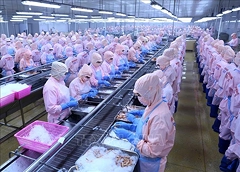
As global consumers shift to prioritizing convenient, safe and sustainable products, Vietnamese seafood is adapting quickly by upgrading the value chain and promoting deep processing.
Although global trade remains volatile, seafood exports still recorded good growth, creating a foundation for the whole year to reach the 11 billion USD mark and opening up prospects for expanding market share in the world's most demanding markets.
With a market expansion strategy, the value of seafood exports in the first 11 months of 2025 reached US$10.38 billion, an increase of over 13% compared to the same period last year. Shrimp – the main product – continued to assert its position with a growth rate of over 20%. Notably, exports to most major markets increased; China was a bright spot thanks to strong demand for live, fresh, and frozen shrimp. Experts predict that China's shrimp imports will continue to increase to serve the festive season and the Lunar New Year 2026, especially in the high-end product segment such as live shrimp, lobster, and large tiger shrimp. The Comprehensive and Progressive Trans-Pacific Partnership (CPTPP) continued to make a significant contribution, reaching over US$1 billion, an increase of 33%, creating a stable foundation for businesses thanks to sustainable demand from Japan, Canada, and Australia.
Meanwhile, the pangasius industry is also showing positive signs of recovery with growth of nearly 10%. After a slowdown in September, the Chinese market has returned to its upward trend, while exports to Brazil have also reversed course and started increasing again. The CPTPP bloc recorded a 36% increase, while the EU increased by 3%; a clear divergence is shown in Spain's 22% increase, while Germany and the Netherlands continue to decline. Besides traditional products, processed pangasius is emerging as a new driving force with a 19% increase, demonstrating the great potential of the value-added segment in the export structure.
Among other product groups, squid and octopus continued to maintain double-digit growth. East Asia and ASEAN accounted for 94% of the export value, with South Korea and Japan as leading partners; Thailand, although an emerging market, also experienced good growth, reaching 39%. Consumer trends are rapidly shifting towards ready-to-eat and convenient products such as instant dried squid, sun-dried squid, and frozen boiled octopus.
This opens up great opportunities for Vietnamese squid and octopus processing and export businesses, as the consumption trend for ready-to-eat processed products is increasing sharply. If the raw material supply remains stable, growth is projected to be around 10-15% in the fourth quarter of 2025 alone. This is a significant opportunity for deep processing businesses, especially in the context of the continued strong growth in demand for convenient food in Asia.
Despite the pressure from inflation and a weakening Yen in the Japanese market, Viet Nam's seafood exports to this market have maintained relatively strong growth, especially whiteleg shrimp – a product that increased by over 15% and accounted for more than 22% of export value. Ms. Le Hang, Deputy General Secretary of the Viet Nam Association of Seafood Processing and Export (VASEP), assessed that Japan is a "high-quality arena," where only businesses that maintain stable standards can survive. Japan increasingly prioritizes sustainable, environmentally friendly products, so businesses must invest systematically in international certifications when exporting to this market.
Ms. Le Hang also added that as Japanese consumer demand shifts towards convenient, reasonably priced, and safe products, Viet Nam is in a "strategic position" to serve this segment. If this trend is well-utilized, Vietnamese seafood can completely consolidate its position and expand its market share in Japan.
In the EU market, Vietnamese pangasius and shrimp continue to have room for growth, but the pressure to meet standards is increasing. Mr. Ho Quoc Luc, Chairman of the Board of Directors of FIMEX Viet Nam, believes that the EU market is increasingly paying close attention to supply chains, traceability, and sustainable certification. Mr. Ho Quoc emphasized: “In the future, farmed shrimp must meet standards such as ASC to successfully penetrate high-end distribution systems. The percentage of Vietnamese shrimp meeting ASC standards is currently modest, so this needs to be considered a crucial bottleneck that needs to be addressed. Completing the supply chain and reducing costs are necessary conditions for Vietnamese shrimp to regain its position in the EU and the UK.”
According to experts, the outlook for seafood exports in the last month of the year and in 2026 is considered positive. The main direction for the industry will be to expand into the CPTPP bloc and the Middle East, where Viet Nam benefits greatly from tariff preferences; while simultaneously promoting high-value-added, sustainable products that meet high food safety standards. The EU is expected to maintain its growth momentum amidst more flexible regulations for aquaculture products and increasing demand for processed seafood.
According to Ms. Le Hang, seafood exports will face many challenges in 2026, especially the prolonged US retaliatory tariffs, the potential impact of the Marine Mammal Protection Act (MMPA), the IUU "yellow card," and increasing competitive pressure from India, Ecuador, and Indonesia. This requires Vietnamese businesses to proactively restructure the market, strongly develop value-added products, invest in processing technology, and raise sustainability standards to maintain long-term growth.
Source: Tin Tuc News
Các tin khác
- U.S. to Impose Duties on Mexican, Thai, Vietnamese Chassis (03/06/2026)
- Mexican sugar producers push to scrap U.S. import quotas (03/06/2026)
- Japan launched an anti-dumping investigation into flat steel imports from three countries (03/06/2026)
- Eurochem challenges anti-dumping duties in the EU (03/06/2026)
- Pangasius prices in Viet Nam surge due to high export demand (03/06/2026)