Home
Home
 About Us



Pipe Made in India Incenses Illinois Town
17/04/2009 12:00
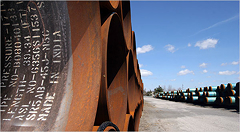
That observation has made him aPaul Revere in the eyes of many townspeople. Hundreds of sections of importedsteel pipe have been moving into
“I was very mad when I saw theywere imported; I wondered why this pipe had not been made in the
The United Steelworkers union hasbeen trying ever since to galvanize the
With the economy in tatters, topcorporate executives often state privately that they fear this downturn willfuel public sentiment against foreign-made products. Indeed, in February —before Mr. Rains made his discovery — 5,000 people marched through the streetsof this steel town in support of a strong “Buy America” clause in the $787billion stimulus bill then before Congress.
The imported pipe has inflamedthat sentiment. The union filed an antidumping lawsuit in
“The steel pipe behind us is asymbol of what has gone wrong in this country,” one of the speakers declared,arguing in effect that a lax Congress and greedy businesspeople, as in WallStreet, had brought three months of layoff, so far, to more than 10 percent ofGranite City’s work force. The crowd cheered, and some chanted back, “No moregreed.”
The union’s hope is that theIndian pipe episode will provoke a broad outcry, and similar finger-pointing,forcing Congress to tighten trade rules and pressuring companies that importsteel to buy more from domestic suppliers instead.
The pressure on Congress isalready evident. A provision in the stimulus package, signed into law inFebruary, limits the hiring of foreign workers by any company receivinggovernment bailout money. At least one institution, Bank of America, hasrescinded job offers to foreign citizens otherwise eligible for H-1B visas.
The United Steelworkers assertsthat free trade is not the issue. The union’s leaders endorse that, as do thechief executives of nearly every multinational company. What the Indian piperepresents, the union argues — and it is joined in this by steel industryexecutives — is a violation of fair trade. They contend that generousgovernment subsidies allow Indian and Chinese manufacturers to “dump” steel inthis country at prices below the fair market value.
“Other countries point the fingerat the
Such strong language aside, theepisode here has not generated the broad public outcry of, say, the bonusespaid by the American International Group. That is perhaps because trade issuesdo not generate the same reaction as huge Wall Street bonuses, and perhapsbecause the steelworkers themselves, as they explained in interviews here,would not have objected to the Indian steel if they were still fully employedat U.S. Steel’s Granite City Works. But the industry has been operating at lessthan 50 percent of capacity since last fall.
Imports have accounted for asteady 20 to 25 percent of the nation’s steel consumption for a decade or more— and neither the union nor the steel mill operators challenged that inroad.
But now they are, partly throughstepped-up antidumping actions, like the one filed against
“I have seven children, and sixof them need a job,” said Ricky Jankowski, a laid-off steelworker here. “If oneof them gets a manufacturing job as a result of our protests, it will be worthit.”
The shrinking of Americanmanufacturing was indeed a handicap when TransCanada, a giant Canadian energycompany, agreed to buy 560,000 tons of large-diameter pipe in 2006 for its1,600-mile Keystone Pipeline, now being built from
An American mill provided 30percent of the pipe, Canadian mills 23 percent and a giant Indian company,Welspun, the remaining 47 percent, at a low enough price, TransCanada says, tocompete with American-made pipe, even allowing for shipping.
“American and Canadian millswould have gotten more if they had had the available capacity to meet ourrequirements,” said Robert Jones, a TransCanada vice president.
Neither union leaders norindustry executives dispute that assessment. Indeed, neither is trying to stopconstruction of the Keystone Pipeline, now that all the steel pipe has beenpurchased. But the union, at least, is putting pressure on TransCanada to buyAmerican-made pipe for a parallel pipeline soon to be built. In a letter filedwith the Transportation Department last week, the union joined the Sierra Clubin challenging, on environmental grounds, TransCanada’s request for a permit —one argument being that the walls of the pipe would be too thin.
Pipe made in
“People here use the word angerto describe their reaction to the Indian steel, but I’m not sure that is theright word,” said the Rev. Gene Fowler, pastor of the First PresbyterianChurch, who attended the rally with other clergy members. “I think the rightdescription is, ‘slapped in the face.’ It is like an offense to the community.”
By LOUIS UCHITELLE
Published:
Source:www.nytimes.com
Các tin khác
- Rising global shipping costs put pressure on Viet Nam’s seafood exporters (22/06/2026)
- India likely to retain anti-dumping duties on Bangladeshi jute products (22/06/2026)
- Japan slaps anti-dumping duties on Chinese, Taiwanese steel (22/06/2026)
- India initiates anti-dumping probe against a Chinese, Japanese chemical used in tyre, rubber items (22/06/2026)
- Reasons why the US continues to suspend customs clearance for Vietnamese trailers (22/06/2026)