Home
Home
 About Us



Official export of pomelos and lemons to China under the new protocol
15/05/2026 04:48
China's opening of official trade channels for Vietnamese pomelos and lemons not only opens up more opportunities in the billion-person market, but also entails stricter requirements for growing areas, packaging, and traceability according to Decree 38/2026/ND-CP.
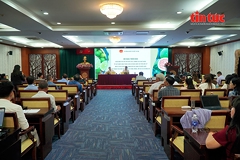
On the morning of May 14th, in Ho Chi Minh City, the Ministry of Agriculture and Environment (MARD) held a conference to announce the Protocol on plant quarantine requirements for fresh pomelo and fresh lemon exported to China, and to disseminate Decree No. 38/2026/ND-CP on the management of planting area codes and packaging facilities.
The conference was attended by representatives from the Department of Crop Production and Plant Protection, leaders of the Departments of Agriculture and Environment of localities, industry associations, businesses and agricultural production cooperatives.
Speaking at the conference, Mr. Hoang Trung, Deputy Minister of Agriculture and Environment, said that the signing of the Protocol on the export of pomelo and lemon was the result of a lengthy negotiation process aimed at bringing Vietnam's key fruit products into the Chinese market through official channels.
According to Mr. Hoang Trung, China has imposed very strict requirements on plant quarantine, especially the rigorous control of eight quarantined items. One of the new requirements is the implementation of "fruit bagging" during cultivation to limit pests and diseases and improve product quality.
"This is a new issue for many localities from a technical standpoint. Previously, we didn't do it systematically, but now, according to the Protocol, we have to organize the implementation in a way that meets the requirements of the other side. If we don't do it in a coordinated manner, it will be very difficult to meet the export conditions," Deputy Minister Hoang Trung said.
In addition to the requirement to bag the fruit, China has also stipulated quite detailed regulations on monitoring and controlling fruit flies through a system of traps and bait. The Ministry of Agriculture and Environment requests the Plant Protection and Quarantine Department to promptly issue unified technical guidelines on the type of traps, installation methods, and monitoring frequency so that localities can implement them uniformly.
According to leaders of the Ministry of Agriculture and Environment, meeting technical requirements is not simply a matter of customs clearance, but is also directly related to the reputation of Vietnamese agricultural products in the international market.
Another notable item on the agenda of the conference was the dissemination of Government Decree No. 38/2026/ND-CP dated January 24, 2026, on the management of growing area codes (MODs) and packaging facility codes (PCs).
According to Mr. Nguyen Quang Hieu, Deputy Director of the Department of Information and Plant Protection, the new decree clearly stipulates the procedures for granting planting area and packaging facility codes, as well as cases for temporary suspension, revocation, or reinstatement of codes.
According to Deputy Minister Hoang Trung, for many years, the management of planting area codes has often been seen as lacking a sufficiently strong legal framework, leading to inconsistent implementation among localities.
"Decree 38 provided the legal basis for unified implementation from the central to local levels. But now that decentralization has taken place, it must be done in a unified manner. If 34 provinces each act independently, businesses won't know what to do," he said.
The Deputy Minister also requested that localities assign tasks to the right specialized agencies, especially the sub-departments closely related to this field, in order to process applications quickly while ensuring compliance with regulations. "Decentralization and delegation of authority are clear, but it must be done in a way that benefits the people and businesses. If today it's right, tomorrow it's wrong, then businesses will find it very difficult to survive," he emphasized.
According to the Ministry of Agriculture and Environment, the country currently has approximately 106,000 hectares of pomelo orchards with an annual production of over 1 million tons. However, the percentage of areas granted planting area codes for export to China is still quite low. Many codes previously served other markets and have not been updated to meet the new requirements of the Chinese side.
In response to this situation, Deputy Minister Hoang Trung requested that the Departments of Agriculture and specialized sub-departments complete the review and issuance of planting area and packaging facility codes for pomelos and lemons before May 30, 2026.
After compilation, the Department of Information and Plant Protection will coordinate with the General Administration of Customs of China for approval and official announcement. "Only when the name is listed in the system of the General Administration of Customs of China will it be eligible for official export," the Deputy Minister affirmed.
At the conference, leaders of the Ministry of Agriculture and Environment also frankly addressed many shortcomings in the management of planting area codes in the past, such as impersonation of codes, misuse of codes, fraudulent export documents, or businesses purchasing from outside the registered raw material areas.
Some localities even make it difficult for businesses from outside the province to participate in the development of raw material areas.
According to Mr. Hoang Trung, localities need to create favorable conditions for businesses to invest in farming areas, regardless of administrative boundaries, while also strengthening training for farmers on technical procedures and traceability.
For businesses, procurement must be linked to the designated growing areas that have been assigned codes, and they must absolutely not abet fraudulent activities.
Regarding traceability, Mr. Nguyen Quang Hieu stated that the Department of Information and Plant Protection is developing a digital database system on growing areas and packaging facilities nationwide. This system will directly connect with localities to serve the monitoring, traceability, and transparency of the agricultural export chain.
According to the Ministry of Agriculture and Environment, traceability has now become a mandatory requirement of many major import markets, including China, the EU, and the US.
The Ministry's leaders believe that opening up the market is only the beginning, while maintaining stability and sustainable development is the long-term challenge for the agricultural sector.
With Decree 38 and new export protocols, the agricultural sector is gradually perfecting the production-packaging-traceability chain towards a more professional and transparent direction, thereby creating a foundation for Vietnamese pomelos and lemons to expand their export markets in the future.
Source: Vietnam.vn
Các tin khác
- U.S. to Impose Duties on Mexican, Thai, Vietnamese Chassis (03/06/2026)
- Mexican sugar producers push to scrap U.S. import quotas (03/06/2026)
- Japan launched an anti-dumping investigation into flat steel imports from three countries (03/06/2026)
- Eurochem challenges anti-dumping duties in the EU (03/06/2026)
- Pangasius prices in Viet Nam surge due to high export demand (03/06/2026)