Home
Home
 About Us



Lychee exports: Standardizing codes for growing areas and packaging facilities.
15/05/2026 04:51
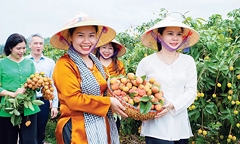
Faced with increasingly stringent requirements from importing markets, especially China, Bac Ninh is strengthening the management of growing area codes and packaging facilities. Strict control of traceability and pesticide residue levels is expected to help ensure stable and sustainable lychee exports.
The import market is becoming increasingly stringent.
Currently, importing countries are strengthening inspections of growing area codes and packaging facility codes to control the entire production process, pesticide use, pest monitoring, and processing and storage conditions. Many markets are continuously updating new regulations on pesticide residues, production logs, and traceability.
In particular, the Chinese market – which consumes the majority of the province's lychee exports – is intensifying online inspections and surprise inspections of growing areas and packaging facilities. If violations of plant quarantine or food safety regulations are detected, the importing party may temporarily suspend or revoke the export code.
On January 24, 2026, the Government issued Decree No. 38/2026/ND-CP regulating the codes for growing areas and packaging facilities. According to the new regulations, growing areas wishing to be granted a code must meet requirements regarding minimum area, production processes, and records of cultivation data storage; packaging facilities must ensure conditions regarding equipment, pest control, and product traceability. All old codes must also be converted to the new format for synchronized management.
Currently, the province has 315 export-oriented growing area codes covering a total area of 17,769.22 hectares for agricultural products such as lychees, longan, pomelo, watermelon, star apple, bananas, and herbs. Lychees alone have 243 export-oriented growing area codes for markets including China, the United States, Japan, Australia, Thailand, and the EU; along with 42 packaging facilities serving export markets.
According to Mr. Nguyen Duc Hung, Director of Global Food Import-Export Joint Stock Company, for many years China has remained the main market, accounting for over 70% of the province's lychee exports. However, in 2026, this market underwent significant changes in its import management policies.
Currently, the assessment and inspection of packaging facilities eligible for export to China are being tightened; Chinese authorities may conduct inspections before the harvest season or monitor throughout the harvesting and export process. "If businesses do not promptly upgrade their facilities and standardize production and packaging processes, the risk of export suspension or code blocking is entirely possible," Mr. Hung stated.
Not only China, but also EU, Japanese, and US markets are becoming increasingly stringent regarding pesticide residue levels and food safety standards. Therefore, many businesses have proactively taken strict control over their raw material sources, cultivation processes, and processing and packaging systems.
Along with businesses, many households have also proactively changed their production methods to meet export standards. Mr. Ly Van Tri, from Chay village (Luc Ngan commune), said that his family always strictly adheres to VietGAP and GlobalGAP procedures; the entire process of caring for the lychee trees is updated on electronic software to ensure transparency and facilitate inspection and monitoring.
Mr. Tri's family currently owns over 2 hectares of lychee trees in the main harvest season, located in an area granted export codes to the United States, Japan, and the EU. Although many lychee orchards suffered crop failures this year, his family's orchard still achieved about 80% of last year's yield, estimated at over 10 tons of fruit.
Strengthen guidance and inspection.
According to Mr. Nguyen Hong Quang, Deputy Director of the Department of Agriculture and Environment, in response to increasingly stringent requirements from import markets, the provincial agricultural sector has identified strict management of planting area codes and packaging facilities as a key task to maintain the reputation and brand of exported lychees.
From the beginning of the season, the Department of Agriculture and Environment issued numerous plans and directives related to the production of lychees for export; assigning the Plant Protection and Crop Production Sub-Department as the focal point for advising on the issuance and management of planting area codes and packaging facilities in the area.
Upon inspection, authorities revoked 8 planting area codes covering 1,128.15 hectares and 2 packaging facilities due to crop conversion or at the request of the owners; simultaneously, they temporarily suspended one planting area code covering 18.17 hectares and one packaging facility at the request of the owner.
In February and March 2026, the Department of Agriculture and Environment reviewed all the codes for lychee growing areas for export and packaging facilities that had been granted codes.
Upon inspection, authorities revoked 8 planting area codes covering 1,128.15 hectares and 2 packaging facilities due to crop conversion or at the request of the owners; simultaneously, they temporarily suspended one planting area code covering 18.17 hectares and one packaging facility at the request of the owner.
Currently, the conversion of planting area and packaging facility codes to the new format is underway and is expected to be completed before June 15, 2026. Once completed, the data will be updated to the National Database system and sent to importing countries for traceability and monitoring purposes.
In addition, the provincial Department of Agriculture also organized many training courses guiding the process of establishing, granting, and managing planting area codes and packaging facilities; closely coordinating with the Department of Crop Production and Plant Protection to promptly update new regulations of import markets and support businesses in selling their products.
In the context of increasing competition, standardizing codes for growing areas and packaging facilities is both a mandatory requirement to maintain export markets and a solution to improve the quality, reputation, and brand value of Bac Ninh lychees in the international market.
Source: Vietnam.vn
Các tin khác
- U.S. to Impose Duties on Mexican, Thai, Vietnamese Chassis (03/06/2026)
- Mexican sugar producers push to scrap U.S. import quotas (03/06/2026)
- Japan launched an anti-dumping investigation into flat steel imports from three countries (03/06/2026)
- Eurochem challenges anti-dumping duties in the EU (03/06/2026)
- Pangasius prices in Viet Nam surge due to high export demand (03/06/2026)