Home
Home
 About Us



In the first quarter of 2026, the trade balance for goods showed a trade deficit
06/04/2026 03:08
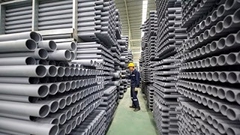
According to the General Statistics Office of the Ministry of Finance, in the first quarter of 2026, the total value of goods exports and imports reached US$249.50 billion, with exports increasing by 19.1% and imports increasing by 27%. The faster growth in imports compared to exports resulted in a trade deficit of approximately US$3.6 billion, compared to a trade surplus of US$3.57 billion in the same period of the previous year.
Export turnover maintains its growth momentum.
According to the General Statistics Office of the Ministry of Finance , in the first quarter of 2026, Vietnam's merchandise exports maintained high growth momentum amidst the challenging and unstable global economic and trade environment. Merchandise export value in March reached US$46.44 billion, a 40.3% increase compared to the previous month and a 20.1% increase compared to the same period last year. For the first quarter of 2026 as a whole, merchandise export value reached US$122.93 billion, a 19.1% increase compared to the same period last year.
Twenty product categories achieved export turnover exceeding $1 billion, accounting for 86.8% of total export turnover. Notably, five product categories exceeded $5 billion in export value, representing 62.4%.
According to a representative from the General Statistics Office, the main driving force behind the export increase came from the processed and manufactured industrial goods group, with a turnover of 110.5 billion USD, an increase of 21.1%, accounting for nearly 90% of the total export turnover. Among these, several key items saw significant growth, including: electronics, computers and components reaching 30.7 billion USD, up 45.5%; telephones reaching 16.7 billion USD, up 19.3%; and machinery, equipment, tools and spare parts reaching 15 billion USD, up 21.2%.
In addition, the agricultural, forestry, and fisheries sector continues to play an important role, contributing to export stability amidst challenging circumstances.
Ms. Nguyen Thu Oanh, Head of the Services and Prices Statistics Department of the General Statistics Office, commented that this result shows the good adaptability of Vietnamese businesses in the context of difficult global trade.
“In the short term, demand in key markets such as the US and EU remains stable; exports to China are recovering positively; and many orders in the first quarter were fulfilled based on previously signed contracts, so they were not immediately affected by geopolitical fluctuations. In addition, the increase in basic commodity prices also contributed to the increase in export value,” Ms. Oanh added.
Import turnover surged sharply.
According to the General Statistics Office, merchandise imports in March reached $47.11 billion, an increase of 38.2% compared to the previous month and a 27.8% increase compared to the same period last year.
Overall, in the first quarter of 2026, merchandise imports reached US$126.57 billion, an increase of 27.0% compared to the same period last year, with production materials accounting for nearly 94% of the total. Notably, 22 imported items exceeded US$1 billion, accounting for 82.8% of total imports (including 2 items exceeding US$5 billion, accounting for 49.8%).
Looking at the statistics, the fact that imports increased faster than exports resulted in a trade deficit of approximately $3.6 billion in the first quarter of 2026, compared to a surplus of $3.57 billion in the same period of the previous year.
Explaining the trade deficit in the first quarter of 2026, Ms. Nguyen Thu Oanh, Head of the Service and Price Statistics Department of the General Statistics Office, said: "In the context of a volatile global economy , the shift to a trade deficit mainly reflects the demand for importing machinery, equipment, and raw materials for production, and also shows that businesses are proactively increasing input reserves to prevent the risk of supply chain disruptions and energy price fluctuations."
Thus, the trade deficit during this period is short-term in nature, linked to the production cycle and price factors, and reflects the proactive adaptation of businesses to fluctuations in the global economy.
Source: Vietnam.vn
Các tin khác
- U.S. to Impose Duties on Mexican, Thai, Vietnamese Chassis (03/06/2026)
- Mexican sugar producers push to scrap U.S. import quotas (03/06/2026)
- Japan launched an anti-dumping investigation into flat steel imports from three countries (03/06/2026)
- Eurochem challenges anti-dumping duties in the EU (03/06/2026)
- Pangasius prices in Viet Nam surge due to high export demand (03/06/2026)