Home
Home
 About Us


Green export - Sustainable direction of enterprises
26/12/2022 04:34
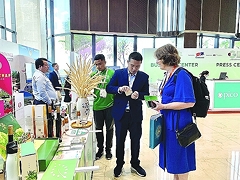
The "green" criteria of products is increasingly being seen as a priority, and even a key, for exporting products to major markets in the future.
Attracting international visitors thanks to "green" criterion
At the recent Green Economy Exhibition - GEFE 2022 organized by EuroCham in Ho Chi Minh City, a large number of European customers showed interest in the coconut nectar products of Tra Vinh Farm Co., Ltd.
Sokfarm's CEO, Pham Dinh Ngai, said that the company's coconut growing area had recently been certified organic by three major markets: the EU (Europe), USDA (USA) and (JAS) Japan.
This would be key for Sokfarm to open new doors in the international market, following its successful official exports to the Netherlands and Japan.
Similarly, in the textile and garment sector, Ms. Nguyen Thi Lien, Deputy General Director of Phong Phu International Joint Stock Company (PPJ), said that four years ago, the company quickly transformed itself to adapt to the strong global trend of green consumption. In particular, the sustainable development strategy is associated with the goals of producing and trading green products, improving the efficiency of natural resource use, reducing emissions, protecting the environment, and the health of workers, consumers, and the social community. These are prerequisites for the success of enterprises.
This strategy has helped PPJ to receive more orders. “In 2022, although the textile and garment industry is facing many difficulties due to a lack of orders and labor, thanks to our goal of developing green products, PPJ has still achieved a growth rate of 20% with expected sales of $400 million, and the best thing is that we have been able to maintain stability for our employees,” Ms. Lien said.
In the fisheries sector, many sustainable fisheries programs have also been implemented. In particular, Kien Giang province has just approved the investment policy for a sustainable aquaculture development project in Hon Dat district, covering an area of about 5,500 hectares. Similarly, Ca Mau province is also promoting high-value aquaculture farming with the combined shrimp-forest model. This is a model of ecological natural farming that does not use drugs and chemicals, reducing costs and actively contributing to forest protection and development. Ca Mau currently has over 27,500 hectares of shrimp farming under the mangrove canopy, of which more than 19,000 hectares are certified by international standards (Naturland, EU Organic, Canada Organic, Selva Shrimp, ASC, BAP). The products from this model are favored and appreciated by many markets.
Goals within reach
Assoc. Prof. Dr. Nguyen Hong Quan, Director of the Institute of Circular Economy Development (ICED) at the National University of Ho Chi Minh City, said that the green economy is opening new doors for export growth by developing green technology solutions to improve productivity and efficiency, enhance investor confidence, open up new markets, and reduce risks in the business environment. The global market for "green" products is growing faster and is more profitable than "brown" products of the same kind.
Mr. Bartosz Cieleszynski, Deputy Head of the Trade Department at the Delegation of the European Union in Vietnam, said that green technology is not out of reach for Vietnam. Every enterprise in the Vietnamese business community can participate in green technology and green commerce. Accordingly, with an export-oriented economy like Vietnam, green technology and sustainable trade should start from key export industries such as agriculture, forestry, and fisheries.
According to Mr. Bartosz Cieleszynski, the export of organic products from Vietnam has developed systematically in the past few years, with a diverse range of products such as tropical fruits, vegetables, processed foods, seafood, and commodities. Given the growing importance of organic farming in the EU, exporters from Vietnam should consider putting more emphasis on promoting the concept of organic farming to better meet the preferences of European consumers. In particular, products with existing voluntary certification for labeling and international certification such as EcoCert or Fair Trade are often purchased at higher prices in the European market.
"Enterprises should familiarize themselves with consumer choices and meet their expectations by providing high-quality, green, and environmentally friendly products and services. The world is changing rapidly and once voluntary practices become the norm, competition in the market will become very fierce. That is why the demand for sustainable development needs to be fully met in the bilateral trade relationship between Vietnam and the EU," emphasized Mr. Bartosz Cieleszynski.
Source: Customs News
Các tin khác
- Viet Nam extends anti-dumping duties on some Thai sugar products to 2031 (05/06/2026)
- Hong Kong: Ministry of Commerce Rules on Inheritance of Anti-dumping Duty Rates for Copolymer Polyoxymethylene Imports Originating from S Korea, Thailand and Malaysia (05/06/2026)
- Early-season Vietnamese lychees conquer US consumers (05/06/2026)
- Global rubber prices surge, raising hopes for Vietnamese exporters (05/06/2026)
- Modern logistics creates new growth opportunities for Lang Son’s border-gate economy (05/06/2026)