Home
Home
 About Us



Grasp consumer tastes, increase exports of tuna products to the UK
17/08/2024 01:37
UK commitments and regulations for tuna products in UKVFTA
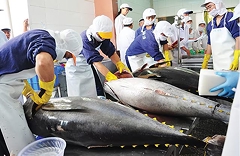
Vietnamese tuna has an advantage in this market thanks to tariff incentives from the Vietnam - UK Free Trade Agreement (UKVFTA). According to the commitments in the UKVFTA Agreement, regarding tariff commitments, this Agreement has a mechanism to continue the EVFTA Agreement, which means that import tax rates for fresh and frozen tuna products will quickly be adjusted. remove. The tax rate on frozen tuna loin or fillet products will be eliminated over a period of 3 years from 18% to 0%.
For processed tuna used for canned tuna – the 24% base rate will be reduced over a 7-year schedule.
For canned and packaged tuna, the quota will be 11.500 tons per year which will be duty-free. After that, the original tax rate of 20,5% will be applied, which will decrease by 3,5% each year. With this agreement, Vietnamese tuna products have an advantage in the UK market
To enjoy preferential tax rates as committed in the UKVFTA Agreement, Vietnamese seafood products must prove their origin. Regulations on Rules of Origin in the UKVFTA are similar to the EVFTA, with the origin criteria for raw seafood and processed seafood in the UKVFTA being pure origin. This means that raw, semi-processed and processed aquatic products for export from Vietnam are considered originating under the UKVFTA Agreement when the aquatic raw materials used in the production process originate purely from Vietnam. (born or raised, caught and processed entirely in Vietnam), are not allowed to be imported from third countries outside the Agreement.
It can be seen that in 2021, the first year of implementing the Agreement, this market imported seafood worth about 3,1 billion pounds, equivalent to more than 3,7 billion USD in 2021. In particular, tuna ranked first. ranked second with a proportion of 16% of this market's total seafood imports with 113,5 thousand tons, accounting for a fairly modest market share of about 2%.
However, after a period of good growth, Vietnamese tuna exports to the UK showed signs of slowing down. According to data from the Vietnam Association of Seafood Exporters and Producers (VASEP), in the first 6 months of 2024, export turnover to this market reached 3,6 million USD, down 5% over the same period. Although in June 6, tuna exports to this market increased by 2024%, reaching 56 million USD, however, the high growth rate in the past 742 months is still not enough to compensate for the previous decrease.
Frozen tuna meat/loin code HS03 is still Vietnam's main export product to this market, accounting for 92%. This year, the UK reduced imports of frozen tuna meat/loin from Vietnam. Meanwhile, imports of other products tend to increase.
Vietnam is currently the second largest source of frozen tuna meat/loin with code HS03 outside the EU for the UK market, after South Korea. Currently, the UK is also reducing imports of this product group.
Opportunities to increase exports of processed tuna products
According to VASEP, in the UK market, tuna is sold in many types of products such as: pre-processed, pre-processed, sushi, sauced, breaded or breaded... Among them, canned and canned tuna products are most consumed bags. However, consumption of this product group is trending down since last year. On the contrary, consumption of tuna products in the form of sushi or breaded tuna tends to increase. Therefore, this is an opportunity for countries to increase exports of processed and canned tuna products.
According to the Import-Export Department, in terms of processed and canned products, tuna is the top choice of British consumers. In the UK, tuna is a food used mainly in fast food dishes, such as sandwiches, or in many meals when traveling.
According to Seafish statistics, 69% of British people's choices in canned seafood are tuna products. In addition, due to the characteristics of fatty fish that are quite suitable for many forms of processing, a number of other processed tuna products such as salads, toppings, bread, etc. are also very popular in Vietnam. this market. Similar to other markets in the European region, consumers in the UK also tend to pay attention to not only the origin and quality of products, but also to labor and environmental factors. market, or the sustainability of the value chain in production and product supply. Other basic factors such as price, processing method, similarity in meals, and location of use are also still of concern.
However, like Vietnam, Ecuador has signed a Free Trade Agreement (FTA) with the UK. This is creating favorable conditions for this country to increase exports to the UK. With a powerful fleet, the supply of pure origin tuna for Ecuador is quite abundant. Therefore, Ecuador has many opportunities to boost exports to this market.
Meanwhile, according to VASEP, Vietnam's fishing output is inherently much lower than other countries' due to the lower fishing capacity of the fleet. In addition, regulations limiting the size of skipjack tuna allowed to be exploited are causing yields to become increasingly lower. Enterprises do not have enough supply of skipjack tuna - the key ingredient of the canned tuna processing and export industry - of pure origin for production and export.
Therefore, to promote this product to the UK, according to experts, Vietnamese businesses need to increase the application of science and technology, develop modern production and processing systems, thereby optimizing production process to improve quality and added value to products, helping Vietnamese seafood gradually move towards international standards and create a competitive advantage. Along with that, diversify export products and increase deeply processed products. Select market segments and distribution channels appropriate to the products and scale of the business; Focus on understanding tastes and market characteristics.
For example, if the product is already branded, you should approach the specialized retail market segment, which will have higher prices but requires stable product quality instead of selling products to retailers that already have the following brands. Then they will package it under their brand, or sell the product raw.
Source: Vietnam.vn
Các tin khác
- Viet Nam extends anti-dumping duties on some Thai sugar products to 2031 (05/06/2026)
- Hong Kong: Ministry of Commerce Rules on Inheritance of Anti-dumping Duty Rates for Copolymer Polyoxymethylene Imports Originating from S Korea, Thailand and Malaysia (05/06/2026)
- Early-season Vietnamese lychees conquer US consumers (05/06/2026)
- Global rubber prices surge, raising hopes for Vietnamese exporters (05/06/2026)
- Modern logistics creates new growth opportunities for Lang Son’s border-gate economy (05/06/2026)