Home
Home
 About Us


G20 and protectionism: What’s there to (really) worry about?
14/11/2014 12:00
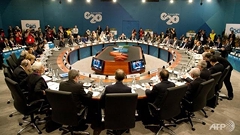
Has G20 protectionism been talked up too much? The latest World Trade Organization (WTO) report, published jointly with the OECD, on trade restrictive measures in the G20 group of leading industrial economies and emerging markets, reveals that protectionism has not significantly been on the rise. Yet there are ‘murky’ areas of protectionism on which the international organisations’ report remains very sketchy.
So India eliminated import tariffs on chickpeas last September. This means Indians will enjoy cheaper curries. That’s the kind of ’fun fact’ we get from the WTO/OECD report on trade restrictive measures in the G20 countries a few days ahead of their summit in Brisbane.
The bi-annual report is being produced since 2008, was mandated by the G20 grouping in the darkest hours of the economic and financial crisis, and aimed at helping its members fulfill a pledge not to introduce trade restrictions.
Obviously, G20 members have not delivered on their promise. The report clearly shows that G20 members have introduced between 14 and 20 trade restrictive measures per month over the last 6 years. However, the report stresses that in the last five months, the actual number number of import liberalising measures (35) was higher than the number of new restrictions (25). The trade restrictive measures that have accumulated since 2008 cover 5.3% of the value of G20 trade.
So is the fear of protectionism overblown? Yes, and no.
Clearly, the sectors most affected by various import restrictions are concentrated in the electrical machinery sector (25.6 percent), mineral fuels (22.6 percent) and ‘pearls and precious metals’ (19.3 percent) sectors. These import restrictions include raising or introducing import tariffs, applying distortive tax measures, or import bans justified (rightly or wrongly ) on technical, environmental or sanitary grounds.
The report indicated that non-tariff measures are being talked about quite a lot in the relevant WTO committees. Russia’s import bans on pork and on other EU agricultural products were among the prominent topics discussed in the committee dealing with sanitary and phytosanitary (SPS) measures. But Russia’s two measures were less numerous than the threenew European Union (EU) measures introduced this year: an import ban on Indian mangoes, a retrieval of recognition of Indian organic products, and an import ban on South African citrus fruit.
Opponents of investor-to-state dispute settlement in trade deals (who very often oppose any kind of trade deal) because these could derail public health policies, will perhaps shift their attention (again?) to the WTO. Indeed, the document reports that the technical barriers to trade (TBT) committee has dealt with the United Kingdom’s tobacco ‘plain packaging’ plans. Small and poor tobacco-growing WTO members – Cuba, Guatemala, Honduras, Malawi, Nigeria - are getting scared of what is awaiting them, now that Australia has gone ahead with such a measure and other countries, including France, are considering doing the same. But surely London’s gentlemen’s clubs will ensure that Cuba’s nicely decorated cigar boxes be exempted?
On raw materials, it is export rather than import restrictions that dominate the picture. But the report stresses that the number of export restrictions has diminished. The WTO ruling outlawing China’s ’rare earths’ export restrictions this spring has chilled others. But perhaps raw material imports will be back on the radar screen: China and India have introduced new import tariffs on coal.
On the issue of raising tariffs on imports unilaterally and outside the context of an antidumping investigation, it is not Russia, India, China, or Argentina that stand out, but the Southern African Customs Union, SACU. The latter introduced a slew of new import tariffs on paper and carboard products, enamels, iron, and crustaceans and molluscs which mostly affect other developing countries and emerging markets, but not the EU, for instance, with which South Africa has a free trade agreement in place.
The G20 report alas only scratches the surface of the more ‘murky’ types of potentially protectionist measures, discriminating or not against foreign imports or investors: taxes and subsidies (or both). Clearly, there have been new discriminatory tax schemes. Brazil confirmed only very recently its internal tax rebates for industrial companies (mostly in the information technology sector) over which the EU has gone to the WTO dispute settlement body late October.
In terms of tax rebates and subsidies that could or could not be detrimental to outsiders, it is EU member states that have most entries in the G20 report: the EU’s support scheme for peaches and other fruit after the Russian embargo this summer, and a slew of state aid measures in favour of companies in various member states. Whether the EU is more protective or simply more transparent and diligent in its reporting to Geneva is an open question. Entries on China on this front are remarkably few, which would tend to support the second hypothesis.
The report is candid on the difficulty of reporting on subsidies:
“The request for information on specific general economic support measures generated a disappointing rate of response similar to that of previous reports. Only two G-20 Members volunteered information relating to economic support measures. According to normal practice, the WTO Secretariat requested confirmation of several such measures, including many obtained from other official sources, from a larger group of G-20 Members, but mostly without success and often generating a request not to include those measures in the report.”
Another difficulty is reporting so-called ’local content requirements’, when investments are authorised under the condition that the company source inputs locally. This G20 report only cites one concrete instance: a measure introduced by Indonesia this year requiring outlet stores to source 80 percent of their products locally. Localisation requirements are also frequent in public procurement deals – which incidentally interest European businesses in particular. One United States (US) ’Buy American’ measure was reported in this G20 paper, but is seems that a lot is happening informally in countries like China, which is also not party to the WTO’s Government Procurement Agreement.
Many are rejoicing that the US and India will be bringing good news to the G20 after they struck a deal on food subsidies this week, potentially clearing the way for a long-awaited trade facilitation deal in the WTO. Even better, China and the US have just paved the the way for the long-blocked extension of the WTO’s Information Technology Agreement, which will lead to an elimination of many import tariffs on various electronic goods. Don’t these moves clearly show that protectionism is not quite as rampant as some say?
However, in Brisbane this weekend, there will likely not be much talk of subsidies, government procurement and other distortive public policy measures where contemorary protectionism has shifted to and which incidentally businesses tend to talk about most. Only a deal like the transpacific partnership (TPP), currently the most advanced of all ongoing ‘mega-regional’ trade agreements under negotiation, would seriouly start addressing them. But the TPP parties, which include the US, and a selection of Asian, Pacific and Western Hemisphere economies, have failed to announce a deal yet.
Source: Borderlex.eu
Các tin khác
- New-generation FTAs open wider export opportunities to Middle East and South Asia (15/06/2026)
- Updated regulations on foreign trade management and import quotas (15/06/2026)
- Mandatory traceability for high-risk goods from July 1st: What should businesses prepare for? (15/06/2026)
- Tariff pressure is forcing businesses to restructure in order to adapt. (15/06/2026)
- Coffee Citizens model aims to lift Vietnamese value chain (15/06/2026)