Home
Home
 About Us



Exports of agricultural, forestry, and aquatic products set a new record.
22/12/2025 09:45
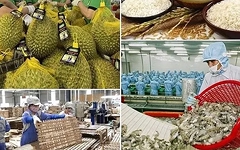
Amidst a volatile global economy, Viet Nam's agricultural, forestry, and fisheries exports are still projected to set a new record in 2025, reaching nearly 70 billion USD
Coffee is the most outstanding highlight.
According to Deputy Minister of Agriculture and Environment Phung Duc Tien, the export value of agricultural, forestry, and aquatic products in the first 11 months of 2025 reached US$64.01 billion. If the last month of the year achieves similar results to the previous months, total exports could reach nearly US$70 billion, far exceeding the target of US$65 billion. This is not only a new record, but also represents a simultaneous achievement of all-time highs for many product groups. 2025 is expected to see strong growth in many key export items such as coffee, pepper, seafood, fruits and vegetables, and forestry products.
Among these, coffee stands out as the most prominent. For the first time, Viet Nam's coffee exports exceeded $8 billion, despite a production volume of only about 1.5 million tons. The average export price increased by approximately 40% compared to 2024, demonstrating a clear shift in the coffee industry from growth based on volume to growth based on quality and added value, while consolidating Viet Nam's position as one of the world 's important coffee supply centers. The structure of exported coffee products is also shifting towards higher value. Robusta coffee continues to play a leading role in terms of scale, creating a stable foundation for the entire industry, while processed coffee products recorded strong growth, reflecting a strategy of deeper integration into the value chain and enhanced international competitiveness.
In key coffee-producing regions such as Dak Lak, Gia Lai, Lam Dong, and Quang Ngai, smart coffee farming models are being implemented, helping to improve productivity, quality, and adaptability to climate change. Farmers' production mindset is shifting from relying on experience to adhering to scientific processes, combined with the application of digital technology in monitoring and traceability, meeting the increasingly high demands of the market.
Fruit and vegetable exports will continue to surge, aiming for the $10 billion mark.
For seafood, businesses have taken advantage of the opportunity to accelerate shipments ahead of the US's expected implementation of new regulations on seafood imports and before the final outcome of the anti-dumping case against shrimp. In November 2025 alone, seafood exports reached nearly $990 million, a 6.6% increase compared to the same period in 2024. Based on the results of the first 11 months and the outlook for the end of the year, the Viet Nam Association of Seafood Processing and Export (VASEP) forecasts that seafood export turnover for the whole year 2025 could reach $11.2–11.3 billion, the highest level ever.
Among these, shrimp exports are expected to exceed $4.6 billion, setting a new record; pangasius exports are estimated to reach over $2.1 billion thanks to recovering demand in Asia and China; and tuna exports are forecast to reach over $900 million, approaching the $1 billion mark.
According to Ms. Le Hang, Deputy Secretary General of the Viet Nam Association of Seafood Processing and Export (VASEP), the positive results of 2025 will help the seafood industry continue to strengthen its supply position in many major markets. However, the US's planned tightening of import requirements from 2026 poses a significant challenge, forcing businesses to prepare thoroughly in terms of supply chain transparency, compliance with labor standards, combating IUU fishing, and increasing the proportion of value-added products.
The fruit and vegetable sector also recorded an unprecedented milestone. The Key Fruit Crop Development Project aims for fruit export turnover to exceed 5 billion USD by 2025, but with a growth rate of nearly 20%, this sector could reach approximately 8.5 billion USD this year. Durian continues to play the "star" role in the fruit industry. Since being officially exported to China, durian export turnover has grown dramatically, bringing significant revenue to farmers and businesses. According to Mr. Dang Phuc Nguyen, General Secretary of the Viet Nam Fruit and Vegetable Association (Vinafruit), at the beginning of 2025, fruit and vegetable exports faced many difficulties due to technical barriers in the Chinese market for durian, along with the impact of US tariff policies.
However, thanks to the flexible management solutions of the Government and the adaptive efforts of businesses and farmers, for the first time, Viet Nam's fruit and vegetable export turnover could exceed 8.5 billion USD. Mr. Nguyen expects that in 2026, fruit and vegetable exports will continue to break through, aiming for the 10 billion USD mark.
This achievement is closely linked to the policy of opening up the market and integrating into trade. In 2025, Viet Nam and China signed five protocols, including those for fruits and vegetables such as passion fruit and fresh jackfruit; fresh pomelo was also officially exported to the Australian market.
According to Mr. Huynh Tan Dat, Director of the Department of Crop Production and Plant Protection, each officially exported agricultural product will help farmers and the industry raise awareness and apply technical measures to meet requirements for quarantine, food safety, and traceability.
Building a national brand for Vietnamese wooden furniture.
For the forestry products sector, the export target of $25 billion by 2030 is gradually being realized through three major directions: enhancing competitiveness based on a closely linked ecosystem; building a national Vietnamese wood product brand; and diversifying markets, products, and distribution channels.
According to Mr. Nguyen Quoc Khanh, Chairman of the Viet Nam Wood and Forest Products Association, the industry needs to build a complete and self-reliant supply chain; invest heavily in technological innovation, green production, and human resource training. Building a Vietnamese furniture brand must be based on four pillars: green, quality, flexibility, and competitiveness, along with a transparent and standardized data system according to international standards.
According to the Ministry of Agriculture and Environment, in 2026 the sector will continue to promote the development of domestic and export markets, proactively adapting to new tariff policies through a group of solutions related to market, science and technology, policy, economic diplomacy, and industry value chains.
At the same time, the sector is strengthening support for businesses to open up markets, promote trade, and boost exports, especially to the US market; managing and effectively exploiting land and water resources; and unlocking internal resources to create new space and impetus for large-scale commodity production.
The record figures for 2025 are the result of proactive and flexible management and production organization. However, the road ahead will not only be measured by turnover, but also by quality, responsibility, and the ability to meet the increasingly stringent standards of the global market.
To maintain growth momentum, the Ministry of Agriculture and Environment will continue to review and improve specialized regulations in accordance with integration requirements; perfect the system of standards, regulations, quarantine, traceability and food safety; and strengthen inspection and supervision to ensure the quality of export goods right from the source.
Source:VTV
Các tin khác
- U.S. to Impose Duties on Mexican, Thai, Vietnamese Chassis (03/06/2026)
- Mexican sugar producers push to scrap U.S. import quotas (03/06/2026)
- Japan launched an anti-dumping investigation into flat steel imports from three countries (03/06/2026)
- Eurochem challenges anti-dumping duties in the EU (03/06/2026)
- Pangasius prices in Viet Nam surge due to high export demand (03/06/2026)