Home
Home
 About Us


Exports of agricultural, forestry, and aquatic products increased sharply
06/03/2026 03:00
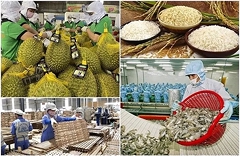
In the first two months of 2026, the total export value of agricultural, forestry, and aquatic products reached approximately 11.3 billion USD, an increase of 17.1% compared to the same period in 2025.
According to the Ministry of Agriculture and Environment , the export value of agricultural, forestry and fishery products in February 2026 was estimated at US$4.71 billion, a decrease of 28.4% compared to the previous month but an increase of 1.9% compared to the same period last year.
Overall, in the first two months of 2026, the total export value of agricultural, forestry, and aquatic products reached approximately 11.3 billion USD, an increase of 17.1% compared to the same period in 2025.
Among these, the export value of agricultural products reached US$6.09 billion, an increase of 17.1%. Seafood exports reached US$1.76 billion, an increase of 23.3%; forestry products reached US$2.82 billion, an increase of 7.4%. Notably, livestock product exports reached US$140.7 million, a sharp increase of 84.3%; exports of production inputs increased by 51.7%; and salt exports increased by 69% compared to the same period last year.
In terms of markets, Asia continues to be the largest export region for Vietnamese agricultural, forestry, and aquatic products, accounting for 45.5% of the total market share. The next two largest markets are the Americas with 21% and Europe with 15.7%. Exports to Africa and Oceania account for 2.2% and 1.4%, respectively.
Compared to the same period last year, the value of agricultural, forestry and fisheries exports in the first two months of 2026 increased by 27.7% to Asia; 10.4% to the Americas; 12% to Europe; and 32.4% to Oceania, while exports to Africa decreased by 19.6%.
Looking at specific markets, China continues to be the largest market, accounting for 22.9% of Viet Nam's total agricultural, forestry, and fisheries exports. The United States ranks second with 18.7%, and Japan is third with 7.2%.
Compared to the same period in 2025, the value of agricultural, forestry, and fishery exports to China in the first two months of this year increased by 55.9%; exports to the United States increased by 9.2%; and exports to Japan increased by 9.8%.
According to the Ministry of Agriculture and Environment, the positive growth results in the first two months of the year show signs of market recovery, creating a favorable foundation for the industry to continue boosting production, expanding markets, and striving to achieve the export target of 73-75 billion USD in 2026.
To promote agricultural, forestry, and fisheries exports in the coming period, the Ministry of Agriculture and Environment has identified a comprehensive set of solutions, focusing on increasing added value, sustainable development, and proactively adapting to the increasingly demanding requirements of the market. Particularly in light of complex geopolitical developments that could impact transportation, payments, and global trade flows, the sector is enhancing its forecasting capacity and developing scenarios to respond to fluctuations in international trade.
Regarding production, the Ministry of Agriculture and Environment focuses on strengthening production management along the value chain, promoting linkages between production, preliminary processing, processing, and consumption. Models of linkages associated with concentrated raw material areas, ensuring traceability and food safety, will be developed and replicated, thereby improving the stability of supply and the quality of products for export.
In addition, the Ministry encourages businesses to invest in technological innovation and develop deep processing linked to raw material areas and safe, sustainable supply chains. The focus is on developing post-harvest preservation technologies and by-product processing technologies in line with the circular economy, aiming to increase raw material utilization, reduce losses, and enhance product value. The industry also aims to increase the proportion of processed products in consumption and export structures, gradually reducing dependence on raw material exports.
The Ministry will support the enhancement of quality control capacity at processing and preservation facilities; guide businesses in meeting technical standards, quarantine requirements, food safety and traceability requirements of importing markets, especially key markets with high demands.
Alongside enhancing internal capacity, the industry is promoting the building and development of Vietnamese agricultural, forestry, and aquatic product brands; strengthening trade promotion and connecting supply and demand; and developing a specialized logistics system towards modernity, sustainability, cost reduction, and increased competitiveness for export goods.
Regarding market expansion, the Ministry of Agriculture and Environment continues to strengthen negotiations and promote market access for strong agricultural and aquatic products; proactively removing technical barriers related to food safety and quarantine in key export markets. At the same time, it expands international cooperation and promotes the signing of treaties and agreements on mutual recognition in the food sector, facilitating export activities.
Source: VTV
Các tin khác
- U.S. to Impose Duties on Mexican, Thai, Vietnamese Chassis (03/06/2026)
- Mexican sugar producers push to scrap U.S. import quotas (03/06/2026)
- Japan launched an anti-dumping investigation into flat steel imports from three countries (03/06/2026)
- Eurochem challenges anti-dumping duties in the EU (03/06/2026)
- Pangasius prices in Viet Nam surge due to high export demand (03/06/2026)