Home
Home
 About Us



Exports continue to surge amid volatility
03/04/2026 05:56
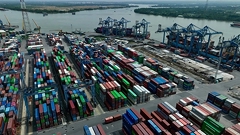
Despite facing many challenges, especially geopolitical conflicts in the Middle East, in the first quarter of 2026, Viet Nam's total export turnover reached nearly 100 billion USD, an increase of over 17% compared to the same period last year.
Typically, the first quarter of each year is a slow start in many sectors, especially trade, due to the impact of the Lunar New Year holidays.
This year, in addition to the aforementioned factors, the outbreak of military conflict in the Middle East at the end of February made March a particularly difficult month due to rising fuel prices, volatile supply chain logistics costs, and stalled orders. However, the results of the first three months show that exports remain extremely vibrant. By the end of the first quarter of 2026, the total export value reached nearly 97 billion USD, an increase of 17.1% (corresponding to an increase of 14.14 billion USD) compared to the same period in 2025. Some product groups with positive growth include: computers, electronic products and components, which increased by 6.69 billion USD (40.3%); and telephones and components, which increased by 2.66 billion USD (23.1%). Machinery, equipment, tools and spare parts increased by $1.79 billion (18.2%).
In the agriculture, forestry, and fisheries sector, the Ministry of Agriculture and Environment announced import and export results for the first quarter, with total exports of agricultural, forestry, and fisheries products reaching US$16.69 billion, an increase of 5.9% compared to the same period in 2025; the trade surplus in agriculture, forestry, and fisheries reached US$4.78 billion.
Looking at each product group, the agricultural sector continued to play a leading role with export value reaching US$8.93 billion, an increase of 4.1%. Notably, livestock product exports recorded the highest growth rate, reaching US$197.7 million, an increase of 54.3%. This is a positive sign showing that the livestock industry is gradually improving its competitiveness and expanding its market.
The fisheries sector also maintained a fairly strong growth momentum, with export turnover reaching US$2.62 billion, an increase of 13.3%. Meanwhile, forestry products reached US$4.11 billion, a decrease of 2.4%, reflecting the difficulties faced by the timber industry due to declining demand in some major markets. Viet Nam's rubber exports in the first three months of the year are estimated at 411,000 tons, worth US$752 million, an increase of 8% in volume and 2.4% in value compared to the same period in 2015. Rubber prices were also supported by the conflict in the Middle East. Because synthetic rubber is produced from petroleum, rising oil prices increased production costs, prompting manufacturers to switch to using natural rubber, thereby supporting natural rubber prices in the international market. One standout item in the first few months of the year was pepper, with exports reaching 64,600 tons, equivalent to $417.5 million, a sharp increase of 36.8% in volume and 28.8% in value compared to the same period in 2015, despite a 5.9% decrease in average export price.
Exports are the backbone of the economy.
Looking back at import and export activities in 2025 and the developments in the first quarter of 2026, there are quite similar trends, both facing numerous difficulties and challenges. At this time last year, the global economy was unstable due to inflation, exchange rate fluctuations, and especially the US retaliatory tariffs, increasing costs and risks for businesses. However, by the end of 2025, Viet Nam's import and export activities had reached a record high, with total turnover reaching US$930.05 billion, the highest ever.
Recalling the export developments in 2025, Ms. Le Hang, Deputy General Secretary of the Viet Nam Association of Seafood Processing and Export (VASEP), shared: Last year, the seafood industry faced many challenges: New reciprocal tariffs from the US, stricter regulations on traceability and marine mammal protection (MMPA), emerged as the biggest challenge for seafood exports. At the same time, the EU's IUU yellow card remained unlifted, causing continued difficulties for harvested seafood in accessing high-end markets. In addition, exchange rate fluctuations, rising logistics costs, and competition from rivals such as India, Ecuador, and Indonesia put significant pressure on the profits of Vietnamese businesses.
"There was a time when we predicted that Viet Nam's seafood exports would stagnate significantly due to the impact of reciprocal tariffs and other barriers," Ms. Le Hang acknowledged. However, even when it seemed that difficulties would lead to a decline in exports, businesses made greater efforts to seek markets and expand their purchasing partners. As a result, on the consumer market side, the EU has taken steps to ease some technical barriers to Vietnamese farmed seafood, opening up strong growth potential for shrimp and pangasius. The expanded CPTPP agreement with the accession of the UK has helped diversify trade channels and create more opportunities for high-end processed products. The Chinese market continues to maintain a large demand for fresh and high-end products. The year 2025 concludes with a special milestone for Viet Nam's seafood industry, with export turnover reaching US$11.3 billion for the first time."
Entering the first three months of 2026, the conflict in the Middle East led to fluctuations in fuel prices, transportation disruptions, and increased logistics costs, causing concern across all sectors. However, export results in the first quarter showed the businesses' ability to adapt and seize opportunities quickly. Mr. Tran Van Duc, Chairman of the Board of Directors of Ben Tre Coconut Investment Joint Stock Company (BEINCO), recounted: After the Lunar New Year holiday, the market was stunned by the shock of the military conflict in the Middle East. This impacted businesses in many ways, from increased input costs such as packaging prices to higher transportation costs. And most importantly, consumer demand stagnated.
"Meanwhile, Europe and America are the company's main markets, so we are under a lot of pressure. To adapt to the new situation, we have to actively negotiate with customers to maintain the market. In addition, we are shifting production and export to deeply processed products with long shelf lives to suit the trend of longer shipping times. On the company's side, we continue to implement cost reduction and improve operational efficiency in all stages. We are also stepping up research into new products that are convenient and environmentally friendly to suit new consumer trends," Mr. Tran Van Duc shared.
Mr. Dang Phuc Nguyen, Secretary General of the Viet Nam Fruit and Vegetable Association, also commented: The context of 2026 presents challenges in terms of costs but also opens up opportunities and a strategic position in supply. The Middle East conflict has led to higher shipping costs and longer transit times due to the need to detour around the Cape of Good Hope, putting significant pressure on fresh fruits and vegetables destined for Europe or the US and then transported to Asia. While European and American competitors face difficulties in the vast Northeast Asian market, Viet Nam has the advantage of being "right next door" to these markets. Northeast Asia currently accounts for 80% of Viet Nam's total fruit and vegetable export turnover; therefore, from the 8.5 billion USD figure of 2025, the target of 10 billion USD is "within reach".
Contributing significantly to export revenue are fertilizer businesses. As soon as the Middle East conflict broke out, causing global fertilizer prices to rise sharply, many domestic fertilizer manufacturers such as Ca Mau Petroleum Fertilizer, Ninh Binh Urea, and Southern Fertilizer took advantage of the opportunity, actively exporting their products to generate profits. "Currently, after increasing production beyond capacity to meet domestic demand, we are also boosting exports to take advantage of the high prices and maximize profits, as domestic consumption remains weak," said Ms. Nguyen Thi Hien, Deputy General Director of Ca Mau Petroleum Fertilizer Corporation.
Some commodities whose prices have declined due to the impact of the global situation are remaining calm and waiting for the right opportunity to accumulate supply, maintain production, and secure market share. Some coffee exporting businesses report that coffee prices have fallen sharply after a period of price surges, presenting an opportunity to buy now and sell later when prices rise. The rice industry hasn't seen strong growth yet, but maintaining steady export volumes is preventing domestic rice prices from plummeting during the peak harvest season. Domestic pepper prices are currently declining due to supply pressure and slowing demand, but the Import-Export Department (Ministry of Industry and Trade) forecasts that domestic pepper prices will soon recover as businesses aggressively purchase to accumulate stock. International import demand is also expected to improve in the near future, especially from the US and other major markets.
We need more strong "boosts".
Speaking about solutions to boost exports in the coming period, Mr. Dang Phuc Nguyen believes that Viet Nam's fruit and vegetable industry will continue to experience remarkable growth and have the opportunity to expand its market share in many other important markets. However, to achieve this goal, Viet Nam also needs to transform and adapt to the market in a sustainable way. "Specifically, the Chinese market is no longer an 'easy' market. They are shifting from raw purchases to formal trade agreements with increasingly stringent requirements, applying quarantine and packaging standards equivalent to those of the US and EU. This standard demands that Vietnamese businesses become more professional, and their production processes must be standardized and more transparent. In other markets such as South Korea and Japan, businesses need to promote processed fruit and vegetable products alongside fresh produce. Deeply processed fruit and vegetable products such as dried, canned, juiced, and frozen products are quite suitable for the growing 'convenience' and 'healthiness' trends in Japan and South Korea due to an aging population. In 2026, it is likely that Northeast Asian markets will open up to Vietnamese fresh pomelos, and this will be an important contributor to the overall export turnover of the fruit and vegetable industry," Mr. Dang Phuc Nguyen emphasized.
Regarding the fisheries sector, Mr. Nguyen Hoai Nam, General Secretary of VASEP, affirmed that the government's policies to promote production and export over the past five years have helped the fisheries sector achieve many important results, making a positive contribution to the development of the marine economy and Viet Nam's international economic integration process. To further enhance support, VASEP proposed additional mechanisms to encourage private investment in irrigation and water supply and drainage infrastructure serving aquaculture; mechanisms allowing the conversion of the purpose of use for imported seafood from production-export or processing for export to domestic consumption and vice versa; and the addition of a legal framework allowing exemption from connecting wastewater to the industrial park's wastewater treatment system for businesses that have already treated their wastewater to meet the national discharge standards.
Solutions to boost exports
To facilitate the promotion of exports and the development of domestic production, the Prime Minister has assigned the Ministry of Finance to closely monitor market conditions, coordinate closely with the Ministry of Industry and Trade in managing gasoline and diesel prices, establishing, managing, and using the Gasoline and Diesel Price Stabilization Fund in accordance with current laws; review and develop export and import tax rates consistent with the roadmap for international and regional integration; and at the same time direct customs forces to strengthen the management and control of goods quality during customs procedures, preventing goods that infringe intellectual property rights and fraudulent origin claims...
Regarding the State Bank of Viet Nam, the Prime Minister requested that it manage the exchange rate flexibly, harmoniously, and in a reasonable balance with interest rates; and enhance access to credit for production and export activities.
The Ministry of Construction is leading the upgrading of transportation infrastructure, warehousing systems, deep-sea ports, and logistics centers; with particular emphasis on developing waterway transportation in the Mekong Delta to reduce transportation costs. The Prime Minister also requested the Chairmen of the People's Committees of provinces and cities to proactively identify and resolve difficulties and obstacles for each enterprise and investment project in accordance with regulations. Border provinces should regularly update information on customs clearance to advise businesses to proactively plan production, packaging, delivery, and export of goods, avoiding congestion and other adverse impacts.
Representatives from VASEP proposed that the Government should boost investment in logistics infrastructure and modern fishing ports, build auction markets at fishing ports to ensure transparency in the purchase of harvested seafood; upgrade irrigation, water supply and drainage, and electricity systems serving aquaculture; implement policies to support businesses (especially small and medium-sized enterprises) in green transformation and meeting international standards; develop large-scale seafood processing centers linked to raw material areas; increase investment in scientific research and development of high-quality aquatic species that are better adapted to climate change, meeting requirements for growth, resistance, and farming efficiency; develop sustainable industry chains and enhance the competitiveness of Vietnamese seafood in the international market.
Source: Vietnam.vn
Các tin khác
- U.S. to Impose Duties on Mexican, Thai, Vietnamese Chassis (03/06/2026)
- Mexican sugar producers push to scrap U.S. import quotas (03/06/2026)
- Japan launched an anti-dumping investigation into flat steel imports from three countries (03/06/2026)
- Eurochem challenges anti-dumping duties in the EU (03/06/2026)
- Pangasius prices in Viet Nam surge due to high export demand (03/06/2026)