Home
Home
 About Us



Exporters at high risk of fraud gain support
06/05/2025 09:26
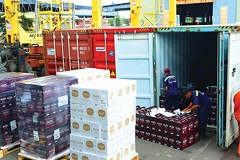
Fresh policies are being called for so that exporters can diversify their export markets and make supply chains more transparent.
Earlier in April, the Ministry of Industry and Trade (MoIT) requested some industry associations and exporters to advise enterprises to diversify their sources of raw material supply. They are urged to ensure the origin of raw materials, meet food safety requirements, and avoid goods origin fraud.
“Strict control of input materials is considered a proactive response solution, ensuring the harmony of interests between Vietnam and export markets without disrupting the production and business activities of domestic enterprises,” the MoIT said.
The recommendations aim to support export manufacturing industries that are dependent on some input material markets and are at risk of origin evasion, such as textiles, footwear, and wood products.
At a meeting between the Hanoi Department of Industry and Trade and business associations and export industries in April, Pham Hong Viet, chairman of the Hanoi Leather and Footwear Association, said that businesses must support each other and even suffer some losses to maintain export markets.
“Local businesses in the industry are very transparent about origins, but we see a lot of fraud in foreign-invested enterprises in Vietnam regarding this issue,” he said.
In the textile and garment industry, more than 60 per cent of raw materials is imported from abroad, and the rest from local suppliers, according to the Ho Chi Minh City Garment, Embroidery, and Knitting Association. In recent years, enterprises have also tried to diversify raw material sources to meet the rules of origin.
“The stages from fabric production to finished products must be carried out in Vietnam, or the fabric must be imported from countries attached to our free trade agreements. Goods must meet the origin requirements of destination market,” said association chairman Pham Xuan Hong.
“The MoIT’s directive is necessary now. In addition to diversifying raw material markets, enterprises and the industry need to be careful with fabric of unknown origin being smuggled into Vietnam through unofficial means,” he added. “We consider the fight against origin evasion to no longer be an industry issue but a national issue. All of us will be careful about this.”
Despite the desire to diversify raw material sources, some businesses struggle to do so. For example, the prices of some raw materials from Turkey are often up to 50 per cent higher than those purchased from other markets. Moreover, there is little interest in investment in textile and garment accessories as it is a labour-intensive industry that pollutes the environment, and so there are no incentive policies.
Businesses have increased their purchases of fabric from Turkey, India, and South Korea, Hong said. “The strategy of diversifying supply sources of businesses needs to be recognised and supported by the government through incentives, so that exporter and manufacturers can ensure domestic inputs,” he said.
Phung Quoc Man, chairman of the Ho Chi Minh City Handicraft and Wood Processing Association, admitted that product origin has been a concern of many enterprises for many years.
“Our members are not concerned about origin or evasion issues because imported raw materials strictly comply with the origin requirements of the markets. However, the risk is always lurking because some product codes are caught up in anti-dumping lawsuits,” he said. “Localities need to say no to foreign investors that apply for export production licences, but in fact only perform simple final stages in Vietnam. That is an act of origin evasion that needs to be severely punished.”
As luring foreign investors in producing raw materials is necessary because of gaining access to high technology and strong finance, Man called for more tech transfer. “When raw materials are supplied domestically, exporters will be more confident to do business, with no more lawsuits on origin evasion.”
Ngo Chung Khanh, deputy director general of MoIT’s Multilateral Trade Policy Department, said that Vietnam is struggling with origins and transparency of supply chains. “In addition to diversifying material supply, exporters should follow free trade agreements to seek new markets with more space. For example, agricultural products, seafood, textiles, and garments can be exported to the UK, UK, and North America with larger quantity than the tiny market shares currently,” Khanh said.
However, Viet from the Hanoi Leather and Footwear Association said that businesses are already aware of diversifying markets and reducing export dependence on the United States.
“The leather and footwear industry currently has some market share in Asia, the Middle East, and Africa. We have also tried to enter the EU but have to be very patient,” Viet said. “My company had absolutely no orders from the EU last year. It has very high requirements for product quality, but the number of products ordered is low. Meanwhile, the US imports a large number of goods, has a population of 350 million people, and spends more on average than EU citizens. That is why we need direction and support from the government.”
Source: Vietnam Investment Review
Các tin khác
- U.S. to Impose Duties on Mexican, Thai, Vietnamese Chassis (03/06/2026)
- Mexican sugar producers push to scrap U.S. import quotas (03/06/2026)
- Japan launched an anti-dumping investigation into flat steel imports from three countries (03/06/2026)
- Eurochem challenges anti-dumping duties in the EU (03/06/2026)
- Pangasius prices in Viet Nam surge due to high export demand (03/06/2026)