Home
Home
 About Us



Expanding export potential for agricultural, forestry, and aquatic products, aiming for a target of 74 billion USD
23/02/2026 04:35
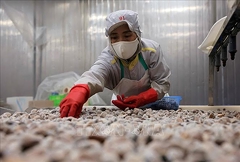
The agriculture and environment sector is opening up many new opportunities to maintain growth momentum and achieve the export target of $73-74 billion.
Viet Nam's agricultural, forestry, and fisheries exports are projected to continue facing numerous challenges as the global economy recovers slowly, protectionist trends increase, and technical standards become more stringent. However, with a foundation of production restructuring, proactive business initiatives, and a shift towards a new growth model, the agriculture and environment sector is opening up new opportunities to maintain growth momentum and achieve the export target of $73-74 billion.
According to Deputy Minister of Agriculture and Environment Phung Duc Tien, while 2026 is predicted to be a challenging year, the industry has a solid foundation after more than 40 years of development, particularly its ability to adapt flexibly to market fluctuations. The restructuring of production, improvement of quality, and reorganization of the value chain have helped enhance the competitiveness of Vietnamese agricultural products.
One of the key solutions is to continue expanding and diversifying export markets. Besides traditional markets, the industry is actively exploring potential markets such as the Middle East, Africa, and South Asia. At the same time, effectively utilizing free trade agreements (FTAs) continues to create competitive advantages and expand market space for Vietnamese agricultural products.
In fact, the shift in market focus and improvement in product quality have yielded positive results. In the first month of 2026 alone, agricultural, forestry, and fisheries exports reached nearly $6.51 billion, an increase of almost 30% compared to the same period last year, demonstrating the industry's strong recovery and adaptability.
Along with market expansion, increasing added value through deep processing is identified as a crucial driver for creating new growth opportunities. According to Mr. Nguyen Dinh Tho from the Institute of Agricultural and Environmental Strategy and Policy, Viet Nam is gradually participating more deeply in the global supply chain, especially through deeply processed products. The shift from exporting raw materials to processed products helps increase value, improve economic efficiency, and enhance the position of Vietnamese agricultural products in the international market.
The coffee industry is a prime example of this trend. In 2025, coffee exports are projected to reach $8.92 billion, an increase of nearly 59% compared to the previous year, not only due to rising prices but also to a strong shift towards roasted, instant, and high-value products. Deeply processed products significantly increase export value while reducing dependence on fluctuating raw material prices.
Investing in processing technology and brand building is becoming an inevitable trend. Many domestic and foreign businesses have increased investment in modern processing plants, developed high value-added products, and expanded export markets. This is a crucial step that helps enhance competitiveness and create a foundation for sustainable development for the industry.
The fruit and vegetable sector has also recorded positive developments. According to Mr. Dinh Cao Khue, Vice Chairman of the Viet Nam Fruit and Vegetable Association and General Director of Dong Giao Export Food Joint Stock Company, the growth of the sector is not only in scale but also reflects a transformation in quality, as businesses increasingly focus on building standardized raw material areas, investing in processing, and diversifying products.
According to experts, the fruit and vegetable industry has enormous potential for growth, especially in demanding markets such as Europe, the United States, Japan, and South Korea. Investing in processing technology helps improve product quality, extend shelf life, and meet stringent technical standards, thereby increasing export value.
Business initiative plays an increasingly important role in market expansion. Many businesses have invested in building standardized raw material areas, applying digital technology in production management, traceability, and quality control. The digitalization of the supply chain enhances transparency, meets international market demands, and improves management efficiency.
Simultaneously, the agriculture and environment sector continues to refine mechanisms and policies to create favorable conditions for business development. The Ministry of Agriculture and Environment is stepping up trade promotion, supporting businesses in expanding markets, improving their capacity to meet international standards, and adapting to new regulations of import markets.
There, science and technology are identified as the core driving force for increasing added value and competitiveness. The application of technology in production, processing, and value chain management not only helps improve product quality but also contributes to reducing costs, increasing production efficiency, and meeting the requirements of sustainable development.
Experts believe that, in the context of a volatile global market, shifting the growth model from one based on volume to one based on quality and added value is an inevitable trend. This process will not only improve export efficiency but also create a foundation for sustainable long-term development.
With a focus on restructuring production, expanding markets, promoting deep processing, and applying science and technology, the agriculture and environment sector is gradually building a solid foundation for a new growth phase. Increasing added value, diversifying markets, and enhancing competitiveness will be key factors in expanding export potential, contributing to affirming the pivotal role of agriculture in the economy.
According to the Ministry of Agriculture and Environment, Viet Nam's agricultural, forestry, and fisheries exports are shifting towards increasing the proportion of processed products and high value-added products. Many key commodities such as coffee, fruits and vegetables, wood, and seafood continue to assert their position in the international market. Viet Nam is currently one of the world's leading agricultural exporters, ranking first in pepper and cashew nuts, and among the leading exporters of coffee and rice.
International organizations also assess that global food demand continues to increase, especially for processed and sustainable products. This presents an opportunity for Vietnamese agricultural products to expand their markets, increase added value, and participate more deeply in the global supply chain.
Source: Tin Tuc News
Các tin khác
- U.S. to Impose Duties on Mexican, Thai, Vietnamese Chassis (03/06/2026)
- Mexican sugar producers push to scrap U.S. import quotas (03/06/2026)
- Japan launched an anti-dumping investigation into flat steel imports from three countries (03/06/2026)
- Eurochem challenges anti-dumping duties in the EU (03/06/2026)
- Pangasius prices in Viet Nam surge due to high export demand (03/06/2026)