Home
Home
 About Us



EU delegation checks out footwear firms
19/11/2008 12:00
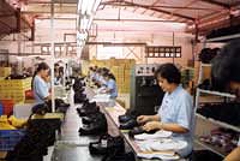
HA NOI — A European Commission (EC) delegation is now visiting the country as part of efforts to review current European anti-dumping measures on Vietnamese leather shoes.
The leader of the delegation, director of Trade Defence under the Directorate General for Trade of the EC, Stefaan Depypere, had a talk with local media about anti-dumping duties on shoes and market economy status in Ha Noi yesterday.
The European Commission (EC) last month decided to continue reviewing the current anti-dumping measures on Vietnamese leather shoes for 12-15 months. Two years ago, the EC imposed the anti-dumping duties of 10 per cent on Vietnamese footwear. According to Stefaan, however, the review may be shorter, with a proposal being made in 8-9 months.
Stefaan arrived in Viet Nam on Wednesday to discuss with the Ministry of Industry and Trade, the Viet Nam Leather and Footwear Association (Lefaso) and other concerned agencies about the issues.
"What we are doing for the European Commission is to collect data from involved participants. We are requiring input from European producers and importers, European customers and Vietnamese exporters. We will bring together all information, and then we will make the analysis and present it to the European Council for final decision," Stefaan said.
The EC’s investigation for the period 2001-05 found that the output of the footwear industry in the block decreased from 223 million pairs of shoes to 146 million, and the number of labourers was cut from 83,000 to 53,000.
Nguyen Duc Thuan, chairman of Lefaso said yesterday that the EC’s decision has adversely impacted approximately 500,000 workers in Viet Nam.
To well prepare for the EC’s investigation process, Thuan is urging local footwear exporters to co-ordinate with European partners and submit accurate replies to the commission’s questionnaires in a timely fashion. Thuan said the number of local companies chosen for survey sampling by the EC has shrunk to three from eight of the previous review.
Lefaso has hired a Belgian law company to consult on the issue.
The domestic footwear industry earned approximately $4.5 billion from exports last year, of which $2 billion came from the European market. Leather shoe uppers accounted for 20 per cent of the total volume of footwear exported to the EU.
The EC has not so far recognised Viet Nam as a market economy, which has caused negative impacts on the country.
The anti-dumping case on Vietnamese shoes is a prime example of what happens if the country is not recognised as having a market economy. With the status in question, the EC will select a third country like Brazil to compare production costs there with costs in Viet Nam.
With this comparison, it is easy for the EC to impose anti-dumping duties, because production costs in Brazil are much more expensive than that of Viet Nam. However, if the EC recognised Viet Nam as a market economy, the commission would consider the production costs in the country directly, rather than looking to a third nation for comparison.
Criteria for the EC to recognise a country as having a market economy include the legal environment, subsidies from the local government, accounting systems and bankruptcy laws. — VNS
The leader of the delegation, director of Trade Defence under the Directorate General for Trade of the EC, Stefaan Depypere, had a talk with local media about anti-dumping duties on shoes and market economy status in Ha Noi yesterday.
The European Commission (EC) last month decided to continue reviewing the current anti-dumping measures on Vietnamese leather shoes for 12-15 months. Two years ago, the EC imposed the anti-dumping duties of 10 per cent on Vietnamese footwear. According to Stefaan, however, the review may be shorter, with a proposal being made in 8-9 months.
Stefaan arrived in Viet Nam on Wednesday to discuss with the Ministry of Industry and Trade, the Viet Nam Leather and Footwear Association (Lefaso) and other concerned agencies about the issues.
"What we are doing for the European Commission is to collect data from involved participants. We are requiring input from European producers and importers, European customers and Vietnamese exporters. We will bring together all information, and then we will make the analysis and present it to the European Council for final decision," Stefaan said.
The EC’s investigation for the period 2001-05 found that the output of the footwear industry in the block decreased from 223 million pairs of shoes to 146 million, and the number of labourers was cut from 83,000 to 53,000.
Nguyen Duc Thuan, chairman of Lefaso said yesterday that the EC’s decision has adversely impacted approximately 500,000 workers in Viet Nam.
To well prepare for the EC’s investigation process, Thuan is urging local footwear exporters to co-ordinate with European partners and submit accurate replies to the commission’s questionnaires in a timely fashion. Thuan said the number of local companies chosen for survey sampling by the EC has shrunk to three from eight of the previous review.
Lefaso has hired a Belgian law company to consult on the issue.
The domestic footwear industry earned approximately $4.5 billion from exports last year, of which $2 billion came from the European market. Leather shoe uppers accounted for 20 per cent of the total volume of footwear exported to the EU.
The EC has not so far recognised Viet Nam as a market economy, which has caused negative impacts on the country.
The anti-dumping case on Vietnamese shoes is a prime example of what happens if the country is not recognised as having a market economy. With the status in question, the EC will select a third country like Brazil to compare production costs there with costs in Viet Nam.
With this comparison, it is easy for the EC to impose anti-dumping duties, because production costs in Brazil are much more expensive than that of Viet Nam. However, if the EC recognised Viet Nam as a market economy, the commission would consider the production costs in the country directly, rather than looking to a third nation for comparison.
Criteria for the EC to recognise a country as having a market economy include the legal environment, subsidies from the local government, accounting systems and bankruptcy laws. — VNS
(14-11-2008)
Source: vietnamnews.vnagency.com.vn
Source: vietnamnews.vnagency.com.vn
Các tin khác
- Rising global shipping costs put pressure on Viet Nam’s seafood exporters (22/06/2026)
- India likely to retain anti-dumping duties on Bangladeshi jute products (22/06/2026)
- Japan slaps anti-dumping duties on Chinese, Taiwanese steel (22/06/2026)
- India initiates anti-dumping probe against a Chinese, Japanese chemical used in tyre, rubber items (22/06/2026)
- Reasons why the US continues to suspend customs clearance for Vietnamese trailers (22/06/2026)