Home
Home
 About Us


Economic Crisis, Doha Completion, And Protectionist Pressure
22/12/2008 12:00
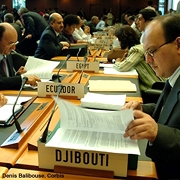
The worry about protectionism should not be centred on completing the Doha Round. This article suggests 80% of world trade is locked-in under legally binding tariffs and the real worry is that of excessive use of antidumping, countervailing duty, and safeguard protection, misguided public subsidies, rising protection in the poorest countries, and temptation in the U.S. Congress to violate existing treaty commitments.
LONDON (voxEU.org) -- With a deepening economic crisis and rising calls for public assistance in sectors ranging from finance to autos, there are also signs of growing nervousness about the dangers of protectionism. These include editorials in the financial press and high profile think tank studies on the stumbling Doha Round (Wolfe 2008, Bouet and LaBorde 2008, Baldwin and Evenett 2008). While the worry is merited, not all hope is lost. Indeed, this crisis is the kind the trading system was engineered for. By rough calculation, almost 80% of world trade in goods ought to be free from wholesale tariff increases, i.e. Smoot-Hawley wannabees, as long as the system holds.
The WTO system for goods is centred on tariff bindings (Francois and Martin 2003, 2004). These are multilateral treaty commitments not to raise tariffs above a certain level. Among the OECD Members of the WTO, actual or applied tariffs are generally at the bound rate (i.e. there is no scope to raise tariffs), except for free trade agreements, where they are actually locked in at zero. Approximately 30% of world trade is locked in at zero tariffs through various European agreements (the European Union treaties and the EEA), another 8% of trade is under zero tariffs locked in through NAFTA, and another 40% involves OECD importers where tariffs are at or very close to bound rates, i.e. there is no "binding overhang"--except for the OECD share involving food trade outside free trade blocks, which is roughly 2.5% of world trade.
On top of this, the commitments undertaken by China and Taiwan when they joined the WTO also limit their room for protectionist manoeuvres. If we also include Hong Kong and Singapore as "safe" importers--they are traditionally staunch free traders, this leaves around 20% of trade "at risk." This involves Asian importers, Africa, Latin America, OPEC Members, and components of the former Soviet Union. Their average rates of protection are 15.1% for food and 6.0% for NAMA products. Roughly 60% of their imports come from non-OECD suppliers, while exports from the OECD to these markets represent only 12.5% of total OECD exports. What all this means is that the recent IFPRI study--which has been widely quoted--may greatly overstate the risk of Doha failing. Because of regional and multilateral bindings that really do bind, we will not get a massive unwinding of trade through systemic applied tariff schedule hikes unless the E.U., NAFTA, and WTO themselves all unwind as well.
So, is the Doha Round really relevant here? Existing WTO bindings mean we should not see systematic increases in OECD tariffs unless they actually withdraw from the WTO, take deliberate steps that violate WTO commitments and invite retaliation, or all agree the crisis justifies temporary suspension of commitments. There are safety valves within the system to handle such pressure -- antidumping, countervailing duties, and safeguards -- but they are just that, safety valves. The points stressed in recent Doha Round studies may be important. However they are unrelated to current protectionist dangers. Bindings are valuable--I made this point in a paper with Will Martin a few years ago, and we should be glad for them now. However, if we finish Doha tomorrow, new ones will not come on-line in time to intercept any rising protection in the current crisis.
While the risk is in areas the Doha Round will not affect, we ought to worry about them anyway. As such, we need to devote energy to non-Doha issues in Geneva. These include the risk of rising and excessive use of antidumping, countervailing duty, and safeguard protection; misguided public subsidies (though some of the current ones may be justified on retro-Keynesian grounds); rising protection in the poorest countries; and temptation in the U.S. Congress to violate existing treaty commitments. While WTO members should spend energy on these issues, the Doha Round is not a critical part of the equation.
Note: trade share calculations are based on the COMTRADE and GTAP databases. Import protection calculations are from Brockmeier and Pelikan (2008), and the WITS, GTAP, and MAcMaps databases.
By Joseph Francois
18 Dec 2008 at 08:00 AM GMT-05:00
Source: www.resourceinvestor.com
Các tin khác
- Rising global shipping costs put pressure on Viet Nam’s seafood exporters (22/06/2026)
- India likely to retain anti-dumping duties on Bangladeshi jute products (22/06/2026)
- Japan slaps anti-dumping duties on Chinese, Taiwanese steel (22/06/2026)
- India initiates anti-dumping probe against a Chinese, Japanese chemical used in tyre, rubber items (22/06/2026)
- Reasons why the US continues to suspend customs clearance for Vietnamese trailers (22/06/2026)